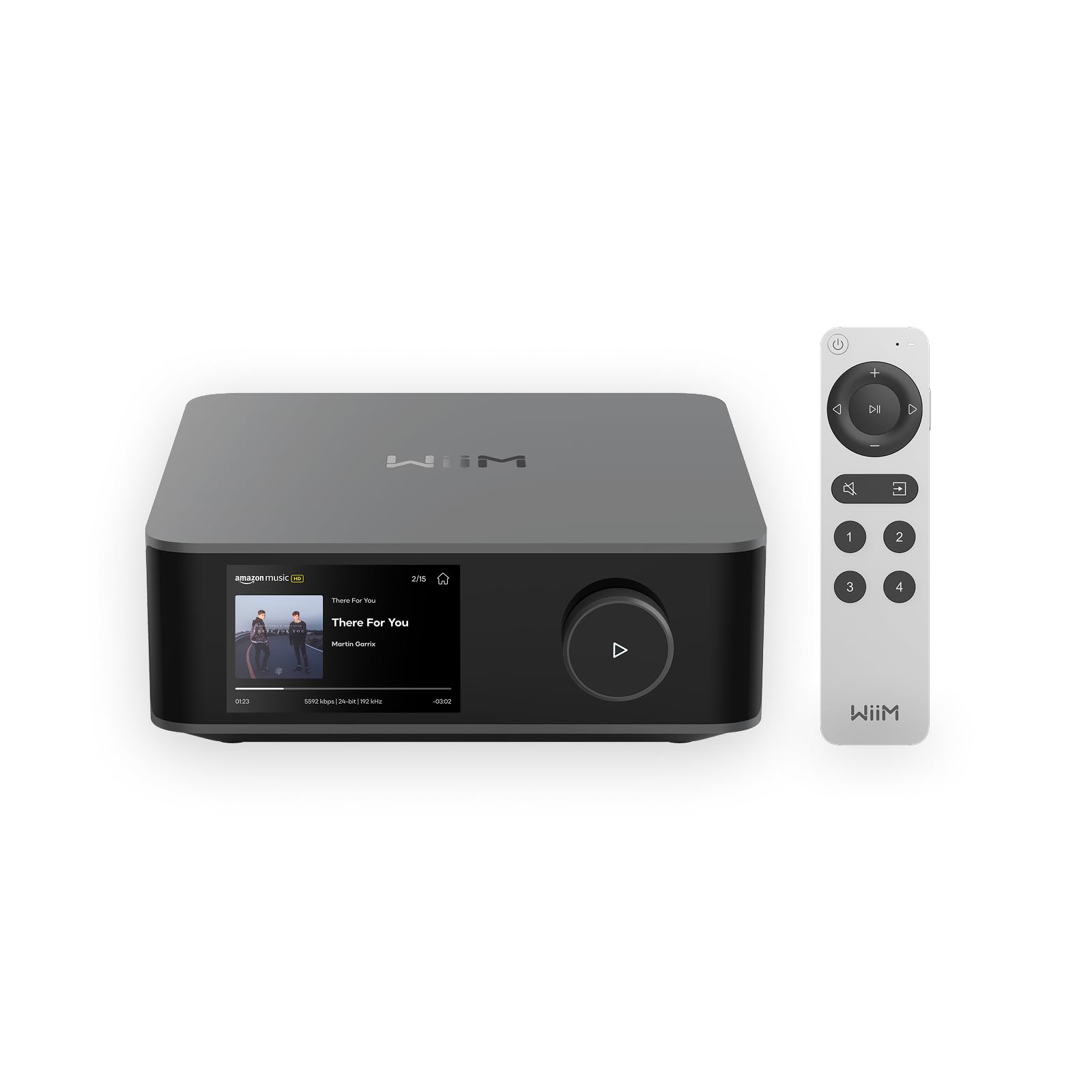
The WiiM Amp Ultra sits in a crowded but increasingly interesting category: the compact streaming amplifier that wants to replace both a stack of separates and a smart speaker. It is a stereo Class-D integrated amp with a built-in streamer, HDMI ARC input, and WiiM’s RoomFit room correction software. At its price point, it competes with products like the Sonos Amp, Bluesound Powernode, and a growing number of Chinese-designed network amplifiers that pack a lot of features into a small box.
In practice, this is the kind of device you put on a shelf between a TV and a pair of bookshelf speakers, wire everything in once, and then control almost entirely from a phone. That use case matters because the Amp Ultra is clearly designed around it. HDMI ARC means the TV remote can control volume and power-on behavior, so a living-room setup with a pair of passive speakers becomes a single-remote system. The streaming side handles the usual services, and the app is the primary interface — there are no front-panel tone controls or input dials in the traditional sense, just a small display and minimal physical controls.
The feature list is broad for the price. You get a built-in streamer with support for the major platforms, AirPlay 2 and Chromecast-style casting, Bluetooth, a subwoofer output with bass management, and the HDMI ARC input alongside optical, coaxial, and USB connections. RoomFit is the more distinctive addition: it uses a measurement microphone (or the phone’s mic in some configurations) to apply corrective EQ to compensate for room modes and speaker placement. That is genuinely useful in small rooms or near walls, where bass tends to pile up. The effect is not subtle if your room has an obvious problem, but it also will not turn a mediocre speaker into a great one — it corrects the room, not the speaker.
Power output is rated in the range typical for this class of amp, which is enough for most bookshelf and modest floorstanding speakers in a normal living room. It is not the right tool for driving inefficient, low-impedance speakers at high volumes; Class-D amps in compact chassis have real limits, and the Amp Ultra’s power supply is sized accordingly. Expect clean output at reasonable listening levels and some compression or protection behavior if you push it hard into difficult loads. That is a trade-off worth stating plainly: the convenience and feature density come at the cost of raw drive capability compared with a larger dedicated power amp.
Another limitation is the app-centric design. If you prefer physical knobs, a remote with more than a few buttons, or a display that shows what is playing without reaching for a phone, this will feel sparse. The app itself is functional and reasonably well organized, but it is the single point of failure for most operations. Firmware updates are frequent, which is good for fixes but occasionally changes behavior in small ways. Buyers who want a set-and-forget appliance may find the software-first approach slightly more demanding than a traditional receiver.
Compared with something like the Sonos Amp, the WiiM Amp Ultra trades ecosystem polish and multiroom integration for broader input flexibility and room correction at a lower price. Compared with a conventional stereo receiver plus a separate streamer, it saves space and cabling but gives up some input count and the tactile experience. It also sits in the same conversation as powered speakers with built-in streaming, which offer simpler setups but less flexibility if you already own good passive speakers.
This amp suits people who already have a pair of passive speakers they like, want to add streaming and TV audio without a rack of components, and are comfortable doing most control from a phone. It is also a reasonable fit for a secondary room or a desk setup where space is tight. It is less suitable for home-theater duty beyond a 2.1 setup, for owners of demanding speakers who listen loudly, or for anyone who wants a traditional component with knobs and a busy front panel. Treated as a compact, feature-rich hub for a modest stereo system, it makes sense; treated as a do-everything centerpiece, its limits show.