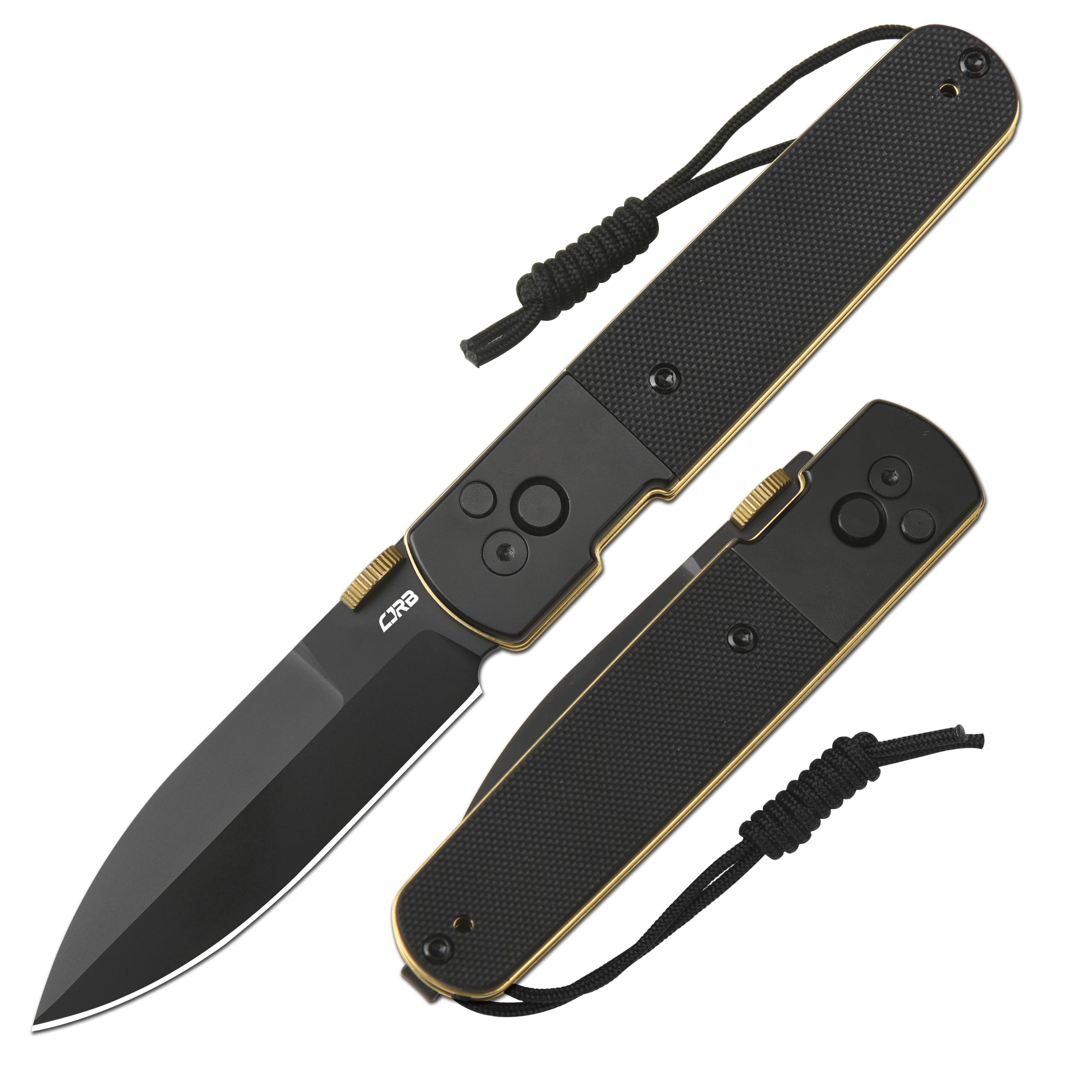
The CJRB Locust sits in a crowded segment of the folding knife market: mid-size EDC folders with a blade just over three inches, a modern powder-metallurgy steel, and a price that undercuts the well-known American and European brands. CJRB has built a reputation for offering decent materials at accessible prices, and the Locust follows that formula. Whether it makes sense for you depends on what you expect from a knife in this class.
The blade measures 3.15 inches, which puts it in a practical middle ground. It is long enough to handle food prep, box breakdown, and general utility work, but short enough to stay within the legal limits of many jurisdictions that cap carry at three inches or slightly above. Buyers in stricter areas should verify local rules, since 3.15 inches exceeds a true three-inch limit. The AR-RPM9 steel is CJRB’s in-house powder metallurgy alloy, positioned roughly in the same conversation as 9Cr18MoV or VG-10 in terms of corrosion resistance and edge retention. In real use, that means it takes a sharp edge without much fuss, holds it through a reasonable amount of cardboard and rope, and resists rust well enough for humid climates or occasional exposure to moisture. It is not a high-vanadium steel, so don’t expect the edge retention of S35VN or MagnaCut, but it sharpens more easily than those steels, which matters if you maintain your own edges.
The black PVD coating on the blade is primarily a cosmetic and corrosion-resistant addition. It reduces glare, which is useful for outdoor use, and it hides scratches better than a satin finish in some cases, though heavy wear will eventually show through at the edge and pivot area. PVD is harder than paint or cerakote, but it is a thin coating, not armor. Users who cut abrasive materials regularly will see finish wear over time.
In daily carry, the Locust’s real-world role is straightforward: opening packages, cutting zip ties, trimming cord, breaking down boxes, and handling light camp tasks. The handle ergonomics are conventional but functional, with a profile that fills the hand without being bulky. The pocket clip and overall footprint matter as much as the blade for EDC, and the Locust is sized to disappear into a jeans pocket without dominating it. The action, as with most CJRB folders, uses a bearing pivot, which generally yields a smooth, flickable deployment. That smoothness is pleasant, though bearings can collect grit in dirty environments more readily than washers, and cleaning them is more involved. For a knife that sees mostly urban and light outdoor use, this is a minor concern; for a knife that lives in mud, sand, or sawdust, it is a real trade-off.
Lockup is another area worth discussing honestly. CJRB’s frame and liner locks are typically solid for the price, but they are production knives, and lockbar tension and detent can vary slightly from unit to unit. Buyers should expect a functional, safe lock rather than a custom-grade feel. The same applies to fit and finish: generally good for the money, with occasional sharp edges on liners or slightly off-center blades. These are not dealbreakers at this price point, but they are the kinds of details that separate budget-adjacent knives from premium ones.
Compared with alternatives, the Locust competes against knives like the Ontario RAT 2, the Civivi Elementum, and various Kershaw and Spyderco budget models. The RAT 2 is a longtime value benchmark with a proven track record but uses older steel and a heavier build. The Elementum offers a more refined design language, often with comparable or better fit and finish, though its blade shape and size differ. The Locust’s AR-RPM9 steel is arguably a step up from the AUS-8 and 8Cr13MoV found on many budget knives, giving it an edge in edge retention while remaining easy to sharpen. Where it may fall short is in aftermarket support and long-term track record; CJRB is a younger brand, and buyers who value proven durability over years of hard use may lean toward established models.
Who is this knife for? It suits the person who wants a capable, reasonably priced EDC folder with modern steel and a subdued black finish, and who is comfortable with the minor variability of production knives. It works well for office and suburban carry, light outdoor use, and as a first serious folder. Who is it not for? Anyone needing a hard-use work knife, a saltwater-specific blade, or a knife with a guaranteed three-inch-or-under blade for strict legal compliance should look elsewhere. Collectors chasing premium fit and finish will also find it lacking. The Locust is a sensible tool at a sensible price, and that is a fair thing to be.