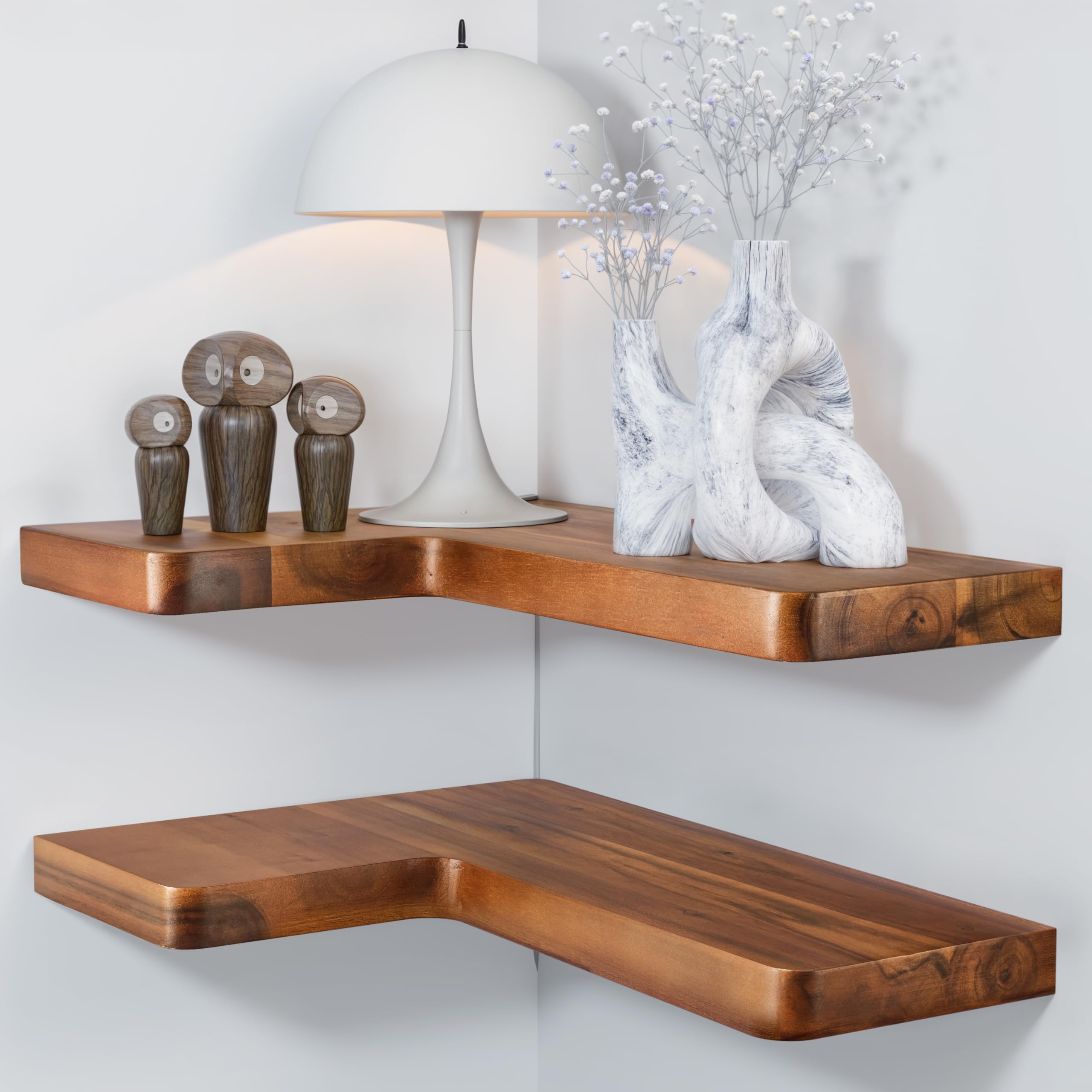
Corner shelves occupy a useful but often overlooked niche in home storage. They can turn an awkward junction between two walls into functional display or storage space, but they also come with installation and load-bearing considerations that straight shelves don’t have. The BATODA Acacia Wood Corner Floating Shelves, sold as a set of two measuring 17 by 12 inches, sit in the mid-range of this category. They are worth examining on their practical merits rather than their appearance alone.
The first thing to understand about these shelves is their geometry. They are designed to fit into a 90-degree corner, with two straight edges meeting at the wall junction and a curved or angled front edge depending on the design. This shape means the usable surface area is effectively halved compared to a rectangular shelf of the same nominal dimensions. A 17-by-12-inch corner shelf does not offer 204 square inches of flat surface; much of that footprint is lost to the corner cutout. Buyers should plan for smaller items—spice jars, small plants, books, toiletries, or decorative objects—rather than large appliances or wide storage bins.
Acacia wood is the material choice here, and it has some practical implications. It is a dense, durable hardwood with a pronounced grain pattern, which gives the shelves a warmer, more natural look than MDF or painted particleboard. Acacia also tends to hold up reasonably well in humid environments like bathrooms, though it is not immune to moisture damage over time if water sits on the surface. The shelves will likely need occasional oiling or sealing to maintain their appearance, especially if used in a kitchen or bathroom where steam and splashes are common. This is a maintenance consideration that buyers of painted or laminate shelves do not face.
The floating design means there are no visible brackets supporting the shelf from below. Instead, the mounting hardware is concealed within or behind the shelf. BATODA includes brackets and shelving hardware in the box, which is a practical inclusion since corner floating shelves often require specific mounting hardware that is not interchangeable with standard straight-shelf brackets. The installation process typically involves locating wall studs or using appropriate anchors, attaching the bracket to the wall, and sliding or securing the shelf over it. Corner installations add a layer of complexity because both walls need to be plumb and square for the shelf to sit flush. In older homes or rooms with uneven walls, this can require shimming or adjustment.
Load capacity is a realistic concern with any floating shelf, and corner shelves are no exception. The cantilevered design means the weight is distributed across two wall attachment points rather than one, which can be an advantage, but the actual capacity depends heavily on the quality of the wall anchors and the installation. BATODA does not publish a specific weight rating, which is common in this product category but still worth noting. For typical use—a few books, small decor items, or bathroom supplies—the shelves should perform adequately when installed into studs or with high-quality drywall anchors. Heavier loads, such as large book collections or kitchen appliances, are not advisable.
Compared to alternative corner storage solutions, these shelves occupy a middle ground. A freestanding corner etagere or a corner cabinet offers more storage capacity and does not require wall mounting, but it takes up floor space and can make a small room feel more crowded. Built-in corner shelving is more permanent and typically more expensive. Floating corner shelves like these are best suited to people who want to reclaim wall space without adding furniture footprint, and who are comfortable with a moderately involved installation.
The set of two is a practical configuration for creating a small vertical arrangement in a corner, such as in a bathroom above a toilet or in a kitchen where counter space is limited. However, buyers should measure carefully. The 17-inch width refers to the span along each wall from the corner, so the shelf will extend 17 inches in both directions. In a narrow corner or above a toilet tank, this may be too large. The 12-inch depth is also substantial for a corner shelf and may protrude further than expected.
Who these shelves are suitable for:
- Renters or homeowners looking to add storage in an awkward corner without floor furniture
- People who want a natural wood finish and are willing to maintain it
- DIY-capable installers comfortable with wall anchoring and leveling
- Use in bathrooms, kitchens, or living rooms for light to moderate loads
Who they are not suitable for:
- Anyone needing to store heavy items or large objects
- Renters unable to drill into walls
- People in homes with significantly uneven walls who are not prepared for installation adjustments
- Buyers expecting a no-maintenance finish
Overall, the BATODA Acacia Wood Corner Floating Shelves are a reasonable option for adding light storage and display in a corner, provided buyers understand the limitations of the format. The acacia construction is a genuine plus for appearance and durability, but the installation demands and modest usable surface area mean these shelves are not a one-size-fits-all solution. They work best when the space is measured carefully and the intended load is kept modest.