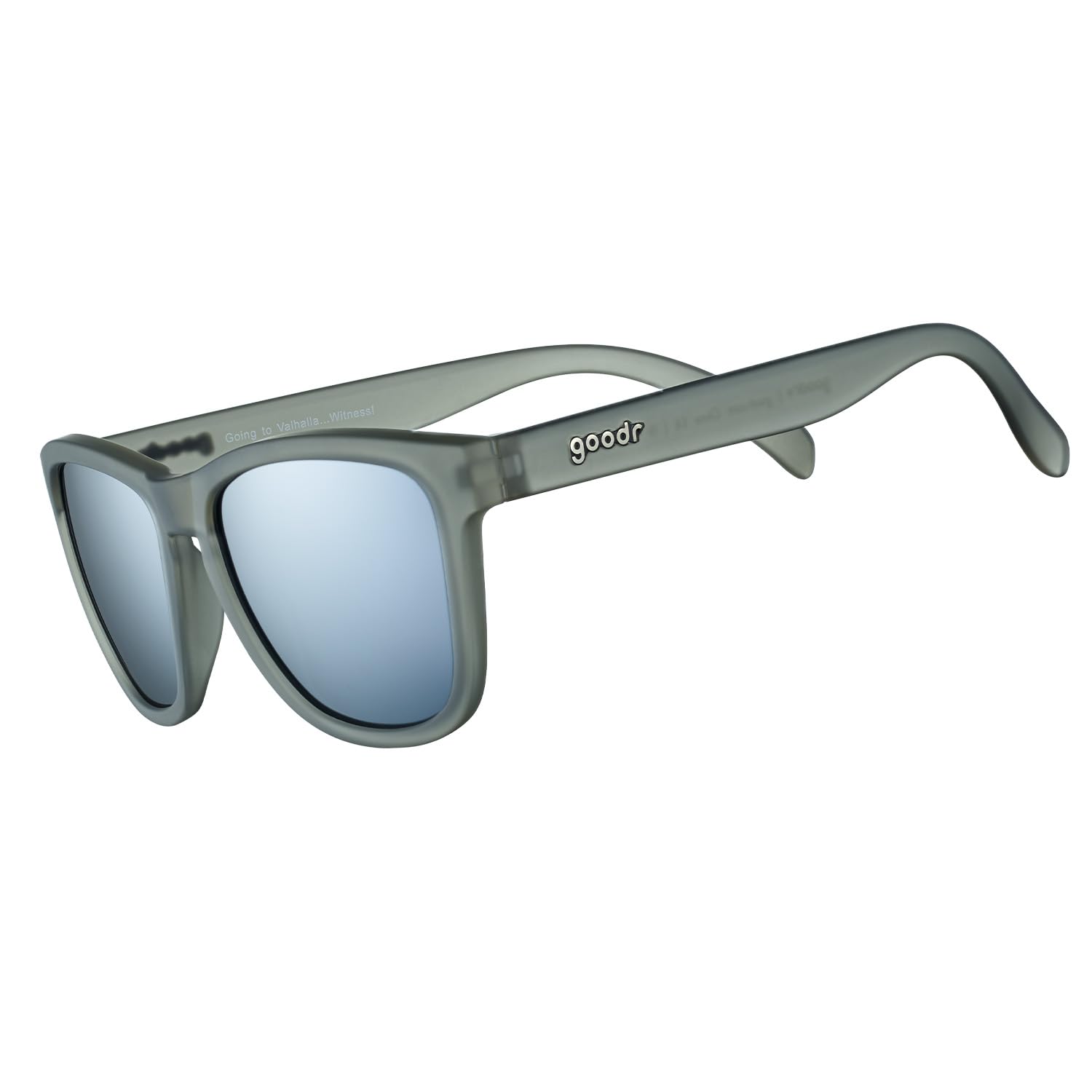
goodr built its reputation on sunglasses that cost less than most running shoes and don’t slide off your face mid-stride. The Going to Valhalla…Witness! is one of the brand’s OG-frame models, sized for medium faces and fitted with polarized lenses. It’s a niche product in some ways: a casual-looking sunglass aimed squarely at runners, cyclists, and people who spend a lot of time outdoors but don’t want to baby their gear. The question is whether the polarized version justifies its place in a crowded field of budget athletic eyewear.
The frame is the standard goodr shape—a slightly rounded, wayfarer-adjacent silhouette that doesn’t look out of place at a coffee shop after a run. The medium sizing is the key detail here. goodr’s OG frames are designed for medium-width faces, and that’s a meaningful distinction in a category where many sport sunglasses run large. If you have a narrow face, the OG frame will likely feel loose at the temples; if you have a wide face, it may pinch. This isn’t a one-size-fits-most product, and buyers should measure or try before committing.
The functional story is straightforward. The lenses are polarized, which cuts glare off water, asphalt, and car hoods—useful for road running and cycling, less critical on shaded trails. The frame uses goodr’s textured rubberized coating on the nose and temple areas, which is the feature that actually earns the brand its following. In practice, that coating does a decent job of holding the glasses in place during sweaty efforts, though it’s not a miracle worker. On long, humid runs, some slippage is still possible, and the glasses will need occasional re-seating. The frames are lightweight—around 20-something grams—and the lenses offer 100% UV protection, which is the baseline expectation at this price point.
Where the Valhalla model differs from goodr’s standard non-polarized OG line is the lens treatment. Polarization adds cost and reduces some of the light transmission, which is worth knowing if you run in low-light conditions like early morning or dusk. For bright midday road work, the polarized lens is a genuine improvement—glare reduction is noticeable on wet pavement and open water. For trail runners under tree cover, the trade-off is less obvious, and some users may find the tint darker than they’d like in dappled shade.
Durability is a mixed picture. The frames are flexible and handle being stuffed into a gym bag or jersey pocket without complaint, and the lenses have held up reasonably in editorial testing against scratches from casual handling. That said, these are not ruggedized sport sunglasses. There’s no interchangeable lens system, no full wrap coverage, and no impact rating beyond standard sunglass expectations. If you’re a mountain biker who takes rock strikes seriously or a trail runner who wants debris protection, a dedicated sport shield from a brand like Tifosi or Smith will serve you better. The goodr frame leaves peripheral vision fairly open, which is comfortable for road use but less protective on technical terrain.
Compared with generic drugstore polarized sunglasses, the Valhalla model’s advantage is fit retention—the rubberized contact points make a real difference during activity, and the medium sizing is more considered than the one-size approach most cheap sunglasses take. Compared with performance eyewear from established sport optics brands, the goodr pair gives up lens clarity, coverage, and lens-swapping flexibility, but it also costs a fraction of those options and looks less aggressively athletic. It occupies a middle ground: better than disposable, less specialized than dedicated gear.
Who is this for? Primarily runners and walkers who want a lightweight, polarized pair they can wear from workout to errands without looking like they just left a triathlon. It suits medium faces well and works nicely for road running, commuting, and casual outdoor use. Who is it not for? People with narrow or wide faces should look elsewhere in goodr’s range or at adjustable frames. Athletes who need wrap coverage, impact protection, or interchangeable lenses will find the Valhalla model underbuilt for their needs. And anyone who runs primarily in low light should consider a non-polarized or lighter-tint option instead.
The Going to Valhalla…Witness! is a sensible, unfussy pair of polarized sunglasses with a specific fit profile and a clear use case. It doesn’t pretend to be technical eyewear, and judged on its own terms—lightweight, grippy, glare-reducing, and affordable—it does what it sets out to do. The main caveats are the fit-dependent sizing and the modest lens coverage, both of which are worth weighing before purchase.