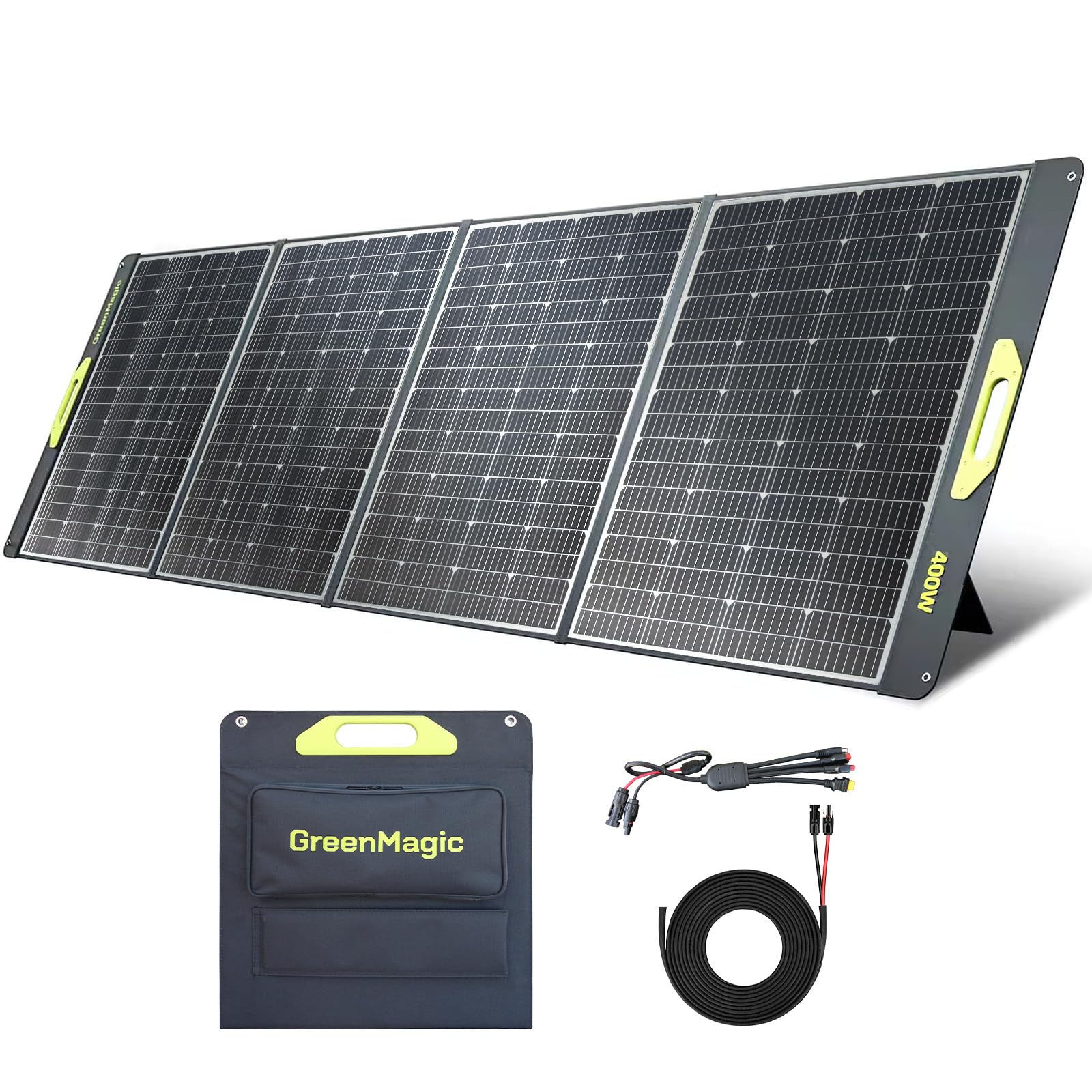
The Greenmagic Portable 400 Watt Foldable Solar Panel sits in a category that has grown crowded over the past few years: high-output folding panels aimed at people charging power stations, running 12V systems, or keeping a 40V battery bank topped up off-grid. At 400 watts and 40V/10A with MC4 connectors, it is clearly pitched at users who need more than a trickle charger but don’t want a rigid glass panel bolted to a roof. The question worth asking is whether the numbers on the spec sheet translate into useful output in the conditions most people actually encounter.
The most common real-world use for a panel like this is pairing it with a portable power station — something in the 500Wh to 2,000Wh range — during camping trips, van builds, or short power outages. The MC4 connectors are the standard in the solar industry, which means the panel will mate with most charge controllers and many power stations that accept an MC4 or adapter input. The 40V/10A rating matters here: it tells you the panel is designed for higher-voltage systems, so it is not a drop-in match for every small power station. Some entry-level units cap their solar input at 25V or 30V, and connecting a 40V panel to those can damage the unit or trigger a protection shutdown. Buyers should verify their charge controller or power station’s accepted voltage window before assuming compatibility.
On the functional side, the foldable design is the main selling point. Panels in this class typically fold into a briefcase-style package with a carry handle, and 400W units generally weigh somewhere in the 20 to 30 pound range depending on cell type and frame construction. That is manageable for a car-to-campsite carry but not something most people will want to haul on a long hike. The lightweight claim in the product name should be read relative to other 400W panels, not relative to portable solar as a whole. A 100W briefcase panel is far easier to move; the trade-off is that you need roughly four times the surface area to match the output.
Performance expectations deserve a candid note. A 400W panel rating is a laboratory figure under standard test conditions — full sun, moderate temperature, panel perpendicular to the sun. In practice, flat-laying the panel on the ground or a vehicle roof will cost you output, and partial shading on even one section can cut production disproportionately, especially with panels that use fewer bypass diodes. Realistic peak output in good summer sun with careful aiming might land in the 280–340W range, and morning or evening sun will be well below that. Cloud cover, heat, and dust all take a further toll. None of this is unique to Greenmagic; it is how solar works. But buyers comparing a 400W folding panel to a 400W rigid panel should know that folding panels often sacrifice a little efficiency for portability, and the flexible or semi-flexible construction used in some models can degrade faster under constant UV exposure than framed glass panels.
Compared with a rigid 400W residential-style panel, the Greenmagic’s advantages are obvious: it folds, it stores flat, and it can be repositioned throughout the day without mounting hardware. The rigid panel will usually cost less per watt, last longer in a fixed installation, and perform slightly better in heat. Compared with a smaller 200W folding panel, the 400W unit doubles your harvest but also doubles the bulk and the setup footprint. For a van or RV owner with roof space, a fixed panel plus a smaller portable unit for shaded campsites is often a more practical combination than one large folding panel.
Who is this for? It suits car campers, overlanders, and emergency-prep users who already own a compatible power station or charge controller and want meaningful solar input without a permanent install. It also works for someone building out a small off-grid 12V or 40V system who needs a panel that can be packed away. Who is it not for? Backpackers and anyone counting ounces will find it too heavy and too large. Owners of small power stations with low solar voltage limits should look elsewhere or plan on a charge controller that can handle 40V. And anyone expecting a full 400W into their battery on a typical day should recalibrate — the panel is a tool for harvesting energy over hours, not a generator.
The build quality and warranty terms are worth checking against the competition before buying, since folding panels vary widely in fabric durability, connector quality, and how well the folding hinges hold up over seasons of use. The MC4 connectors are a plus for standardisation, but the included cabling length and whether adapters are bundled can affect how usable the panel is out of the box. Overall, the Greenmagic 400W is a reasonable option for its niche, provided the buyer goes in with realistic expectations about voltage compatibility, weight, and real-world wattage.