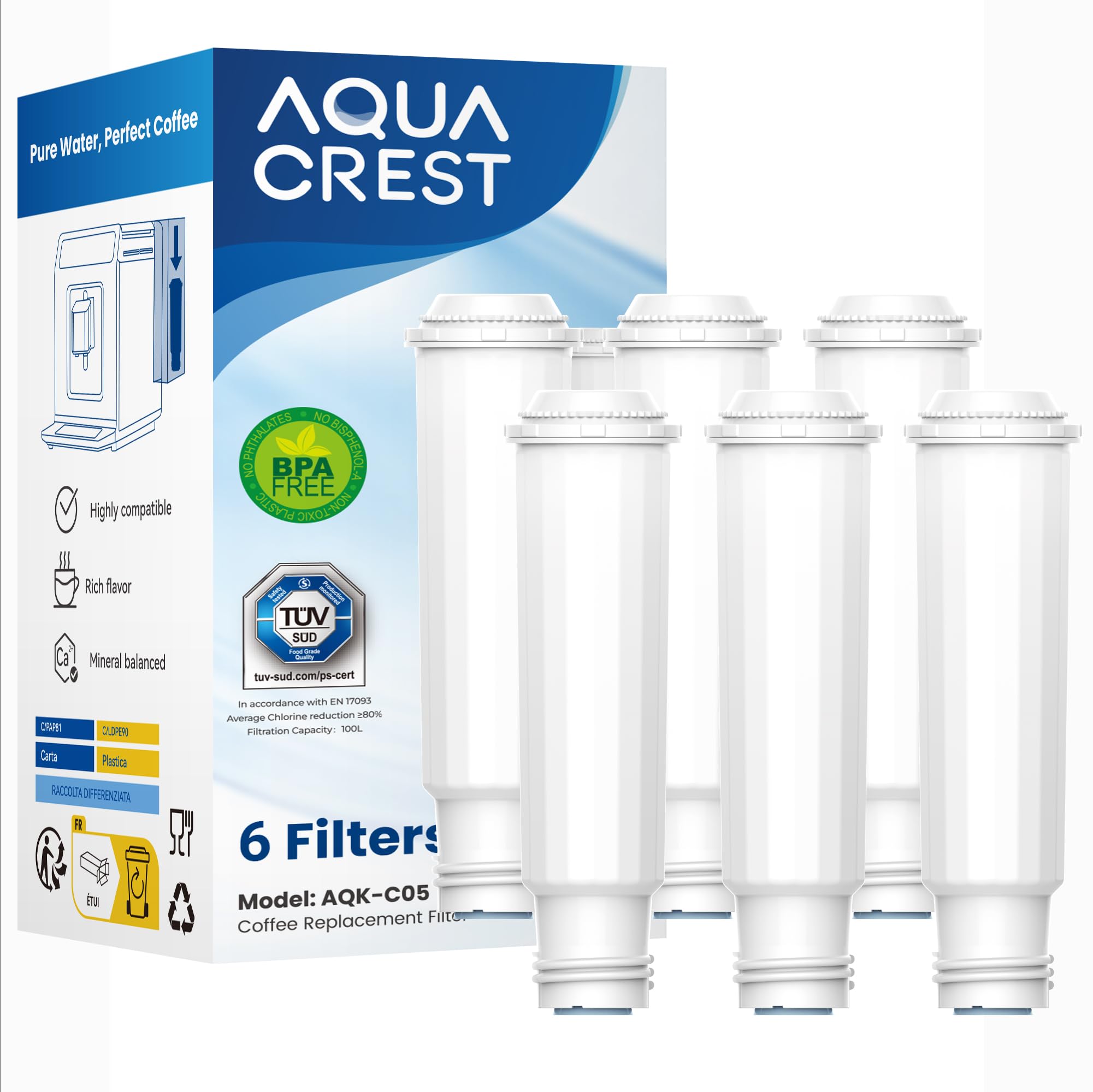
Coffee makers that use pod-style or cartridge filters tend to hide a recurring cost that buyers don’t think about until the first replacement is due. The KitchenAid KESWF filter is one of those consumables, and third-party replacements like this six-pack from AQUA CREST exist mainly to lower the per-filter price. The question worth asking is whether the savings come with any meaningful trade-offs in fit, filtration, or longevity.
These filters are designed as direct replacements for the KitchenAid KESWF cartridge, which is used in select KitchenAid coffee makers and similar brew systems that rely on an in-reservoir water filter. The filter sits in the water tank and reduces chlorine, sediment, and some taste-affecting impurities before the water reaches the brew path. In practice, that means less scale buildup in the machine over time and a cup that tastes less like tap water, particularly in areas where municipal water is heavily chlorinated. The six-pack format is the main selling point: it covers roughly a year of use for most households, since manufacturers typically recommend swapping the filter every two months or so.
Functionally, the cartridge uses a carbon-based filtration medium inside a plastic housing, the same general approach as the OEM part. Installation is a straightforward push-in fit on compatible models, and there is nothing electronic or complicated about it. The filters are individually wrapped, which helps keep them fresh during storage and makes it easy to keep a spare in a drawer without the rest absorbing odors. AQUA CREST states the filters are tested for compatibility with the KitchenAid system, though as with most third-party consumables, the certification story is less elaborate than what you get from the original manufacturer.
Where this product makes sense is in the cost-per-use math. OEM KitchenAid filters are priced as a single unit or in small packs, and the per-filter cost adds up quickly for anyone who actually follows the replacement schedule. Buying six at once brings the unit price down noticeably, and for a household that goes through six filters a year, that is a real budget difference rather than a marginal one. The trade-off is that you are committing to a year’s supply up front, which is fine if you like the filters and less fine if the fit turns out to be slightly off on your particular machine model.
That fit question is the main caveat. Third-party filter cartridges occasionally vary in tolerance, and some users of replacement KESWF filters report that they seat a little more tightly or loosely than the OEM version. In most cases this doesn’t affect function, but it is worth checking the model compatibility list before ordering, because KitchenAid has used the KESWF designation across more than one machine generation. If your brewer is older or a less common variant, the OEM part is the safer choice even at a higher price.
Performance expectations should be realistic. These are carbon block filters, not reverse osmosis systems. They will reduce chlorine taste and odor and capture coarse sediment, which is what they are designed to do. They will not soften hard water, and they will not remove dissolved minerals that cause scale. If your tap water is very hard, a filter like this slows scale accumulation but doesn’t prevent it, and you should still plan on descaling the machine periodically. Buyers sometimes expect a filter swap to fix a machine that is already scaled up; it won’t.
Compared with the OEM KitchenAid filters, the AQUA CREST pack wins on price and convenience and roughly matches on basic filtration, but it gives up some of the assurance that comes with a first-party part. Compared with an inline or under-sink filtration setup, these cartridge filters are far less effective and more expensive per gallon, but they require no plumbing and fit the machine you already own. The comparison depends on what you’re solving for: convenience within an existing brewer, or genuinely better water at the source.
This six-pack is a reasonable fit for KitchenAid owners who change filters on schedule, have moderately treated municipal water, and want to cut consumable costs without much risk. It is a poor fit for anyone with a machine model that isn’t clearly listed as compatible, for households on very hard well water where filtration needs are heavier, or for buyers who prefer the certainty of the manufacturer’s own part and don’t mind paying for it. For everyone in the middle, it is a sensible, unglamorous purchase that does what a water filter is supposed to do.