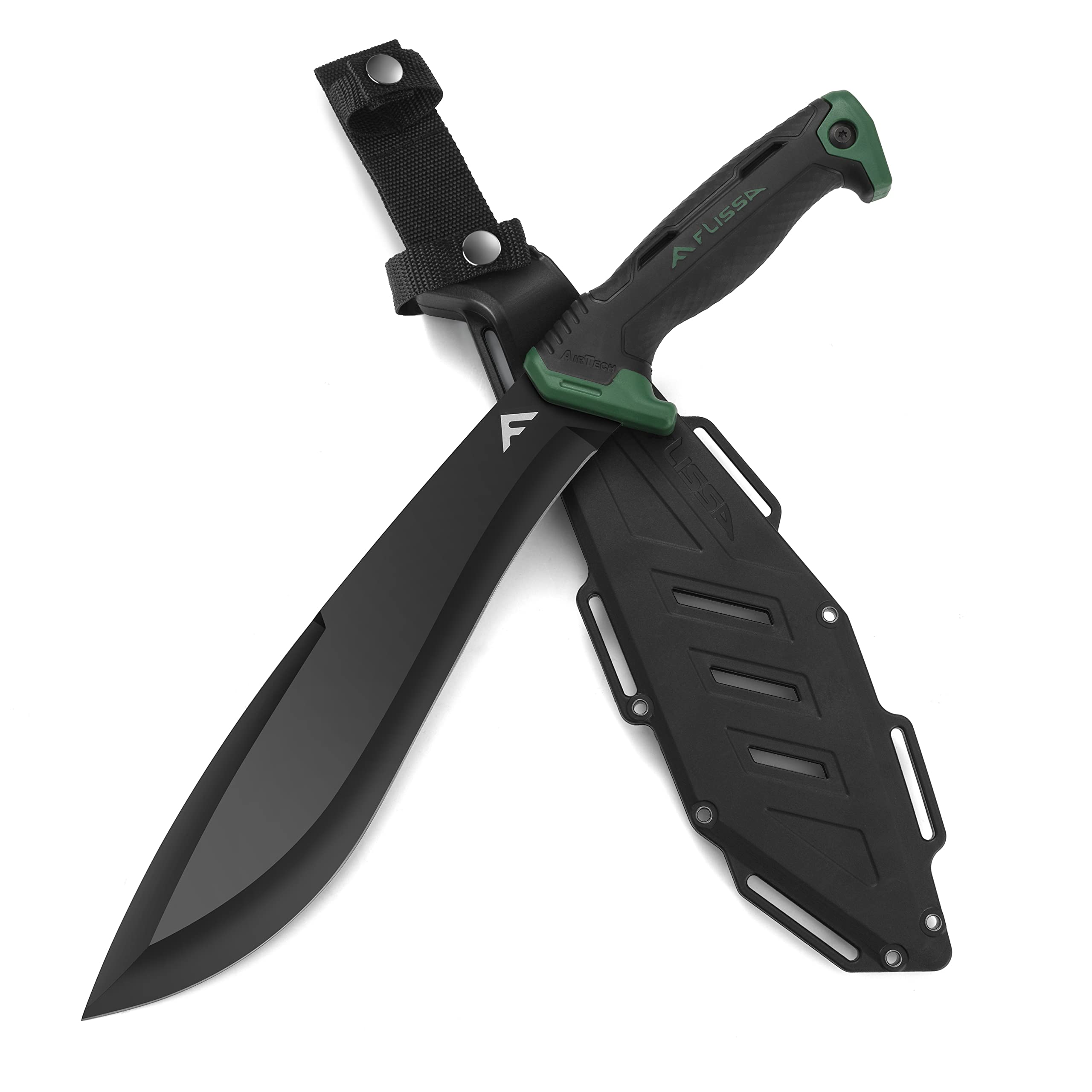
The FLISSA VALK Machete sits in a crowded but fairly predictable corner of the market: mid-priced working blades aimed at campers, gardeners, and people who keep a chopper by the back door. What separates it from a generic hardware-store machete is mostly the handle design, which FLISSA markets under the “Air Tech” name. The blade itself is an 11-inch bolo pattern, a shape with a long history in agricultural and jungle work. This review looks at where that combination works and where it asks for patience.
The bolo profile is the first thing worth understanding. Unlike a straight Latin-pattern machete, a bolo widens toward the tip, putting more mass forward on the blade. In practice that means it chops better than it slices. For clearing brush, limbing fallen branches, or cutting through vines and saplings up to a couple of inches thick, the forward weight does useful work. For fine tasks like whittling stakes or trimming soft vegetation cleanly, it is clumsier. Buyers expecting a do-everything blade should adjust expectations: this is a chopper first.
The handle is the product’s main talking point, and it deserves a fair look. The grip uses a segmented, rubberized construction with what the company calls shock-absorbing properties. In real use, that translates to a handle that feels less punishing during repeated swings than a hard plastic or bare wood grip. The texture provides decent traction when hands are sweaty or wet, which matters more than most spec sheets admit. That said, the segmented design creates seams and recesses where dirt, sap, and mud collect. Cleaning takes a little more effort than wiping down a smooth handle, and long-term durability of the rubber over years of sun exposure is an open question. It is a reasonable trade-off, not a free upgrade.
Build quality is consistent with the price band. The blade is steel, though FLISSA does not emphasize a specific alloy or hardness rating in its consumer materials, and that vagueness is worth noting. Edge retention is adequate for light-to-moderate work but will not match a premium carbon-steel chopper. Users should expect to touch up the edge with a file or sharpener after a few solid sessions of clearing. The factory edge is serviceable out of the box, though not razor-grade, which is normal for this category and arguably safer for a swinging tool.
Balance and weight are where the bolo shape and handle interact. The knife feels tip-heavy in the hand, which is intentional and helpful for chopping momentum. During extended use, that same tip-heaviness tires the wrist faster than a lighter, more neutral blade. Someone clearing a trail for an hour will notice it; someone processing a few branches in the yard will not. The handle length accommodates a full grip with room for a second hand near the pommel if needed, though two-handed swinging on a blade this size is more of a novelty than a technique.
Comparing it to alternatives helps place it. Against a standard straight Latin machete of similar price, the VALK trades slicing efficiency for chopping power. Against a compact hatchet, it is lighter and better for green vegetation, but a hatchet will out-chop it on dry, seasoned wood and is generally safer for splitting tasks. Against a folding saw-and-knife combo favored by ultralight campers, the machete is heavier and bulkier to carry but far faster at clearing a path or processing a pile of brush. The honest framing is that this is a brush and vegetation tool that can handle light wood, not a wood-processing tool that happens to cut grass.
Carrying and storage deserve a mention. An 11-inch blade needs a sheath, and buyers should confirm what is included with the specific listing, since machete packages in this price range vary. A blade this length is awkward in a standard backpack and is better lashed to the outside of a pack or carried on a belt. The exposed, relatively long blade also means storage at home should be deliberate, especially in households with children.
Maintenance is straightforward but not optional. Wipe the blade dry after use, apply a light oil to the steel, and keep the edge touched up. The handle should be rinsed and dried rather than left caked with plant matter, given the recesses in the grip. None of this is unusual for a working blade, but the rubberized handle makes neglect slightly more costly than it would be on a simpler design.
Who it suits: homeowners with overgrown fence lines, campers who want a dedicated brush-clearing tool, and gardeners dealing with thick stems and saplings. It is also a sensible first machete for someone who wants a forgiving handle without paying premium prices.
Who it does not suit: ultralight backpackers counting ounces, woodworkers wanting a precise slicing edge, and anyone expecting a survival knife to handle carving and fine tasks. Buyers who need to split seasoned firewood should look at a hatchet or saw instead.
Overall, the FLISSA VALK is a competent, honest working tool with a handle that genuinely reduces vibration and a blade shape that favors chopping over finesse. It is not a precision instrument, the steel is not exceptional, and the grip demands a bit more care than simpler designs. Within its price and purpose, though, it does the job it was built for, provided the buyer understands what that job is.