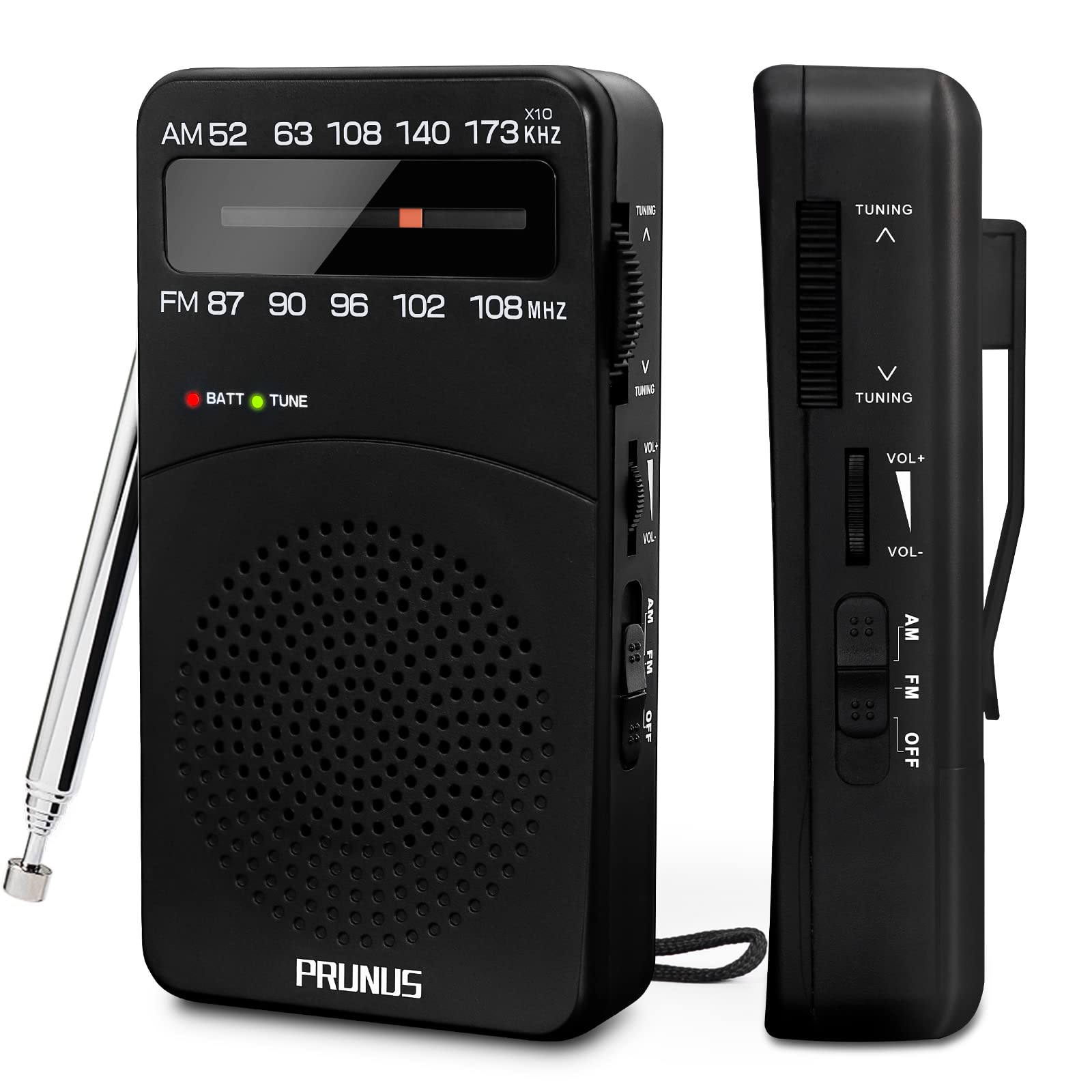
The PRUNUS J-166 is a small, battery-operated AM/FM radio aimed at people who want a straightforward listening device without apps, accounts, or a charging routine. It sits in the same general category as emergency radios, pocket radios, and the inexpensive battery sets sold for workshops and kitchens. Based on its specifications and the way this class of radio typically performs, it is best understood as a basic utility device rather than a serious receiver.
In real-world use, a radio like this tends to live in specific places: on a garage shelf, in a kitchen where counter space is tight, in a camping kit, or in a drawer reserved for power outages. The J-166’s battery operation is the main reason it suits those roles. Because it does not depend on mains power, it can stay usable when electricity is out, and it can be carried outdoors without worrying about charging. For anyone who mainly wants to hear a local news station, a weather update, or a ballgame, that is the core appeal.
The feature set is modest and mostly conventional. It receives AM and FM bands, uses a telescopic antenna for FM, and has an internal ferrite antenna for AM, which is standard for radios in this size and price range. Tuning is done with a manual dial rather than digital presets, and volume is controlled by a thumbwheel. There is a built-in speaker, and a headphone jack lets you listen privately, which also helps in shared spaces or late at night. The radio runs on standard batteries, and the compact body is designed to be set on a surface or carried by hand.
Performance expectations should be set accordingly. FM reception in a city or near a transmitter is usually the strongest part of a radio like this; the telescopic antenna helps, and local stations should come in clearly. AM is more variable. It can work well for strong local signals, but it is prone to interference from electronics, wiring, and building structure, and it will not pull in distant stations reliably. The manual dial also means tuning is approximate: finding a station takes a little patience, and fine adjustment is needed to avoid drift or bleed from adjacent frequencies. This is not a set for someone who wants to scan and lock onto stations precisely.
Sound quality is the other predictable trade-off. A single small speaker in a compact plastic body produces a narrow, somewhat thin sound. It is adequate for spoken word, which is what most buyers of this type of radio listen to, but music will lack bass and depth. At higher volume, distortion is likely to become noticeable. The headphone output is the better option for anyone who cares about clarity, and it also avoids disturbing others.
Build and ergonomics are functional rather than refined. The controls are simple enough to operate by feel, which matters in low light or during a power cut, but the plastic housing and thumbwheel tuning reflect the budget positioning. Battery life depends on the cells used and how often the radio is played, but standard batteries are easy to replace, and keeping a spare set on hand is sensible for emergency use. There is no digital clock, alarm, or weather-band feature, so it should not be confused with a dedicated emergency radio that includes a flashlight, hand crank, or NOAA channels.
Compared with alternatives, the J-166 makes most sense as a low-cost secondary radio. A digital-tuning portable radio offers more precise station selection and often better selectivity, while a dedicated emergency radio adds features like a crank charger and weather alerts. A Bluetooth speaker, by contrast, offers better sound but depends on a phone and a power source. The J-166’s advantage is simplicity: no pairing, no charging, and no menus. Its disadvantage is that it does little beyond basic reception, and its analog tuning and small speaker limit how enjoyable it is for music or weak-signal listening.
This radio is suitable for people who want an inexpensive battery-powered set for local AM/FM listening, a backup during outages, or background news in a garage or kitchen. It is also reasonable for older users who prefer physical dials over digital interfaces. It is not suitable for DXers, audiophiles, or anyone who needs precise digital tuning, weather-band coverage, or strong sound quality. Buyers should expect a dependable basic radio with modest reception and sound, not a high-performance receiver.