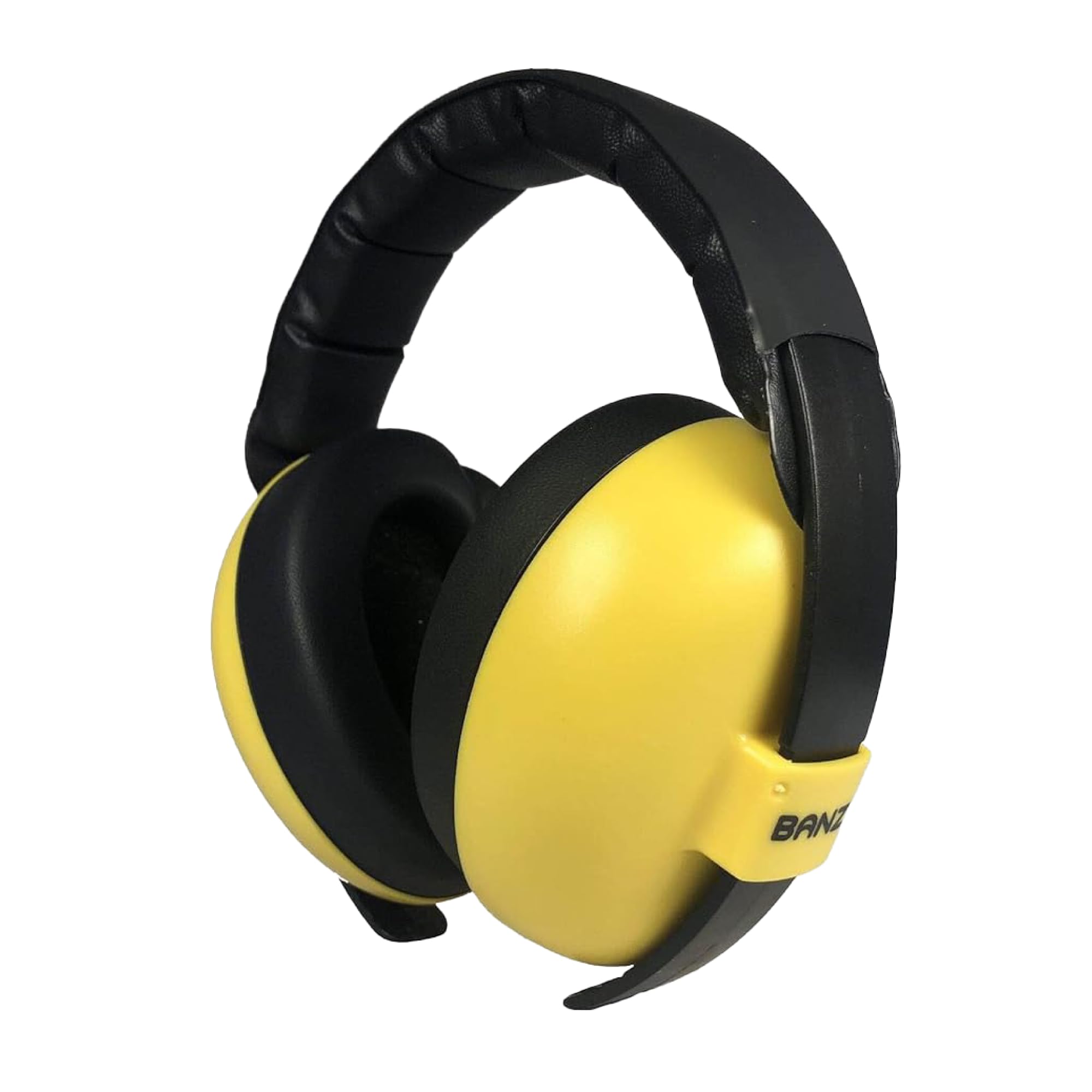
Baby ear defenders sit in an odd corner of the market. They are sold as safety gear, but most parents encounter them for the first time in a situation that is not especially dangerous — a wedding, a fireworks display, a loud restaurant, or a flight with a crying infant two rows back. The BANZ infant ear muffs are one of the more recognizable options in that space, and the gold finish makes them easy to spot in a diaper bag. Whether they are the right choice depends less on the color and more on how your child tolerates wearing something on their head.
The basic premise is straightforward. The muffs use a padded, over-ear cup design attached to an adjustable headband, with the cups sized for infants rather than older children. The band is meant to sit snugly against the skull without pressing hard enough to cause discomfort, and the cups rotate slightly so they can be positioned over the ears at the angle a small head actually requires. BANZ markets them for infants and toddlers, and the sizing reflects that — these are not going to fit a school-age child comfortably, and they are definitely not adult-sized.
In real use, the most common scenario is a parent holding a baby in one arm while trying to put the muffs on with the other. That is where fit and ease of adjustment matter more than spec sheets suggest. The band on this model adjusts via a sliding mechanism, and the cups have a soft cushion that sits against the skin. Parents typically report that getting a good seal takes a few tries, especially with younger infants whose heads are still small and round. A loose seal is the most common reason ear defenders underperform, and it is worth checking before assuming the product is at fault.
On noise reduction, it helps to be realistic. These are passive ear defenders, not active noise cancelling headphones despite the product naming. There is no battery, no electronics, and no cancellation circuitry — just physical attenuation from the cup and cushion. That means they reduce sound rather than eliminate it. At a loud event, a baby will still hear muffled noise, but the sharp peaks that tend to startle infants are softened. For sleep, that can be enough. For a genuinely deafening environment like a rock concert or a motorsport event, no infant ear defender is a substitute for distance and limited exposure. The muffs are a supplement to sensible positioning, not a replacement for it.
Build quality is decent for the category. The plastic feels sturdy enough for the handling it will get, and the cushion material is soft rather than stiff. The gold color is a cosmetic choice that will show scuffs and fingerprints more than a darker finish would, which is worth knowing if you care about how gear looks after a few months in a bag. The folding or compact design, depending on the variant, helps with storage, though the cups do not collapse as flat as some competing models.
- Passive attenuation only — no electronics, no batteries, no active cancellation
- Adjustable headband sized for infants and younger toddlers
- Rotating ear cups to help position over small ears
- Soft cushioned pads against the skin
- Compact storage for diaper bags and travel cases
The clearest limitation is tolerance. Some infants accept the muffs without complaint; others pull them off within minutes, and no amount of adjustment fixes that. This is a temperament issue as much as a product issue, but it means the muffs are not a guaranteed solution for a fussy baby at a loud event. A second trade-off is the seal. Because the cups rely on a snug fit, they can shift when a baby turns their head or leans against a parent, and the attenuation drops noticeably once the seal breaks. Parents often end up reseating them repeatedly during longer outings.
Compared with generic foam earplugs or the soft silicone putty-style plugs sometimes used for infants, over-ear muffs have the advantage of being harder to dislodge and easier to see. They are also easier to remove quickly if a baby becomes distressed. The downside is bulk and the fact that they depend on head shape. Compared with active noise cancelling headphones marketed for children, the BANZ set is simpler and cheaper, but it also lacks the electronic attenuation that helps with steady low-frequency noise like airplane engines. For that specific use case, neither approach is dramatically better for an infant, since fit and tolerance dominate the outcome.
Who is this for? Parents heading to a one-off loud event — a parade, a fireworks show, a wedding with a band — who want a low-cost, no-fuss layer of protection for a baby who will tolerate something on their head. It is also reasonable for families who want a visible, adjustable option rather than inserting anything into a baby’s ear canal. Who is it not for? Parents expecting silence, or parents of a baby who reliably removes hats and headbands. In that case, the money is better spent on limiting exposure time and positioning rather than on gear the child will not wear.
The gold finish is a matter of taste, and it does not change performance. What matters is whether the fit works for your child and whether you understand that these reduce noise rather than block it. Treated as a modest, practical accessory for occasional loud situations, the BANZ muffs do their job. Treated as a guarantee of quiet, they will disappoint — as will nearly every infant ear defender on the market.