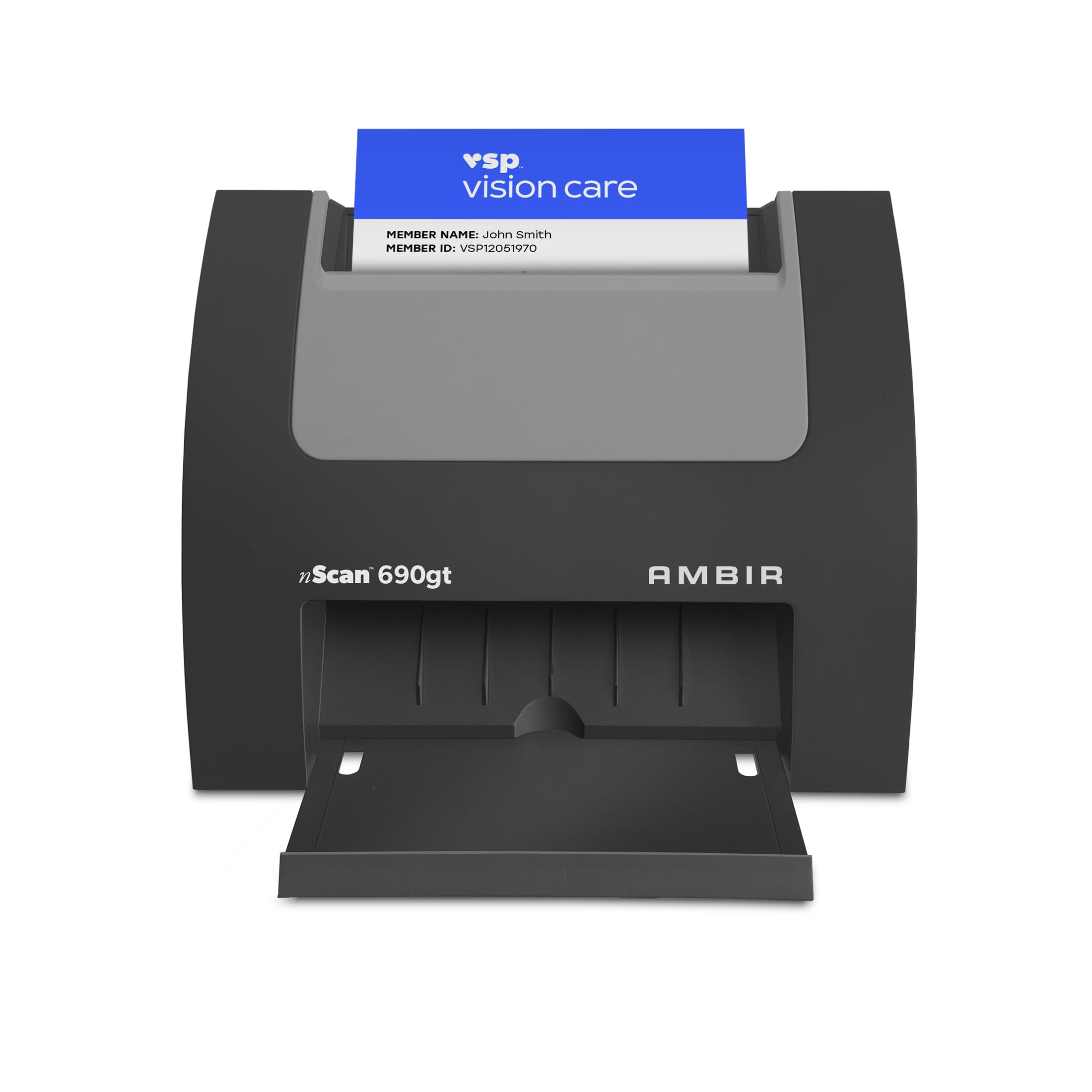
The Ambir nScan 690gt-AS is a niche piece of hardware aimed at a specific job: feeding plastic cards and small documents into a computer quickly and reliably. It is a vertical-feed scanner, meaning cards are inserted edge-first into a slot rather than laid flat on a glass bed. That design choice shapes nearly everything about how the device works and who should consider it.
In practice, this scanner shows up in reception desks, clinic front offices, insurance agencies, and small businesses that need to digitize driver’s licenses, insurance cards, membership cards, and the occasional business card or check. The workflow is straightforward: insert a card, the scanner pulls it through, and imaging software on the connected PC or Mac captures the front and back. Ambir bundles its own scanning software, and the device is TWAIN-compliant, which means it can also work with third-party document management and imaging applications that support that standard. For organizations already running a records system, that compatibility matters more than any single bundled feature.
Functionally, the 690gt-AS is built around speed and duplex capture. It reads both sides of a card in a single pass, which is the main reason someone would choose it over a flatbed. Rated throughput is in the range of a few seconds per card, and in real use that holds up for intermittent, one-at-a-time scanning. Resolution is adjustable and sufficient for reading fine print and small photos on an ID, though it is not a photo-grade device. The vertical path also keeps the footprint small, so it can sit beside a monitor without eating much desk space.
- Duplex scanning: captures front and back of a card in one pass
- Vertical feed: compact footprint, card-at-a-time operation
- TWAIN support: works with many third-party imaging applications
- Cross-platform: drivers and software for Windows and Mac
- Bundled software: includes Ambir scanning and image management tools
The trade-offs are real and worth stating plainly. This is not a general-purpose scanner. It handles cards and similarly sized stiff media well, but it is not the tool for receipts, multi-page contracts, or bound documents. If your office needs to scan a mix of paper sizes, a document feeder scanner or a flatbed is the more sensible purchase, and many flatbeds now include a card slot that covers occasional ID capture at a lower price. The 690gt-AS makes sense when card scanning is frequent enough that a flatbed’s slower, manual process becomes a bottleneck.
Reliability is another consideration. Card scanners of this type depend on clean rollers and a straight insertion; bent or worn cards, or cards with raised embossing, can jam or feed unevenly. Users should expect to clean the feed path periodically, and heavy daily volume will eventually wear consumable parts. The device also requires a host computer at all times — there is no standalone mode or onboard storage — so it is not a solution for someone who wants to scan cards away from a desk. Software setup can be fiddly on Macs in particular, and the bundled application, while functional, is not especially polished compared with mainstream document tools.
Performance expectations should be calibrated to the category. For a few dozen cards a day, the scanner keeps pace without drama. For hundreds per day at a busy counter, it will work but may feel like a bottleneck compared with dedicated high-volume ID readers used in banking and government settings. Image quality is good enough for records and verification purposes, but color accuracy and fine detail will not match a quality flatbed at higher resolutions.
Who is it for? Front-desk staff, small offices, and administrative teams that regularly capture ID cards and need both sides digitized with minimal steps. It also suits developers or integrators who want a TWAIN-compatible card scanner to plug into an existing capture workflow. Who is it not for? Home users who scan a card once a month, offices that need to scan paper documents of varying sizes, and anyone expecting a plug-and-play experience with no software configuration. Those users are better served by a multifunction printer with a flatbed or a document scanner with a card path.
Overall, the Ambir nScan 690gt-AS does one job and does it competently, provided the job matches the device. It is a specialized tool with a specialized price, and the value depends entirely on how often cards cross your desk. Buy it for throughput on cards; look elsewhere for general document scanning.