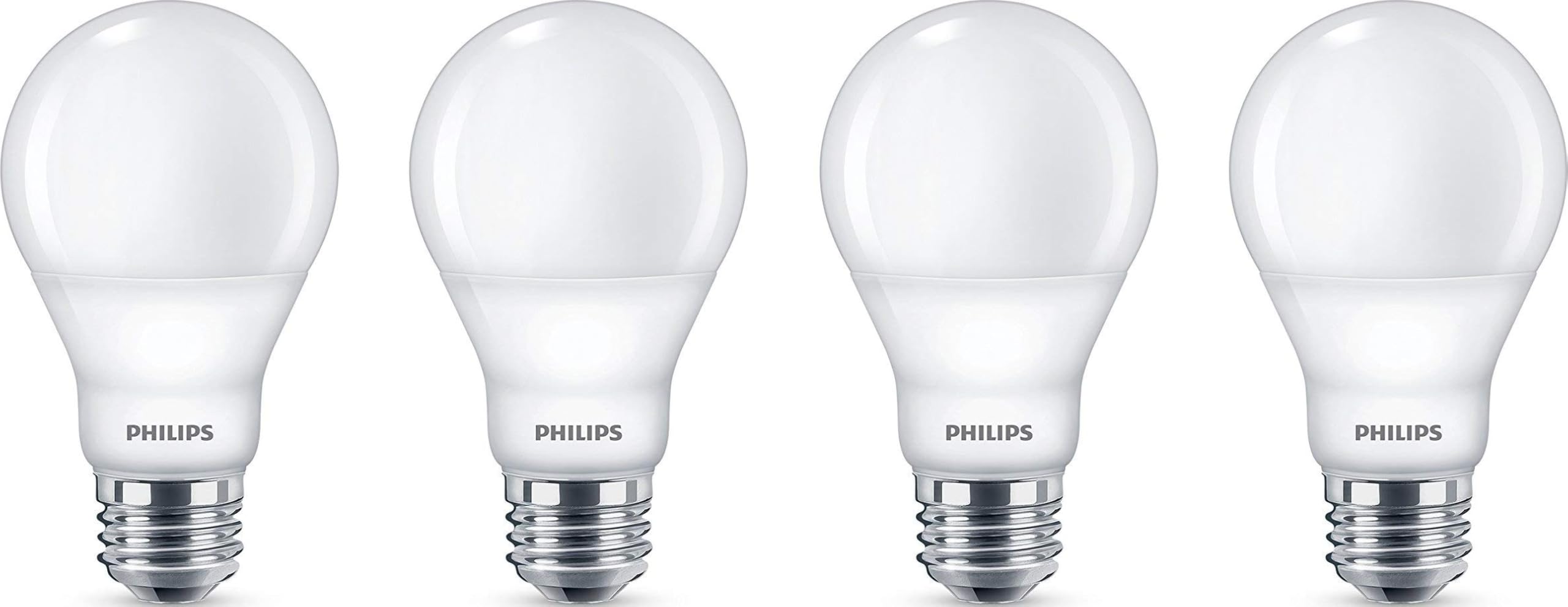
Philips has been selling its Warm Glow line for years now, and the four-pack of A19 dimmable bulbs sits in an interesting spot: it promises the kind of color shift you normally associate with vintage filament bulbs, but in a standard frosted A19 shape that fits ordinary lamps and fixtures. The pitch is straightforward. At full brightness the bulbs run at 2700K, a conventional soft white. As you dim them, the color temperature drops toward 2200K, taking on a warmer, amber tone rather than the flat, slightly gray look that many dimmable LEDs produce at low levels. Whether that matters depends heavily on where you plan to put them.
In practice these are bedroom, living room, and dining fixture bulbs. The 800-lumen output matches a traditional 60W incandescent, which is enough for a table lamp, a pair of bedside lights, or a small ceiling fixture, but not enough to light a large room on its own. The E27 base is the standard screw fitting used across Europe and much of the world, so they drop into most existing sockets without adapters. At 8.8 watts each they draw roughly a seventh of the power of the incandescent bulbs they replace, which is the main practical reason to buy them.
The dim-to-warm behavior is the feature people are actually paying for, so it deserves scrutiny. The shift from 2700K to 2200K is noticeable but not dramatic. It reads as a gentle warming rather than the deep candlelight glow of a genuine filament bulb. If you are chasing that very orange, low-level ambiance for a dining table or a bar cart, a dedicated vintage-style filament LED will get you closer. The Warm Glow bulbs are better understood as a refinement of standard soft white dimming, not a replacement for decorative bulbs. They also need a compatible dimmer to behave well. On older or cheap dimmers, expect some flicker at the low end and possibly a limited dimming range before the light cuts out entirely.
Color rendering is decent for the price bracket. Skin tones and wood surfaces look natural under them, and the frosted diffuser does a reasonable job of hiding the LED elements, so you are not staring at a cluster of yellow dots. There is a slight warm cast even at full brightness that some people will find cozy and others will find a touch yellow compared with cooler 3000K or 4000K bulbs. That is a preference issue rather than a defect, but worth knowing if you are mixing these with existing cooler bulbs in the same room.
Build quality is typical of mainstream Philips LED stock: plastic diffuser, standard aluminum neck, nothing remarkable but nothing flimsy. Lifespan claims run in the tens of thousands of hours, and in normal household use you are unlikely to replace them for years. The four-pack format makes sense for people relighting a room at once, though it does mean you pay for four even if you only need two. Buying singles is possible but usually at a worse per-bulb price.
Compared with basic non-dimming LEDs, these cost more and only earn that premium if you actually dim them regularly. Compared with smart bulbs, they are far cheaper and simpler, with no app, hub, or Wi-Fi dependency, but they also lack color control, scheduling, and voice commands. Compared with filament-style dim-to-warm bulbs, they are more practical for enclosed fixtures and general-purpose lamps, where exposed filaments can look out of place and sometimes glare.
Who should consider them: anyone with a dimmer who wants warmer light at low levels without going full vintage, people relighting bedrooms or living rooms where a soft 2700K baseline is appropriate, and households replacing a batch of 60W incandescents at once. Who should look elsewhere: anyone who needs bright task lighting, since 800 lumens is modest; people without dimmers, who will get a perfectly fine but unremarkable soft white bulb and pay a small premium for a feature they cannot use; and anyone wanting deep amber ambiance, who will likely be happier with a dedicated filament or smart bulb.
The honest summary is that these are competent, well-behaved bulbs with one specific trick, and that trick is worth the extra cost only if your dimmer and your room actually call for it. They are not a revelation, and they will not transform a space on their own, but they do what Philips claims with fewer of the usual LED compromises than most budget options.