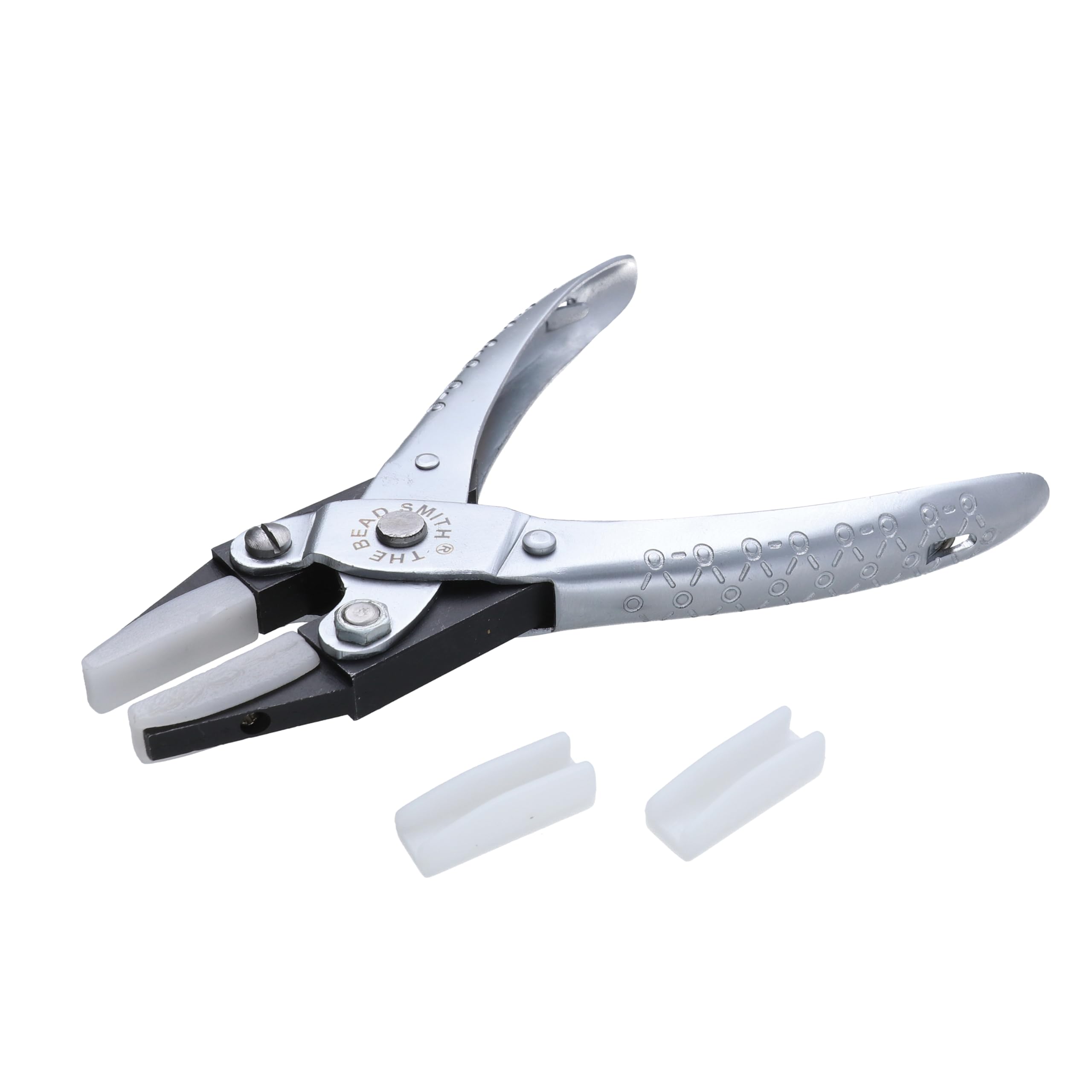
The Beadsmith Parallel Pliers are a specialized hand tool aimed at jewelers and metalworkers who need to hold, flatten, or bend wire and small metal components without marring the surface. Unlike standard chain-nose or flat-nose pliers, which pivot at a single point and cause the jaws to arc through a curve as they close, parallel pliers keep their jaws aligned flat against each other throughout the closing motion. That distinction matters more than it might first appear, and it is the main reason this tool exists as a separate purchase rather than a substitute for a general-purpose plier.
The defining feature here is the double nylon flat nose jaws. Two flat nylon pads sit on the inside of the jaws, and because the jaws close in parallel, those pads meet evenly rather than pinching at one edge. In practice, this makes the pliers useful for gripping flat stock, straightening kinked wire, holding a component steady during soldering or filing, and pressing small pieces together without leaving tool marks. The nylon is the key detail: it is softer than steel and will not scratch or dent most non-ferrous metals, which is why this configuration shows up in jewelry benches rather than general hardware kits.
The parallel action itself is worth understanding before buying. As the handles close, the jaws translate toward each other while staying parallel, so the gripping faces contact the workpiece across their full width at the same moment. With conventional pliers, the jaws meet first at the tips or at the pivot end, and the grip point shifts as you squeeze. For tasks where you want even pressure along a length of wire, or where you need to hold something flat without it rotating, the parallel design is genuinely more controllable. It also means the pliers can hold thin flat stock more securely than a standard flat-nose tool of similar size.
Real-world use tends to fall into a few categories. Jewelry makers use them to hold wire while wrapping, to flatten small coils, to straighten bent wire before forming, and to grip findings during assembly. Hobbyists working with memory wire, craft wire, or soft brass and copper appreciate the nylon faces because the workpiece comes out unmarked. Model makers and small-parts assemblers sometimes use them as a gentle holding tool where a metal-jawed plier would damage the part. They are not, however, a substitute for a proper bending plier or a forming tool; the flat nylon faces are for holding and flattening, not for creating curves or tight bends.
There are trade-offs, and the nylon is the most obvious one. Nylon is a wear item. Under repeated use, especially on harder wire or with edges that catch, the pads will develop grooves, flat spots, or nicks, and once they do, the tool’s main advantage, a clean unmarked grip, starts to erode. Replacement pads are available from the manufacturer, but it is an ongoing cost and a maintenance step that steel-jawed pliers do not require. Users who routinely grip sharp-edged or hardened material may find the nylon wears faster than expected, and the pads can be damaged by heat if the pliers are used to hold work near a torch.
Compared with a standard flat-nose plier, the parallel version costs more and is more mechanically complex, with more joints and linkage to keep clean and free of grit. Compared with smooth steel-jawed parallel pliers, the nylon version sacrifices some grip strength and durability for surface protection. That is the central trade-off: the Beadsmith pliers are gentler on the workpiece but less rugged than their all-metal counterparts. For soft wire and delicate assemblies, the nylon is the right call. For heavier gauge stock or tasks that need serious clamping force, a steel-jawed parallel plier or a standard flat-nose will hold up better.
Build quality is reasonable for the price point, which sits in the affordable-to-midrange territory for jewelry tools. The parallel mechanism works smoothly when new, though like most linkage-based pliers it benefits from occasional lubrication and keeping dust and metal filings out of the joints. The handles are comfortable enough for intermittent bench work, but these are not tools designed for all-day continuous squeezing; the parallel action requires a bit more hand force than a simple pivot plier, and fatigue can set in during long sessions. Spring return, where present, helps, but the feel is firmer than a lightweight craft plier.
Who is this for? Primarily jewelry makers, wire workers, and crafters who regularly handle soft non-ferrous wire and small components and who care about avoiding tool marks. It suits bench jewelers doing assembly and holding tasks, and hobbyists who want a dedicated gentle-grip tool. Who is it not for? Anyone working mainly with hard steel, heavy-gauge stock, or tasks requiring strong clamping force should look at steel-jawed parallel pliers or conventional flat-nose pliers instead. Buyers who dislike consumable parts or maintenance should also weigh the nylon pad replacement cost against the convenience. It is a niche tool that does one job well, and it is worth owning only if that job matches your actual work.