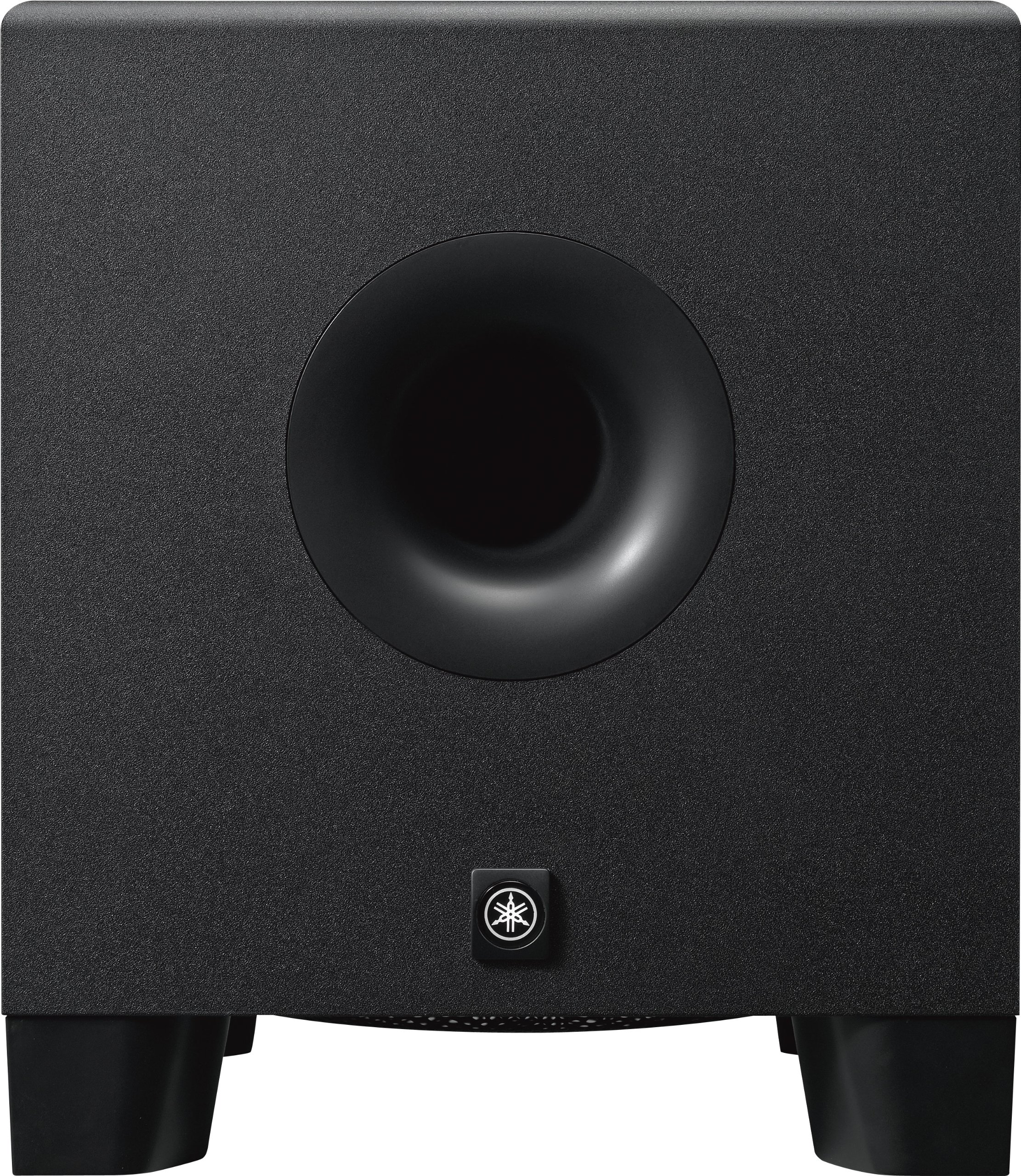
The Yamaha HS8 subwoofer is an 8-inch powered sub designed to extend the low-frequency response of a monitoring system, most obviously the HS-series monitors it shares a name with. It is a studio tool first and foremost, and the way it behaves in a room reflects that intent. Anyone expecting a home-theater-style sub with room-shaking output and a consumer-friendly feature set will find it more restrained than expected, while people mixing or producing in a nearfield setup will recognize what it is trying to do.
In practice, the HS8 is usually paired with HS5, HS7, or HS8 nearfields in a small to mid-sized treated room, crossed over somewhere in the 80–120 Hz region depending on the monitors and the room. It sits on the floor or on a low stand, often slightly off-center, and the user spends a session or two dialing in level and crossover before it stops drawing attention to itself. That is the intended outcome: the sub should make the bottom octave audible without announcing its presence. When set up carelessly, it does the opposite, and the results are muddy and boomy. The unit rewards patience and punishes guesswork.
Functionally, the HS8 is a fairly straightforward box. It uses an 8-inch cone driver in a bass-reflex enclosure with a rear port, powered by an onboard amplifier rated around 150 watts. Connectivity is balanced XLR only, which is a deliberate choice for studio use but limits casual hookups. There is no RCA input and no high-level speaker input, so it does not integrate easily with a hi-fi amplifier or a consumer receiver. Controls include a level knob and a crossover adjustment, along with a phase switch. The crossover is variable rather than fixed, which gives useful flexibility when matching different monitors, though the markings are not especially precise and fine adjustment is done by ear.
One of the more useful details is the pair of low-cut filters, typically around 80 Hz and 100 Hz, intended to roll off the low end sent to the satellite monitors when the sub is handling those frequencies. This matters more than it might seem: without it, small monitors and the sub can overlap and produce a lumpy response around the crossover point. There is also a phase switch, which is a coarse 0/180-degree toggle rather than a continuous control. That is enough to correct obvious cancellation, but it is less surgical than the continuously variable phase controls found on some competing subs.
Performance-wise, the HS8 reaches down into the 30s in hertz with usable output, which is a meaningful extension for nearfield work. It is not a sub for large rooms or for playback at high levels, and it will run out of headroom before a dedicated home-theater sub would. The character is neutral rather than plush. It does not add warmth or thickness for its own sake, which is the right call for monitoring but can feel lean to someone used to consumer subs. Transient behavior is decent, and kick drums and bass lines stay reasonably defined when the crossover and level are set correctly.
Placement is the biggest practical constraint. The rear port means it wants some space from the wall, and corner placement tends to excite room modes and produce one-note bass. In a small untreated room, the sub can easily make the low end worse rather than better, and the lack of built-in room correction or any kind of calibration means the user has to solve those problems with positioning and, ideally, acoustic treatment or measurement. This is a real limitation, not a minor footnote. A subwoofer in a modest room is as much a room problem as a gear problem.
Compared with a studio sub from a brand like Genelec or Neumann, the HS8 is less expensive and less refined in its control set, lacking things like detailed calibration or networked adjustment. Compared with a generic home-theater sub, it trades output and convenience features for a flatter, more predictable response and balanced connectivity. It sits in a middle ground: more purpose-built than consumer gear, less elaborate than premium monitoring subs. For many project studios, that middle ground is the sensible place to be.
The HS8 suits producers and mixers working in small to medium rooms who already own HS-series monitors or similar nearfields and want to hear the bottom octave accurately. It also works for anyone who needs a balanced-input sub with a variable crossover and is willing to spend time on placement. It is not suitable for home-theater enthusiasts wanting dramatic output, for people with untreated rooms who expect plug-and-play results, or for anyone needing RCA or speaker-level inputs. It is also not the right choice for large rooms, where its output limits will show. Buyers should expect to invest effort in setup and to accept that the sub will expose room problems rather than hide them. Treated as a monitoring component rather than a lifestyle product, it does its job without drama.