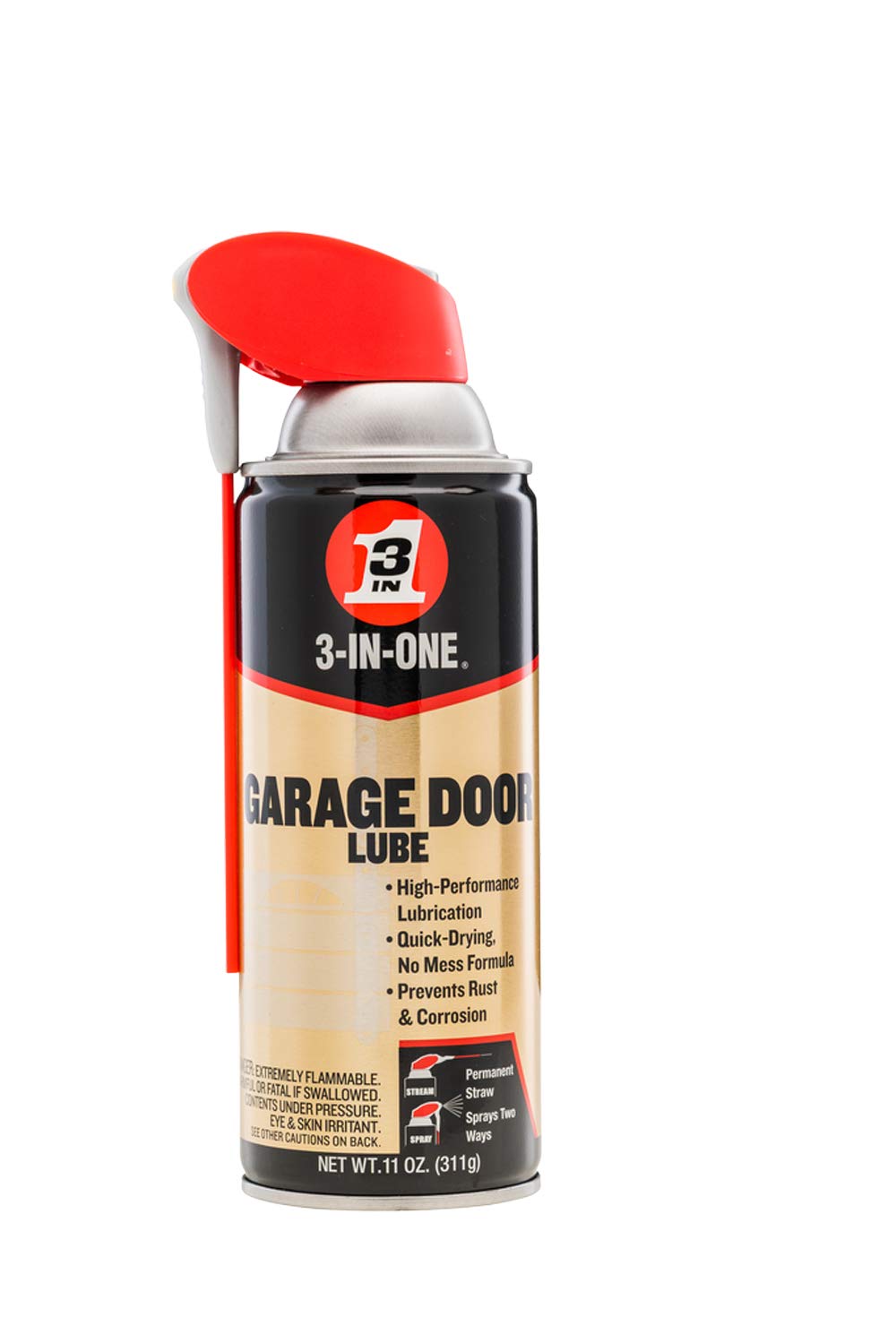
Garage door lubrication is one of those maintenance jobs that gets ignored until something starts squeaking, sticking, or moving slower than it should. The 3-IN-ONE Garage Door Lubricant is aimed squarely at that job, packaged in an 11-ounce aerosol can with the company’s Smart Straw nozzle, which sprays either as a wide fan or through a thin straw depending on how the tip is flipped. It is a fairly specific product in an aisle full of general-purpose sprays, so the real question is whether the specialization earns its place on the shelf.
The intended use is straightforward. Homeowners apply it to hinges, rollers, tracks, springs, and the pivot points on the door’s linkage. The formulation is a lubricant rather than a cleaner or a rust dissolver, and 3-IN-ONE positions it as safe for metal components while resisting the tendency to attract dust the way some heavier greases do. In practice, that means it goes on wet, penetrates into tight joints, and leaves a film that is meant to stay put rather than run off. The Smart Straw is the most tangible feature: flip it up and you get a precise stream for hinge pins and roller stems; flip it down and the fan spray covers track surfaces and wider contact areas more quickly. It is a genuinely useful design for a job that involves both narrow gaps and broad surfaces, and it avoids the annoyance of losing a separate straw.
In real-world use, the product fits into a seasonal maintenance routine. A typical application involves wiping down the tracks first, then spraying the hinges and rollers, and finally running the door up and down a few times to distribute the lubricant. The aerosol format makes this fast, and the can’s size is manageable for reaching overhead components without a ladder in some cases. The fan setting is helpful for the track, though it can overspray onto the door panels or the floor if you are not careful, and the straw setting requires a steady hand to avoid blasting lubricant past the target. Expect the initial application to look and smell like a solvent-based aerosol; the odor fades, but it is noticeable in a closed garage.
- Format: 11-ounce aerosol can with a two-way adjustable nozzle (fan spray or straw)
- Intended surfaces: Hinges, rollers, tracks, springs, and metal pivot points on garage doors
- Application: Spray-on film; no separate applicator or straw to keep track of
- Claimed behavior: Lubricates without leaving a heavy, dust-attracting residue
The main trade-off is longevity. Aerosol lubricants of this type tend to be lighter than a dedicated grease or a silicone-based spray, which means the film can thin out or migrate over time, especially on high-cycle doors that open and shut several times a day. For a door used once or twice daily, a reapplication every few months is a reasonable expectation; for heavier use, the interval shortens. That is not a flaw so much as a characteristic of the format, but it is worth knowing before assuming one can will last a year. The other limitation is that this is a lubricant, not a fix. If a roller is worn flat or a hinge is bent, spraying it will quiet it temporarily but will not correct the underlying mechanical problem. It also is not a substitute for cleaning accumulated grit out of the tracks, and applying it over dirt can create a gritty paste rather than a smooth surface.
Compared with a general-purpose penetrating oil like WD-40, this product is formulated to leave a longer-lasting lubricating film rather than act primarily as a water displacer, which makes it better suited to ongoing door maintenance. Compared with white lithium grease in a tube, it is easier to apply precisely to hinges and rollers but less durable under heavy load. Silicone sprays are another common alternative; they tend to be cleaner and less likely to attract dust, but they can be less effective on metal-to-metal contact points like hinge pins. The 3-IN-ONE product sits in a middle ground that favors convenience and targeted application over maximum staying power.
This is a sensible buy for a homeowner with a standard sectional garage door who wants a single product for routine upkeep and does not want to deal with separate straws or grease guns. It is less suitable for commercial or high-cycle doors where a heavier lubricant is warranted, for doors with plastic or nylon rollers that may call for a manufacturer-specified lubricant, or for anyone expecting a permanent cure for a noisy or binding door. Used as part of a basic maintenance routine, with realistic expectations about reapplication, it does the job it is designed for without much fuss.