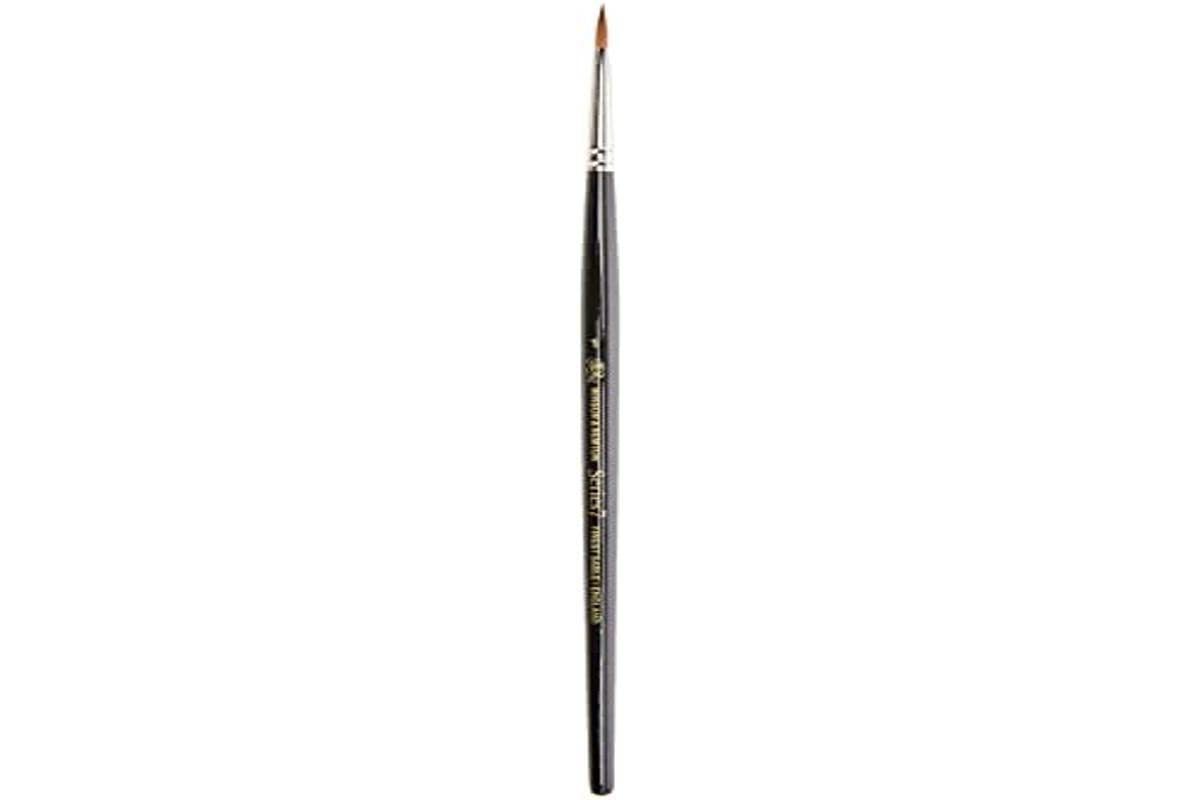
The Winsor & Newton Series 7 Kolinsky sable round in size #1 occupies an odd position in the brush market. It is a genuinely expensive tool for a very small job, and much of its reputation comes from a tradition of watercolour and miniature painting that predates the current wave of synthetic alternatives. Whether that reputation still translates into value depends heavily on what you intend to do with it.
In practice, a #1 round is a detail brush. It is used for fine linework, small highlights, lettering, miniature figure faces, and the tight areas of a watercolour wash where a larger brush would flood the paper. The Series 7 head is built from Kolinsky sable hair, which is known for holding a sharp point and releasing pigment in a controlled way. The brush comes with a round ferrule and a short handle relative to long-handled watercolour rounds, which makes it comfortable for close work and for painters who rotate the brush between fingers.
The functional story here is mostly about the point and the belly. Kolinsky hair has a natural taper that allows the brush to form a fine tip while still carrying a useful reservoir of colour. That combination is why miniature and botanical painters have used this class of brush for decades. The Series 7 is also crimped and set by hand, and the hair is treated to retain its shape. None of this is magic; it is careful manufacturing of a material that behaves differently from synthetic filament.
Where the brush earns its keep is in repeated, precise work. A painter doing eyes on a 28mm figure or fine veins on a leaf will notice the difference between a sable point that stays together and a synthetic brush that curls after a few sessions. The #1 size is small enough for those tasks but not so tiny that it becomes a single-hair tool. It also handles thin washes reasonably well, though it is not the brush you would choose for laying in large areas.
There are real trade-offs. Kolinsky sable is a natural material, and it requires more care than synthetic brushes. Paint must not be allowed to dry in the ferrule, and the brush should be reshaped after rinsing. Even with good habits, a sable brush will gradually lose its point over months or years of heavy use. The Series 7 is also priced well above comparable synthetic rounds. For a hobbyist who paints occasionally, a good synthetic #1 from a brand like Rosemary & Co or a mid-range Princeton will do most of the same work for a fraction of the cost, though it will not match the spring and point retention of sable.
Another limitation is availability and consistency. Natural hair varies, and while Winsor & Newton has a long-standing quality control process, individual brushes can differ slightly in snap and belly size. Buyers who expect a perfectly uniform product may be disappointed. The brush also arrives with a protective cap or gum arabic coating depending on the retailer, and that coating must be washed out before first use, which is a minor but easy-to-miss step.
Comparison to alternatives is useful here. A synthetic sable-style brush, such as a Golden Taklon round, is more durable, easier to clean, and holds up better to acrylics and rough handling. It is the sensible choice for students and for anyone who paints mostly with acrylics. The Series 7, by contrast, is best suited to watercolour, gouache, and thinned acrylics where a fine point and controlled release matter more than durability. A larger Series 7 round, say a #4 or #6, is a more versatile single-brush purchase for general watercolour work; the #1 is a specialist’s tool.
Who is it for? Painters who already have a stable of brushes and want a reliable detail round for miniature figures, fine art, or illustration will find it useful. It is also a reasonable choice for someone learning watercolour who intends to keep the brush clean and use it for small-scale work. It is not suitable for beginners on a tight budget, for painters who work mainly in heavy-body acrylics, or for anyone who tends to leave brushes standing in water. Those users will get better value and longer service from a synthetic alternative.
Overall, the Series 7 #1 is a well-made specialist brush with a clear use case and a price that reflects both the material and the brand’s history. It is not a necessary purchase for most people, and it will not make a beginner paint better. But for the narrow set of tasks it is designed for, it performs as expected, provided the buyer understands the maintenance it requires.