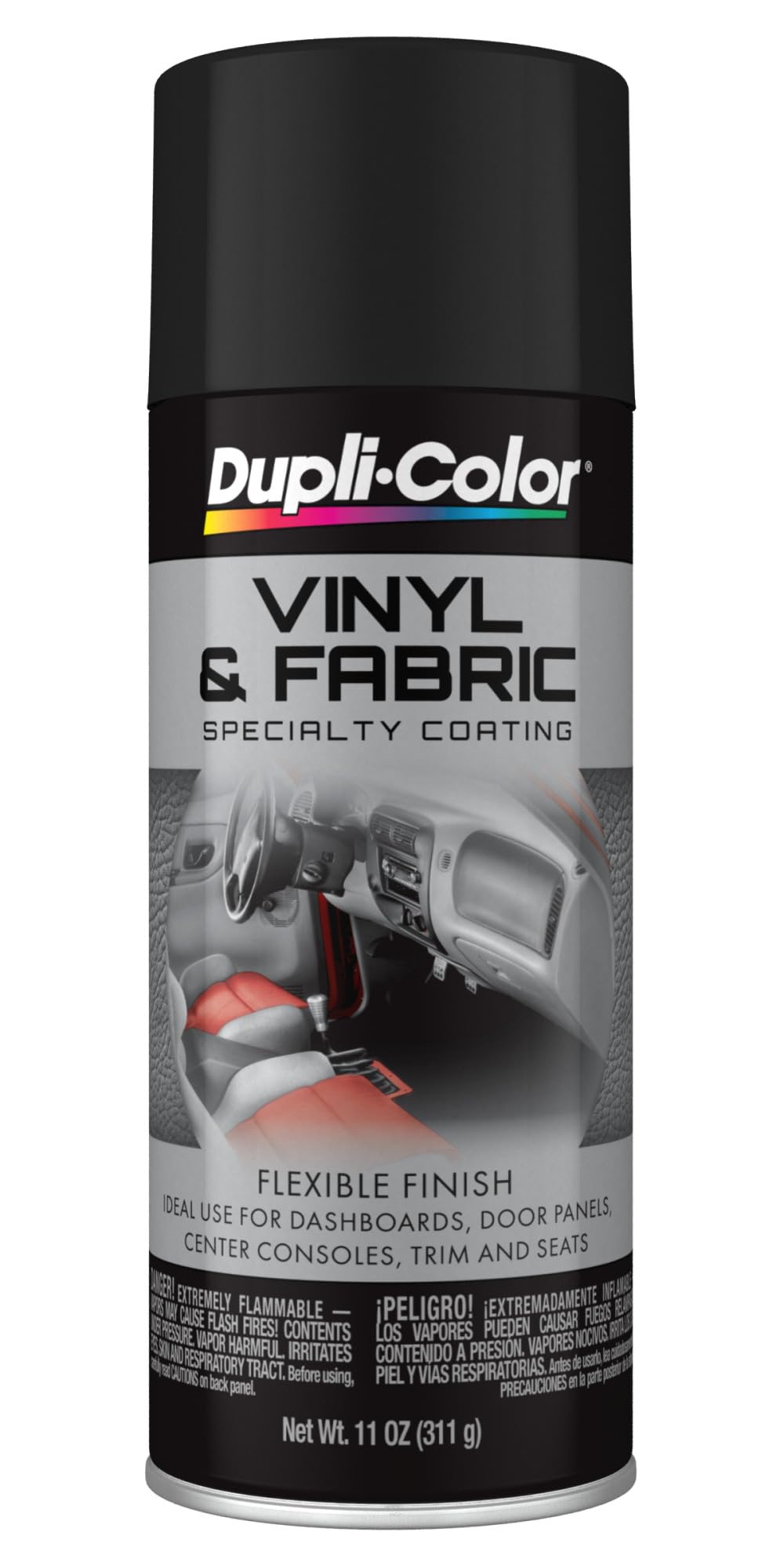
Dupli-Color’s Vinyl & Fabric Spray sits in an odd but useful corner of the aerosol market. It isn’t a dye, and it isn’t a conventional paint. It’s a flexible coating formulated to bond to soft interior materials—car seats, door panels, headliners, convertible tops, and similar surfaces—and restore or change their color. The flat black version is the most common choice, largely because black is the default interior color in most vehicles and because flat finishes hide uneven application better than gloss.
The product comes in an 11-ounce aerosol can, which is enough to cover a small area like a single seat bolster or a pair of sun visors, but not much more. Anyone planning to redo a full set of seats should expect to buy several cans, and that math matters when comparing it to alternatives.
In practice, this spray is used most often for three jobs: reviving faded or sun-bleached vinyl and fabric, unifying mismatched interior panels after a partial replacement, and darkening surfaces that have gone chalky from UV exposure. It’s also used on home upholstery, boat seats, and RV interiors, though results vary by material. The manufacturer specifies it for vinyl and fabric, and the flat black works best on textured surfaces where a slight sheen mismatch would otherwise be obvious.
Application is straightforward but less forgiving than the can suggests. Surfaces need to be clean and dry, and fabric in particular benefits from a light brushing to lift fibers before spraying. Multiple thin coats are required; a single heavy pass tends to soak fabric unevenly and can leave a stiff, crusty patch. On vinyl, adhesion is generally better, but flexible surfaces still need to be free of silicone-based dressings, which are common on car interiors and will cause the coating to fish-eye or flake. Drying time is short—typically under an hour to touch—but full cure and wear resistance take considerably longer, and the surface should be left alone for at least a day before use.
- Formulation: Flexible coating designed for vinyl and fabric, not hard plastic or metal
- Finish: Flat black, which reduces glare and hides application streaks better than satin or gloss
- Coverage: Roughly 10–15 square feet per can depending on material absorbency
- Cure: Touch-dry in under an hour; full durability develops over 24 hours or more
- Cleanup: Requires solvent; overspray must be masked carefully
The biggest limitation is durability on high-wear surfaces. On a driver’s seat bottom or an armrest that sees daily contact, the coating will begin to wear through at friction points within months, especially on fabric. It behaves more like a surface treatment than a permanent re-dye, and repeated coats can build up into a slightly tacky film that attracts lint and dust. On fabric, the hand feel changes noticeably—surfaces become stiffer and less breathable—which is a real trade-off for anyone expecting a factory-like result. Color matching is another issue: flat black is flat black, but it won’t match every OEM black, and on faded panels the contrast between treated and untreated areas can be visible.
It’s worth comparing this to fabric dye and to dedicated vinyl and leather coatings. Dyes penetrate fibers and preserve the original texture, but they’re messy, require hot water or prolonged soaking, and are impractical for installed interiors. Vinyl-specific coatings offer better flexibility and wear resistance on hard trim but aren’t intended for fabric. Dupli-Color’s spray sits between these categories—convenient and fast, but a compromise on longevity and feel. For a quick refresh on a low-contact surface, that trade-off is reasonable. For a daily-driven seat, it’s a stopgap.
This product suits DIYers touching up faded panels, used-car sellers sprucing up a trade-in, and anyone restoring a project vehicle where the interior is secondary to the mechanical work. It’s also fine for boat and RV upholstery that sees occasional use. It is not suitable for high-traffic seating, for anyone expecting a soft, factory-original fabric feel, or for surfaces that will be scrubbed regularly. It also isn’t a repair product—cracks, tears, and sagging vinyl need to be addressed before spraying, or the coating will simply highlight them.
Ventilation matters. The solvent smell is strong and lingers for a day or two, so indoor use requires open windows and a respirator. Overspray travels further than expected, and masking adjacent surfaces is not optional. Used within its limits—thin coats, clean surfaces, low-wear applications—it does what it claims. Used as a permanent fix for a worn driver’s seat, it will disappoint, and that distinction is worth understanding before buying a can.