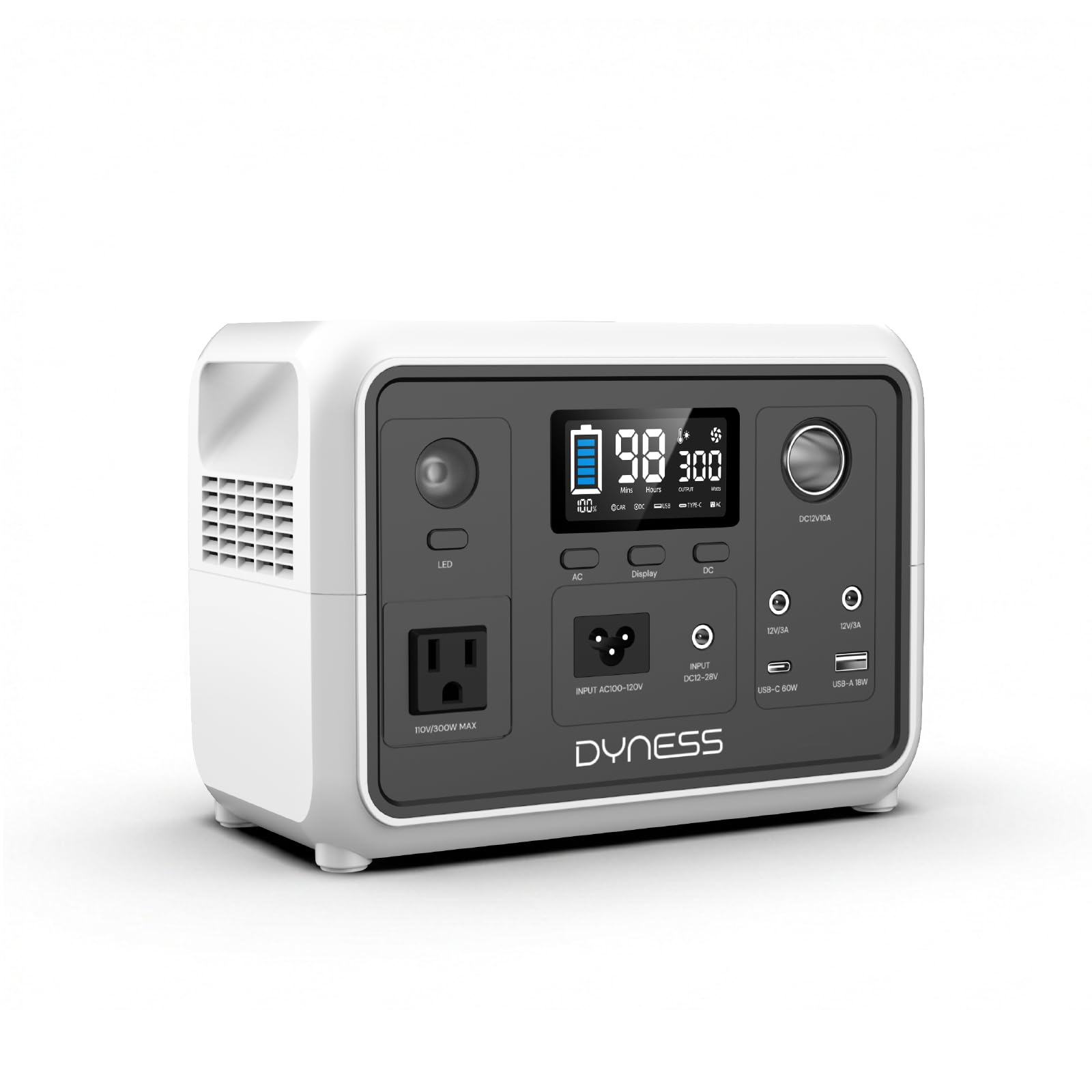
The DYNESS 300W portable power station sits in a crowded but useful corner of the market: small enough to carry, large enough to run a laptop, a light, and a phone charger at the same time. With a 256Wh LiFePO4 battery and a 300W pure sine wave AC outlet, it is aimed at campers, RV owners, and people who want a modest backup for short outages. It is not a whole-home solution, and it does not pretend to be.
In practice, this kind of unit gets used in fairly mundane ways. It powers a CPAP machine overnight for some users, keeps a Wi-Fi router and a modem running for a few hours during an outage, or charges camera batteries and drones at a campsite. The 300W AC output means it can handle small electronics and a few appliances, but anything with a heating element or a compressor is out of reach. A typical laptop draws 50–60W, a phone charger under 20W, and a small fan around 30–40W. Add those up and the 256Wh capacity translates to roughly three to four hours of mixed use, or a full laptop charge plus several phone top-ups. Real-world runtime is always lower than the math suggests because of inverter losses, so expect about 80–85% of the rated capacity to be usable.
The LiFePO4 chemistry is the most notable specification here. Compared with the lithium-ion NMC cells found in many older power stations, LiFePO4 tends to offer more charge cycles and better thermal stability. DYNESS does not publish a cycle count in the main listing, but LiFePO4 packs commonly rate between 2,000 and 3,500 cycles to 80% capacity. That matters if the unit will sit in a closet for years between outages. The trade-off is weight: LiFePO4 is heavier per watt-hour than NMC, and this unit is not something you would want to carry on a long hike. It is better suited to car camping or being moved between rooms than to backpacking.
Port selection is the usual mix for this class. There is one 110V AC outlet, USB-A and USB-C ports, and a 12V DC output. The single AC outlet is a limitation worth noting. If you want to run a laptop and a small appliance simultaneously, you will need a power strip, and you need to watch the total draw. The 300W continuous rating is modest, and while some units in this class allow brief surge loads, you should not count on running anything with a motor, such as a small fridge or a blender. For a cooler-sized 12V fridge, the DC port is the better route, though runtime will depend heavily on the fridge’s duty cycle.
Charging options include a wall outlet, a car port, and solar input. The solar panel is optional and sold separately, which is common but worth factoring into the total cost. Without a panel, the unit is really a battery box that needs to be topped up from the grid before an outage. With a compatible panel, it becomes more useful for extended camping trips, though solar charging is slow and weather-dependent. Buyers should check the panel’s voltage and connector compatibility before assuming a random panel will work.
Compared with a larger 500Wh or 1,000Wh power station, the DYNESS unit is lighter and cheaper but far less capable. A 500Wh model can run a small fridge for several hours or power a CPAP machine for two nights. The 256Wh class is better understood as an oversized phone battery with an AC outlet. Compared with a traditional sealed lead-acid jump starter box, the LiFePO4 unit is lighter for the same usable capacity, lasts more cycles, and provides a pure sine wave output that is safer for sensitive electronics. The trade-off is price.
Who is this for? Campers who need to charge devices and run a light or fan, RV owners who want a small backup for electronics, and homeowners who want to keep a router and a phone charged during short outages. It is also a reasonable choice for a CPAP user who wants a few hours of backup without buying a dedicated medical battery. Who is it not for? Anyone hoping to run a space heater, a full-size refrigerator, a microwave, or power tools. It is also not for backpackers, given the weight, or for people who need silent, long-duration backup for critical medical equipment. For those cases, a larger unit or a dedicated solution is the better fit.
Build quality is generally solid for this category, with a plastic shell and a carry handle. The display shows remaining capacity and input/output wattage, which is useful for tracking how fast the battery is draining. Fan noise is present under load but not excessive. One realistic expectation to set: the unit will lose charge over time when stored, so it should be recharged every few months. Overall, the DYNESS 300W is a competent small power station with a durable battery chemistry, a modest output, and a single AC outlet that limits simultaneous use. It does what it claims without much margin for error.