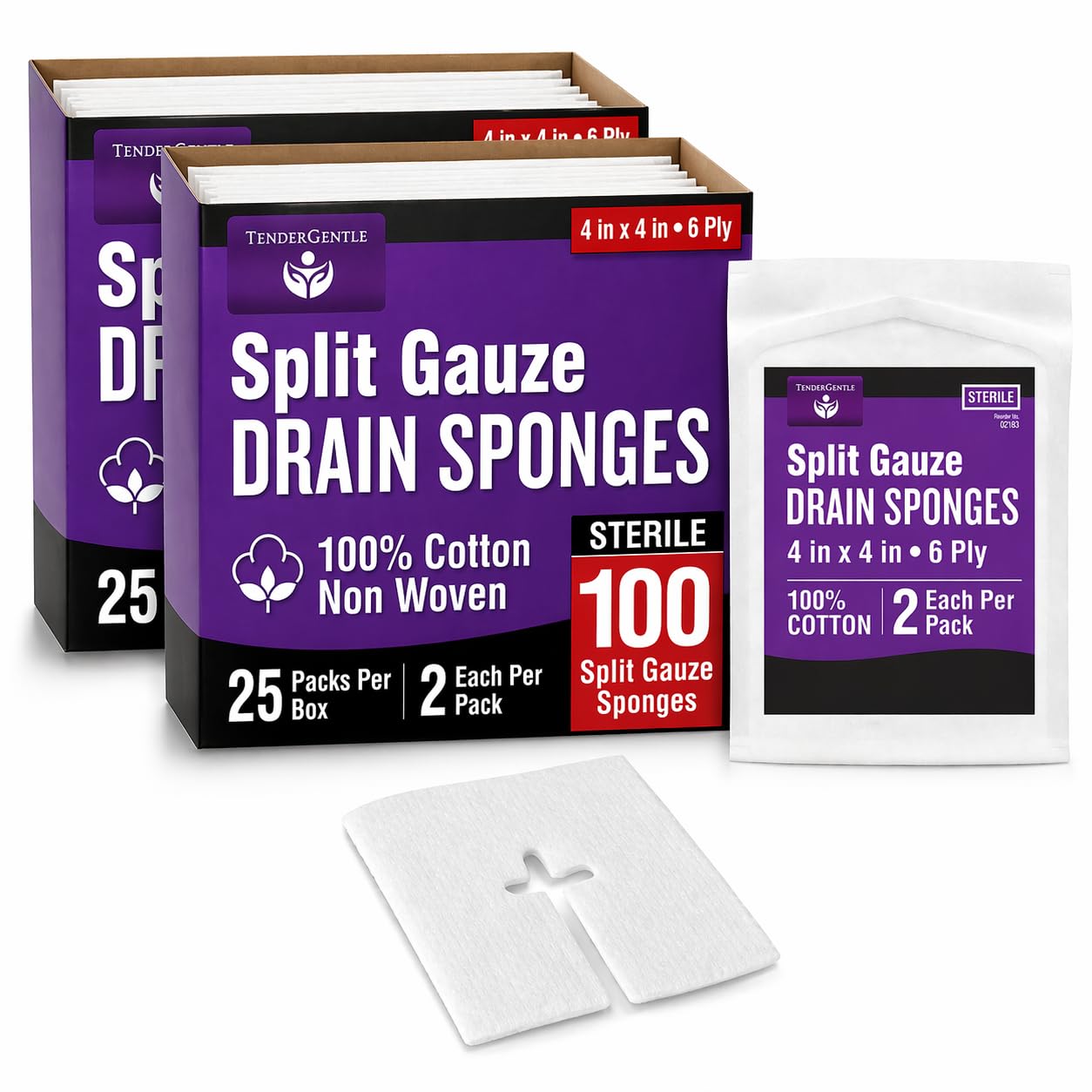
Split gauze sponges occupy a narrow but important niche in home and clinical wound care. Unlike a standard gauze pad, these have a slit cut from the edge to the center, allowing them to be placed around a tube or catheter without removing it. This 100-count pack of 4×4-inch, 6-ply sterile sponges is marketed for feeding tubes, drains, IV sites, tracheostomies, and G-tubes, which is a fair summary of where this format is actually useful.
The core appeal is practical rather than impressive. A split sponge lets a caregiver position a clean, absorbent layer around a device that stays in place, which matters for anyone managing a PEG tube, a surgical drain, or a tracheostomy stoma at home. The 6-ply construction gives the pad enough body to absorb typical drainage without falling apart when wet, and the 4×4 size is the de facto standard for this kind of dressing. Sterile packaging is a reasonable expectation here, since these pads are often used on broken skin or around a stoma where contamination is a real concern.
In real-world use, the split design is the whole point, and it works as intended: the pad wraps around the tube, the slit overlaps to close the gap, and the dressing can be taped or secured with a drain sponge holder. For tracheostomy care, the split allows the pad to sit under the flange without threading anything over the tube. For G-tubes and feeding tubes, it provides a replaceable absorbent layer that catches leakage and keeps the site drier between changes. These are the scenarios where the product makes sense, and they are common enough that a 100-pack is not unreasonable for a household managing ongoing care.
There are trade-offs worth naming. First, 6-ply is a moderate thickness, not a heavy-duty absorbent pad. For lightly draining sites it is fine; for wounds producing significant exudate, a thicker sponge or an absorbent dressing with a backing will outperform it. Second, the split means the pad is not a sealed barrier. It is an absorbent cover, not a waterproof or occlusive dressing, so it does not protect against moisture from the outside or provide a true seal. Third, while the pack is sterile, once opened and handled, sterility is only as good as the technique used, and the split edges can fray slightly if the pad is handled roughly or cut further. Finally, 100 pads is a lot for occasional use; someone changing a dressing once a week may find the box outlasts the need, though the individual sterile wrappers do help with shelf life.
Compared with alternatives, the closest comparison is a standard non-split gauze sponge, which is cheaper and more widely available but requires either removing the tube or folding and improvising around it, which is clumsy and less hygienic. A second alternative is a pre-cut drain sponge with a reinforced slit or a manufacturer-specific dressing kit, which may fit a particular device better but costs more and is less flexible across different tube types. For general wound packing or large abrasions, a plain gauze pad or an adhesive dressing is a better fit; the split format offers no advantage there and adds a small handling step.
Performance expectations should stay realistic. These are consumable dressings, not a treatment. They absorb, cushion, and keep a site cleaner between changes, and they do that job without fuss. The sterile packaging, the 6-ply body, and the 4×4 size are all appropriate for the stated uses. What they are not is a substitute for proper wound care advice, and they will not suit high-drainage situations or sites needing an occlusive seal.
Who it is for: caregivers and patients managing feeding tubes, G-tubes, tracheostomies, IV sites, or surgical drains who need a replaceable absorbent layer around a device that stays in place. It also suits clinics and home health settings where the 4×4 split format is a standard stock item.
Who it is not for: anyone dressing a flat wound without a tube, where a plain gauze pad is simpler and cheaper; high-exudate wounds needing a thicker absorbent dressing; or sites requiring a waterproof or occlusive barrier. Occasional users may also find a 100-pack larger than they need.
Overall, this is a functional, appropriately specified consumable that does a specific job well. The limitations are inherent to the format rather than defects, and the main caution is matching the pad to the drainage level and the device. For its intended niche, it is a reasonable, unremarkable choice.