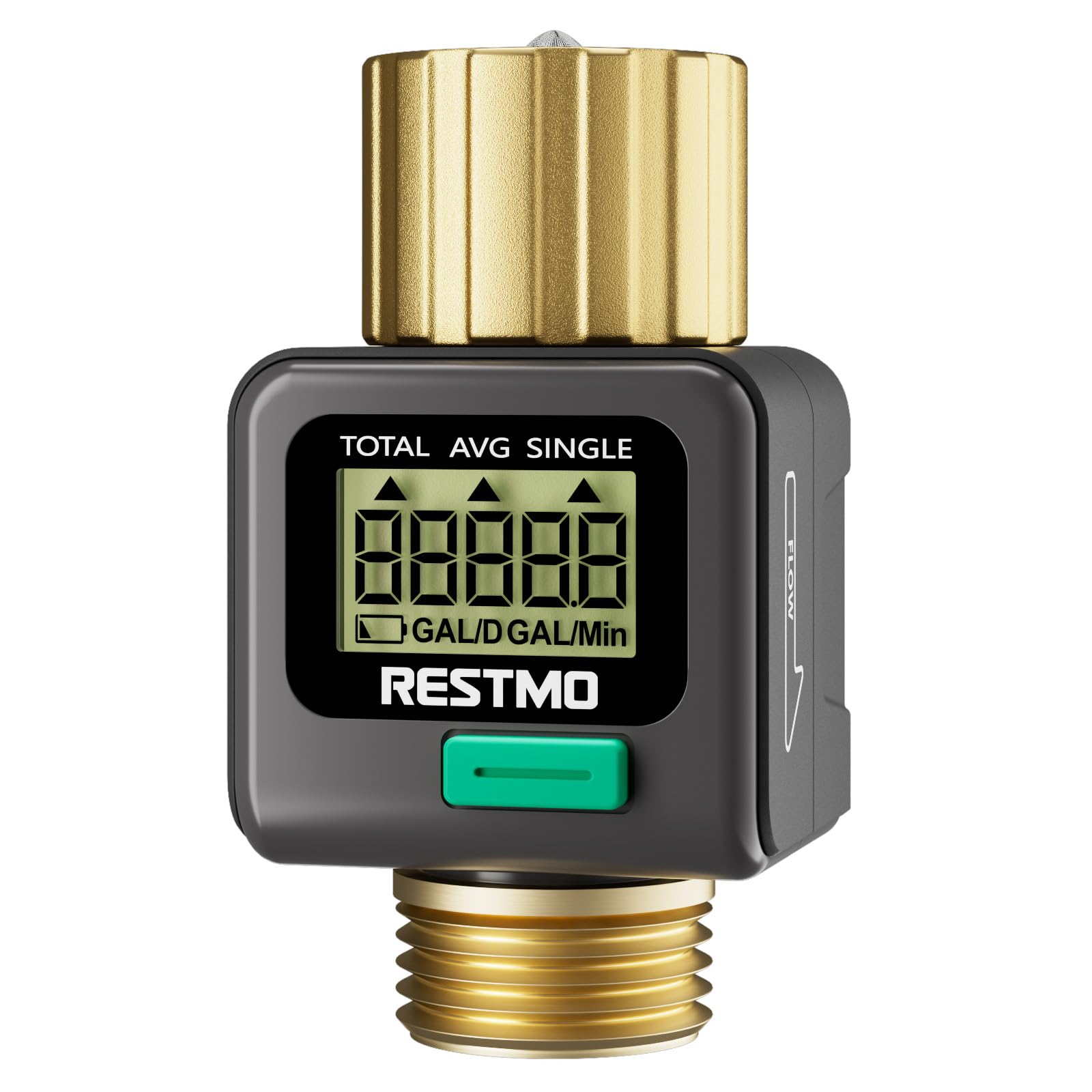
The RESTMO Water Flow Meter is a inline device that measures both total water consumption (in gallons or liters) and instantaneous flow rate. It’s aimed at homeowners, gardeners, and anyone who wants to quantify how much water they’re using for tasks like irrigation, car washing, or filling pools. Unlike smart water monitors that require app integration, this is a standalone unit with a simple LCD display and a few buttons. It’s the kind of tool that appeals to people who prefer a straightforward, no-frills approach to water management.
In real-world use, the meter attaches between a hose and a spigot or nozzle. The threaded connectors are standard 3/4-inch, so it fits most garden hoses. The display is easy to read in direct sunlight, and the buttons are large enough to operate with wet or gloved hands. The unit is battery-powered (2 AA batteries, not included), and the battery compartment is sealed with a rubber gasket to prevent water ingress. The meter can display total volume, current flow rate, and also has a reset function to start a new measurement session. It’s particularly useful for tracking how much water a lawn receives over a week, or for monitoring the output of a drip irrigation system to ensure it’s within expected ranges.
Functionally, the RESTMO meter offers both cumulative and real-time data. The flow rate is displayed in gallons per minute (GPM) or liters per minute (LPM), and the total volume in gallons or liters. Switching between units is done via a button, and the selected unit is retained even after power-off. The meter has a maximum flow rate of 26.4 GPM (100 LPM) and a maximum pressure of 145 PSI, which covers typical residential water systems. Accuracy is stated as ±5%, which is reasonable for a consumer-grade device. In practice, that means if you use 100 gallons, the meter might read anywhere from 95 to 105 gallons. For most gardening and household tasks, that’s acceptable, but it’s not precise enough for billing or scientific purposes.
One limitation is the lack of a backlight, which makes the display hard to read in low light conditions. Also, the meter does not have a memory function to store multiple readings; you have to manually note the total before resetting. The plastic housing feels durable enough for outdoor use, but it’s not designed to be left outside permanently—prolonged UV exposure may cause the plastic to become brittle over time. Another trade-off is the battery life: while the manufacturer claims up to 12 months, heavy use with frequent backlight (if it had one) would drain faster, but since there’s no backlight, battery life is likely closer to the claimed figure. However, the batteries are not included, which is a minor inconvenience.
Compared to smart water monitors like the Flume or Phyn, which provide whole-house water usage data and leak detection, the RESTMO is a manual, point-of-use device. It doesn’t offer app connectivity, historical logging, or alerts. But it also costs a fraction of those systems and doesn’t require installation by a plumber. For someone who just wants to know how much water their hose uses, the RESTMO is more practical and less intrusive. Another alternative is a simple mechanical water meter, which is cheaper but lacks the digital display and unit conversion. The RESTMO sits in the middle: more features than a basic mechanical meter, but less than a smart monitor.
Who is this for? It’s suitable for gardeners who want to optimize irrigation, homeowners tracking water usage during drought restrictions, or anyone curious about the water consumption of various outdoor tasks. It’s also useful for RV owners or campers who need to monitor water use from a tank. However, it’s not for those who need precise measurement for commercial or laboratory settings, nor for people who want automated logging or remote monitoring. If you’re looking for a whole-house water monitoring solution, this isn’t it. Also, if you have a non-standard hose thread (like some European systems), you’ll need an adapter.
In summary, the RESTMO Water Flow Meter is a functional, no-nonsense tool that delivers on its core promise: measuring water volume and flow rate at the point of use. It’s not without flaws—the lack of backlight and memory are notable—but for the price, it offers good value for the intended audience. Just keep your expectations in check: it’s a helpful gadget, not a precision instrument.