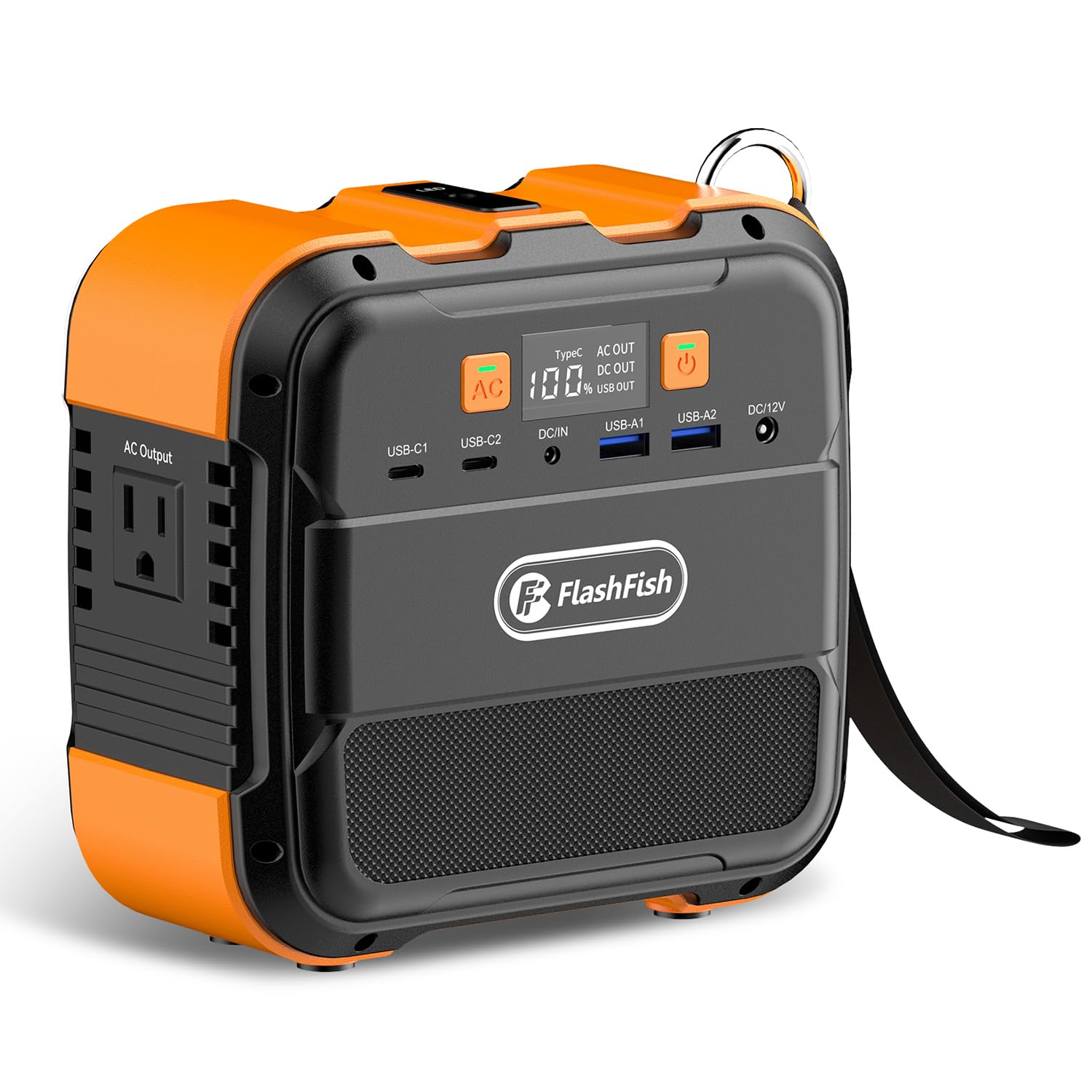
The FF Flashfish 120W Portable Power Station is a small backup battery with a 98Wh capacity and a 120W AC inverter, aimed at campers, travelers, and anyone who needs a bit of power for phones, laptops, and small electronics. It’s not a whole-home backup or a tool for running appliances, but for its size and price, it covers the basics.
What it is and how it’s used
At about the size of a thick book and weighing roughly 3 pounds, the Flashfish is easy to carry in a backpack or stash in a car trunk. The 98Wh capacity translates to about 26,500mAh at 3.7V, which is enough to charge a typical smartphone five to seven times, a tablet two to three times, or a 50W laptop for about an hour and a half. The 120W AC outlet (with a peak of 150W) can run small devices like a laptop charger, a fan, or a camera battery charger, but it will not handle anything with a heating element or a motor. The built-in LED flashlight has three modes (steady, strobe, and SOS) and is bright enough for campsite tasks or emergency use.
Port selection is generous for the size: one AC outlet, two USB-A ports (one rated at 5V/2.4A, the other at 5V/3A), one USB-C port (5V/3A), two DC ports (5.5mm), and a DC input for charging. The USB-C port is output-only, so you can’t charge the unit via USB-C—you’ll need the included AC adapter or a solar panel (not included, but supported). The DC ports are useful for powering 12V accessories like a car fridge or a CPAP machine with the right adapter, though the 98Wh capacity limits runtime.
Performance and real-world expectations
In practice, the Flashfish performs as expected for a budget power station. The AC output is modified sine wave, not pure sine wave, which means it can cause buzzing or overheating in some sensitive electronics like audio equipment or certain medical devices. For laptops and phone chargers, it’s fine. The 120W continuous rating is modest; a laptop charger that draws 90W will work, but a device that spikes above 150W will trip the overload protection. The battery takes about 5-6 hours to charge from empty via AC, which is slow but acceptable for overnight charging. Solar charging is slower and depends on panel wattage and sunlight.
One limitation is the lack of a pure sine wave inverter, which is common in this price range but worth noting if you plan to power sensitive devices. Another is the capacity: 98Wh is small, so it’s best for short trips or as a supplemental battery, not for extended off-grid use. The built-in flashlight is handy but not a substitute for a dedicated headlamp. The unit also lacks a wireless charging pad or a 12V car socket output, which some competitors offer.
How it compares
Compared to larger power stations like the Jackery Explorer 240 or the Goal Zero Yeti 200X, the Flashfish is smaller and cheaper but has less capacity and fewer features. It’s also less powerful than a 300W unit, which can run larger devices like a small TV or a blender. On the other hand, it’s more portable than those options and costs significantly less. If you only need to charge a phone and a laptop, the Flashfish is adequate; if you need to run a CPAP machine all night or power a fridge, you’ll need a bigger unit.
Who it’s for and who it’s not
This power station suits campers who want a lightweight backup for phones, cameras, and lights, or as an emergency kit for short power outages. It’s also useful for students or remote workers who need a few extra charges during the day. However, it’s not for anyone planning to run appliances, power tools, or medical devices that require pure sine wave power. It’s also not ideal for extended off-grid living or for charging multiple devices simultaneously at high draw.
Overall, the FF Flashfish 120W is a basic, affordable power bank with an AC outlet. It does what it claims for small electronics, but its limitations in capacity and inverter type mean it’s best viewed as a supplemental power source rather than a primary solution.