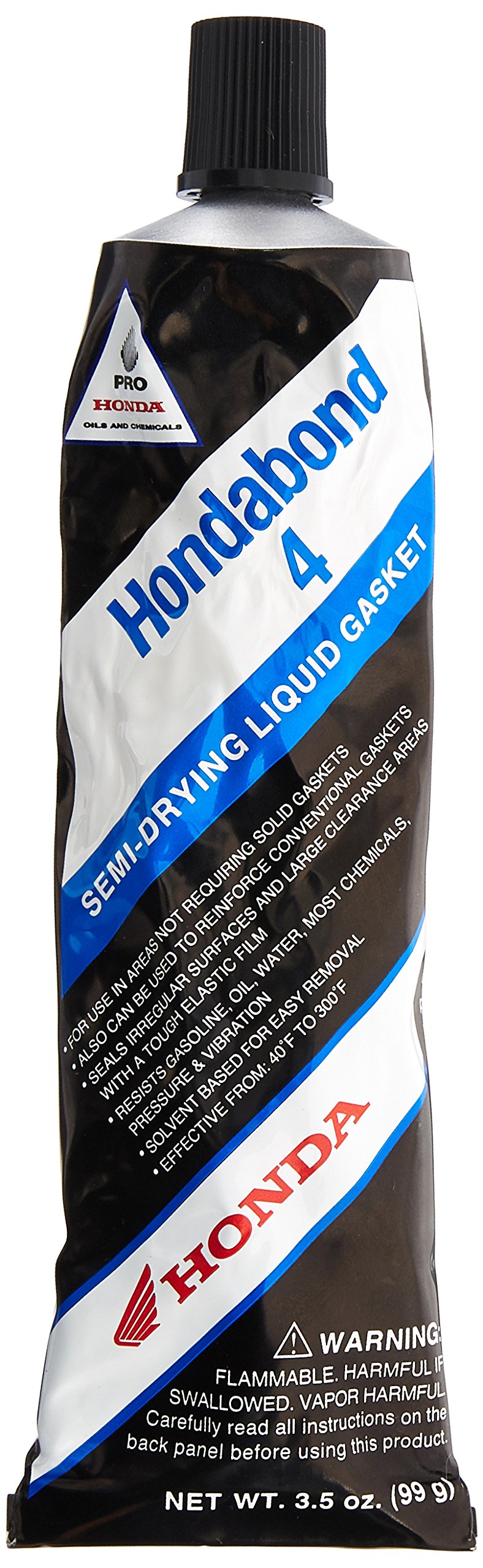
Hondabond 4 is one of those workshop consumables that rarely gets discussed until a job calls for it. It is a liquid gasket from Honda’s own parts catalog, sold under part number 08717-1194, and it is designed to be applied in place of a pre-cut gasket in certain engine assemblies. The tube is small, the labeling is plain, and there is nothing about the packaging that suggests it is anything other than a specialized sealant. That is exactly what it is.
Understanding where this product fits means understanding how modern engines use sealants. Many mating surfaces on Honda engines, particularly on transmission cases, oil pans, and certain cover interfaces, are machined to close tolerances and specified to be sealed with a liquid gasket rather than a fiber or rubber gasket. Hondabond 4 is one of the formulations Honda lists for those applications. It is a room-temperature vulcanizing sealant that cures in the presence of moisture, forming a rubbery, semi-flexible bond between metal surfaces.
The practical appeal is straightforward. A tube of Hondabond 4 lets a technician or home mechanic recreate the factory seal on surfaces where a conventional gasket either does not exist or is not specified. Because it is an OEM product, the formulation matches what the service manual calls for, which matters on engines where the wrong sealant can lead to leaks, poor adhesion, or contamination of oil passages. For anyone working on a Honda engine that specifies a liquid gasket, this removes the guesswork of picking a generic anaerobic or silicone product off a shelf.
Functionally, Hondabond 4 is a non-hardening, solvent-based sealant that remains somewhat pliable after curing. That flexibility is useful on components that expand and contract with heat, such as transmission housings and oil pans. It is applied in a thin, continuous bead, typically around 2 to 3 mm wide, and the parts are assembled while the sealant is still wet. Working time is limited, so the job needs to be organized before the tube is opened. Full cure takes longer than the initial set, and the manufacturer’s guidance on assembly and cure time should be followed rather than improvised.
There are real trade-offs. The most obvious is that this is not a general-purpose sealant. Using Hondabond 4 where a proper gasket is specified, or where an anaerobic flange sealant is required, is a mistake that can cause leaks or make future disassembly difficult. The tube size is modest, which is fine for a single job but not ideal for someone doing repeated work. The solvent odor is noticeable, and ventilation matters. Cleanup requires care, and any excess squeezed out on the inside of an assembly needs to be avoided, since cured fragments can migrate. It also has a shelf life, and an old tube that has thickened or skinned over should be discarded rather than used.
Compared with generic RTV silicone, Hondabond 4 is more application-specific. A conventional high-temp RTV is more forgiving and easier to find, but it is not always the correct chemistry for a given joint. Anaerobic flange sealants are another alternative, and they cure only in the absence of air, which suits rigid, closely machined flanges. Hondabond 4 sits in a middle ground: flexible enough for parts that move slightly, but specified by the manufacturer for particular joints. The right choice depends on the service manual, not on which tube is closest to hand.
Who is this for? It suits someone doing a repair where the factory procedure explicitly calls for Hondabond 4, or a closely related Honda liquid gasket. It also makes sense for a shop that services Honda vehicles regularly and wants the specified product on hand. It is not a good fit for someone looking for a universal sealant to keep in a toolbox for random jobs, nor for a beginner who has not read the service procedure. The product assumes the user knows where it goes, how thick to apply it, and how long to wait before adding fluid.
Expectations should stay realistic. Hondabond 4 is not a leak repair in a tube, and it will not compensate for a warped flange, a damaged mating surface, or improper torque. Used correctly, it does what an OEM sealant is supposed to do: reproduce a factory seal on a specified joint. Used carelessly, it creates a mess and possibly a comeback. The product is a tool in a procedure, not a shortcut around one.