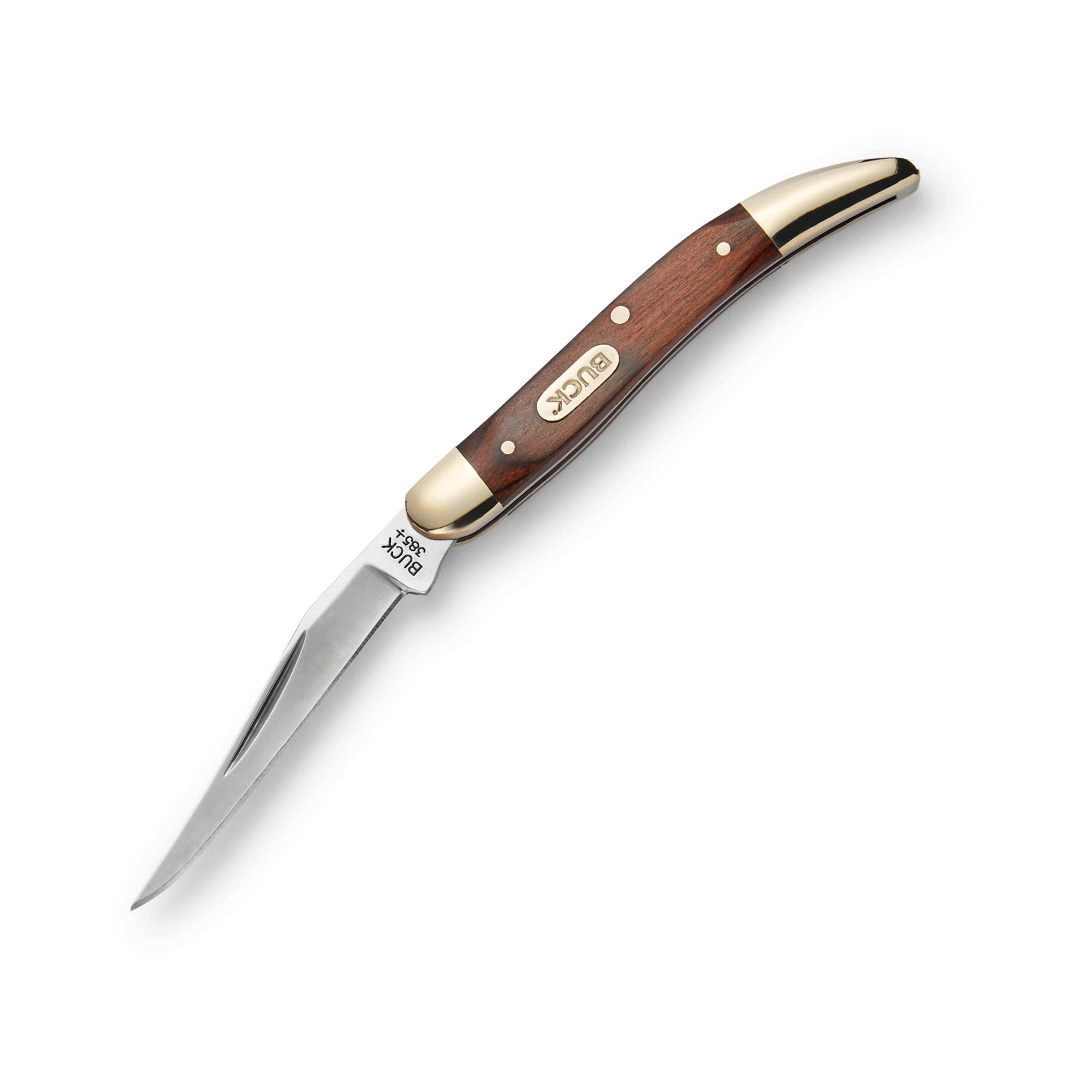
The Buck 385 Toothpick is one of those knives that tends to get overlooked in a catalog full of larger folders. At roughly 0.8 ounces and with a slender, tapered profile, it occupies a specific niche: a knife you carry when you want something almost unnoticeable in a pocket, but still want a functional cutting edge available. It is not a general-purpose workhorse, and Buck does not really position it as one. Understanding what it is designed to do makes the trade-offs easier to accept.
The Toothpick name comes from the shape. The single blade is narrow and tapers to a fine point, giving it a profile closer to a fish fillet or paring knife than a typical drop-point folder. In practice, that shape is useful for detail work: trimming loose threads, opening packages, cutting tape, slicing fruit, cleaning fingernails, or making small adjustments where a larger blade would be clumsy. The woodgrain handle adds a traditional look, and the overall build is simple, with a back lock mechanism typical of Buck’s smaller traditional patterns. There is no pocket clip, no one-handed opening, and no modern locking flourish. It is a two-hand-opening, slip-it-in-your-pocket kind of knife.
For real-world use, this is the knife that lives in a desk drawer, a glovebox, a tackle box, or a pocket on a day when you are not expecting to cut anything substantial. It handles light tasks competently. The narrow blade is thin behind the edge, so it slices cleanly through soft materials. The small size makes it easy to control for precision cuts. It is also light enough that you forget it is there, which is the main reason people buy knives this small. If you need to open a bag of coffee or cut a stray string on a jacket, it does the job without fuss.
The limitations are worth stating plainly. The blade is short, and the fine tip is not built for prying or heavy cutting. The handle is small, so users with larger hands may find a full grip awkward, especially during extended use. The back lock is secure for normal folding-knife tasks, but the design is not intended for hard use, and the lack of a pocket clip means it will settle at the bottom of a pocket or bag. The woodgrain handle looks nice but is not particularly grippy when wet. These are not flaws so much as characteristics of the category. A tiny traditional folder is a compromise by design.
Compared with a small modern folding knife, such as a compact locking folder with a clip and one-handed opening, the 385 trades convenience and grip for a slimmer, lighter, more traditional package. A modern small folder is easier to deploy and more secure in hand, but it is also bulkier and more conspicuous. Compared with a small fixed-blade paring or detail knife, the 385 wins on portability but loses on strength and handle comfort. It sits in a middle ground that appeals to people who value discretion and traditional styling over tactical features.
Who is it for? It suits someone who wants a light, unobtrusive knife for everyday small tasks, a collector of traditional patterns, or a person who keeps a knife in a bag or vehicle for occasional use. It is also a reasonable choice for someone who prefers a two-hand-opening folder for simplicity. Who is it not for? Anyone who needs a knife for camping, food preparation in volume, cardboard breakdown, or any task that requires a substantial handle and blade. It is also not a good fit for users who expect one-handed opening or a pocket clip. Those users will be better served by a small modern folder.
Performance expectations should be realistic. The 385 is not a survival tool or a heavy-duty cutter. It is a light-use pocket knife with a traditional design, and it performs well within that boundary. The steel and heat treatment are consistent with Buck’s general approach, and the simple construction means there is little to go wrong. Maintenance is straightforward: keep the pivot clean, oil it occasionally, and avoid twisting the blade. The woodgrain handle will show wear over time, which is normal for a knife that gets carried.
Overall, the Buck 385 Toothpick is a niche product that does what it is designed to do. It is small, light, and traditional, with a blade shape that favors detail work over heavy cutting. The trade-offs are real, but they are predictable. If your needs match its design, it is a sensible choice. If they do not, there are more capable options in the same general price range.