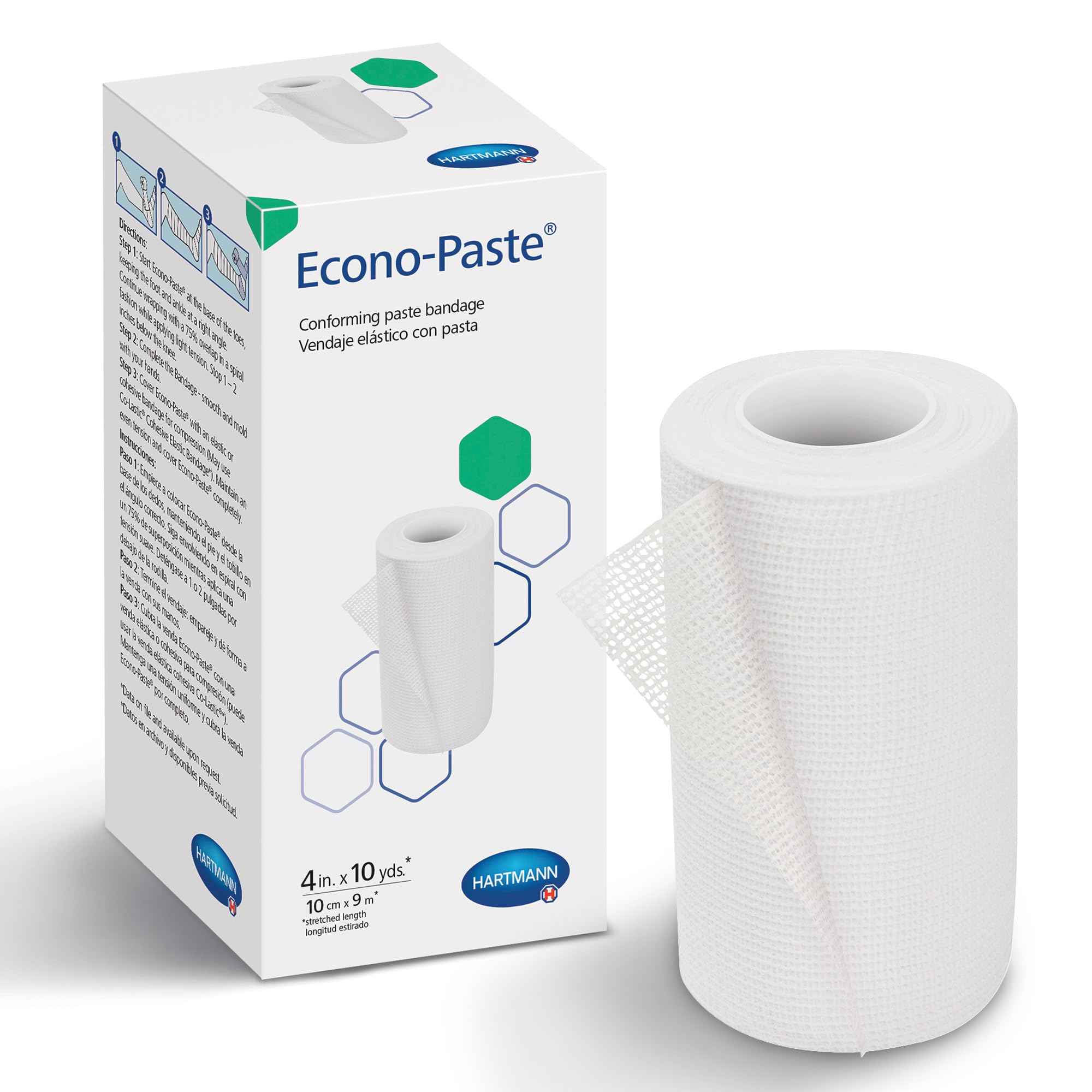
The Econo-Paste Unna Boot Bandage is one of those medical supplies that most people never think about until a clinician hands them one. It sits in the same category as compression stockings and multilayer bandage systems, but its form is distinct: a gauze roll impregnated with a zinc oxide paste that stiffens as it dries. The 4-inch by 10-yard size is a common choice for lower-leg wrapping, and a single roll is enough for one application on most adult legs. This review looks at what the product is, how it behaves in practice, and where it falls short.
In real-world use, an Unna boot is typically applied in a clinic or wound-care setting, not at home by a patient. The roll is wrapped in a spiral from the foot toward the knee, usually over a wound dressing, and the paste dries into a semi-rigid shell. That shell provides continuous, low-level compression and keeps the skin moist, which is why it shows up in venous ulcer treatment and in managing edema. The 4-inch width suits average calves; larger legs may need a wider roll or overlapping technique. The 10-yard length gives enough material for a full wrap with some left over, though the leftover paste tends to dry out once the packaging is opened, so extra material is not always reusable.
Functionally, the appeal is simplicity. There is no pump, no gauge, no multi-layer kit to assemble. The paste is already on the gauze, so application is a matter of wrapping with consistent tension. The zinc oxide formulation is the traditional one, and the bandage stiffens within hours to provide support. Because it is a single roll, it is inexpensive relative to multi-component compression systems, and that is clearly where the “Econo” name comes from. For clinics that apply these regularly, the per-application cost matters, and a single-roll format keeps inventory straightforward.
Performance expectations should be realistic. An Unna boot is not a high-compression device in the way a graduated compression stocking is. It provides support and mild compression, and its rigidity helps limit ankle motion, but it will not deliver the measured pressures of a multilayer system. It also does not breathe well once dry, and many patients describe itching or a sensation of tightness, particularly in warm weather. The paste can ooze slightly at the edges during the first hours, and the bandage can loosen or crack if the wrap tension was uneven. These are known characteristics of the category rather than defects specific to this brand, but they are worth stating plainly.
The most significant trade-off is that the product requires trained application and is not something a patient can reasonably self-apply with good results. Inconsistent tension is the usual failure mode, and a poorly applied Unna boot can cause pressure points or fail to control edema. Removal is also a clinical task, typically done with bandage scissors, and the dried paste can adhere to hair and skin. For anyone expecting a peel-and-stick convenience, this is not that product.
Compared with alternative categories, the Unna boot sits between simple elastic wraps and full multilayer compression bandage kits. Elastic wraps are cheaper and reusable but provide inconsistent compression and no moisture management. Multilayer kits offer more controlled, graduated compression and are often preferred for active venous ulcer treatment, but they cost more and involve more steps. The Unna boot’s niche is the middle ground: a single, paste-impregnated roll that offers support and a moist wound environment at a low unit cost. It is also sometimes compared with short-stretch bandages, which are reusable and washable but require separate wound dressings and do not provide the same paste-based skin contact.
Who is this suitable for? Primarily clinicians and wound-care providers who are familiar with Unna boot technique and want a low-cost, single-roll option for appropriate patients. It suits situations where mild compression and a moist environment are the goal, and where follow-up visits for reapplication are feasible. It is not suitable for patients who need measured high compression, for those who cannot tolerate occlusive wraps, or for anyone hoping to manage a venous ulcer without clinical oversight. Patients with arterial insufficiency should not use this type of bandage without medical clearance, as compression can be harmful in that population.
Overall, the Econo-Paste Unna Boot is a functional, no-frills product that does what the category promises. It is not a premium item, and it does not try to be. The paste dries, the wrap stiffens, and the cost stays low. The limitations are inherent to Unna boots generally: application skill matters, comfort is middling, and the product is not a substitute for a properly assessed compression plan. Buyers should treat it as a clinical tool with a specific role rather than a general-purpose bandage.