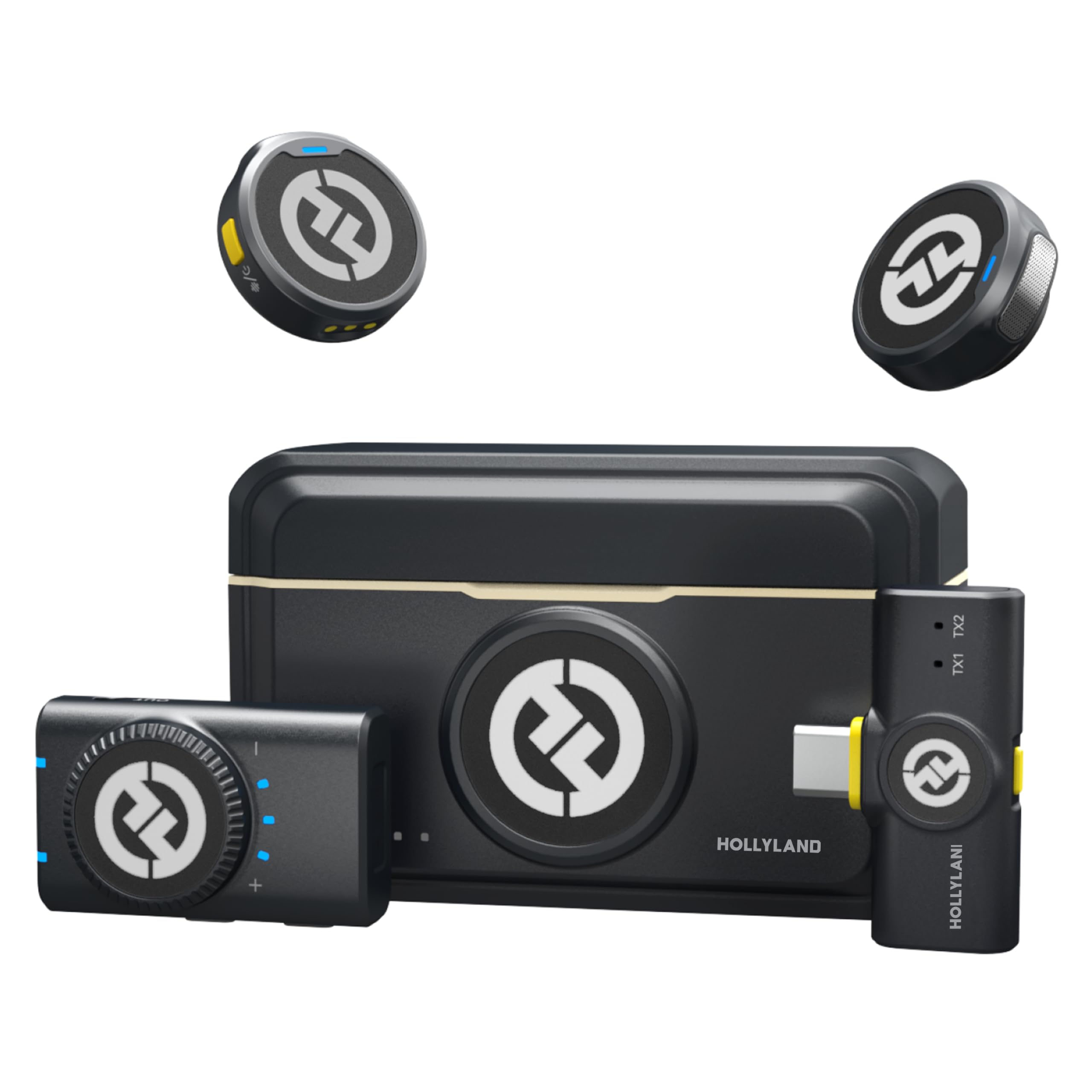
The Hollyland Lark M2 is a wireless microphone system that tries to cover a lot of ground at once. It ships with two transmitters, a camera receiver, and a USB-C receiver, so you can record to a camera and a phone or computer without swapping gear. That flexibility is the main draw, but it also means the system carries some compromises that are worth understanding before you buy.
In real-world use, the Lark M2 is aimed at solo creators who move between setups. A typical week might involve shooting a vlog with a mirrorless camera, recording a voiceover directly into a laptop, and then doing a quick phone interview for social media. Having both receivers in the box means you can leave one attached to the camera and keep the USB-C receiver in your bag for phone or computer work. The transmitters are small and clip on easily, and the included windscreens help outdoors, though they add a bit of bulk.
Key features are straightforward: 48kHz/24-bit audio recording, a claimed 300-meter range, noise cancelling, and up to 40 hours of use with the charging case. The 48kHz/24-bit spec is standard for this class and should satisfy most content needs. The 300-meter range is optimistic in real conditions—walls, bodies, and interference will cut that down significantly. In open spaces you might get close to half that before dropouts, which is still plenty for most shoots. Noise cancelling is a basic high-pass filter rather than advanced processing; it helps with low-frequency rumble like air conditioning or traffic, but it won’t remove sudden noises or voices in the background.
Battery life is a strong point. The transmitters run for several hours on a charge, and the charging case extends total use to around 40 hours. That means you can shoot a full day and recharge overnight without worrying. The case itself is pocketable and holds both transmitters and one receiver, though the second receiver needs to be carried separately.
Audio quality is good for the price. Voices come through clear and natural, with enough detail for YouTube, vlogging, and streaming. The built-in microphones are sensitive, so you’ll want to use the gain controls to avoid clipping loud speakers. There’s no onboard recording, so if the wireless signal drops, you lose that audio. That’s a trade-off compared to systems with internal recording, which offer a safety net.
One limitation is the lack of advanced features like onboard recording or interchangeable lavalier microphones. The transmitters have built-in mics only, so you can’t clip a discreet lav to a shirt. For interviews where you want a more professional look, that’s a drawback. Also, the noise cancelling is not adjustable; it’s either on or off, and the effect is subtle.
Compared to similar systems like the Rode Wireless GO II or DJI Mic, the Lark M2 holds its own on battery life and dual-receiver convenience. The Rode offers onboard recording, which is a significant advantage for critical work, while the DJI Mic has a more polished app and case design. The Lark M2 sits in the middle: it’s less expensive than those options but lacks some pro features.
Who is it for? It suits vloggers, YouTubers, and streamers who need a reliable, easy-to-use wireless mic that works with both cameras and phones. It’s also good for small teams doing interviews or presentations, thanks to the two transmitters. Who is it not for? Professional videographers who need onboard recording or lavalier options should look elsewhere. Also, if you only record on a phone, you’re paying for a camera receiver you may never use.
Overall, the Hollyland Lark M2 is a practical choice for creators who value flexibility and battery life over advanced features. It’s not the most robust or feature-packed system, but it handles the basics well. Just keep your expectations realistic about range and noise cancelling, and consider whether you need the safety of onboard recording before committing.