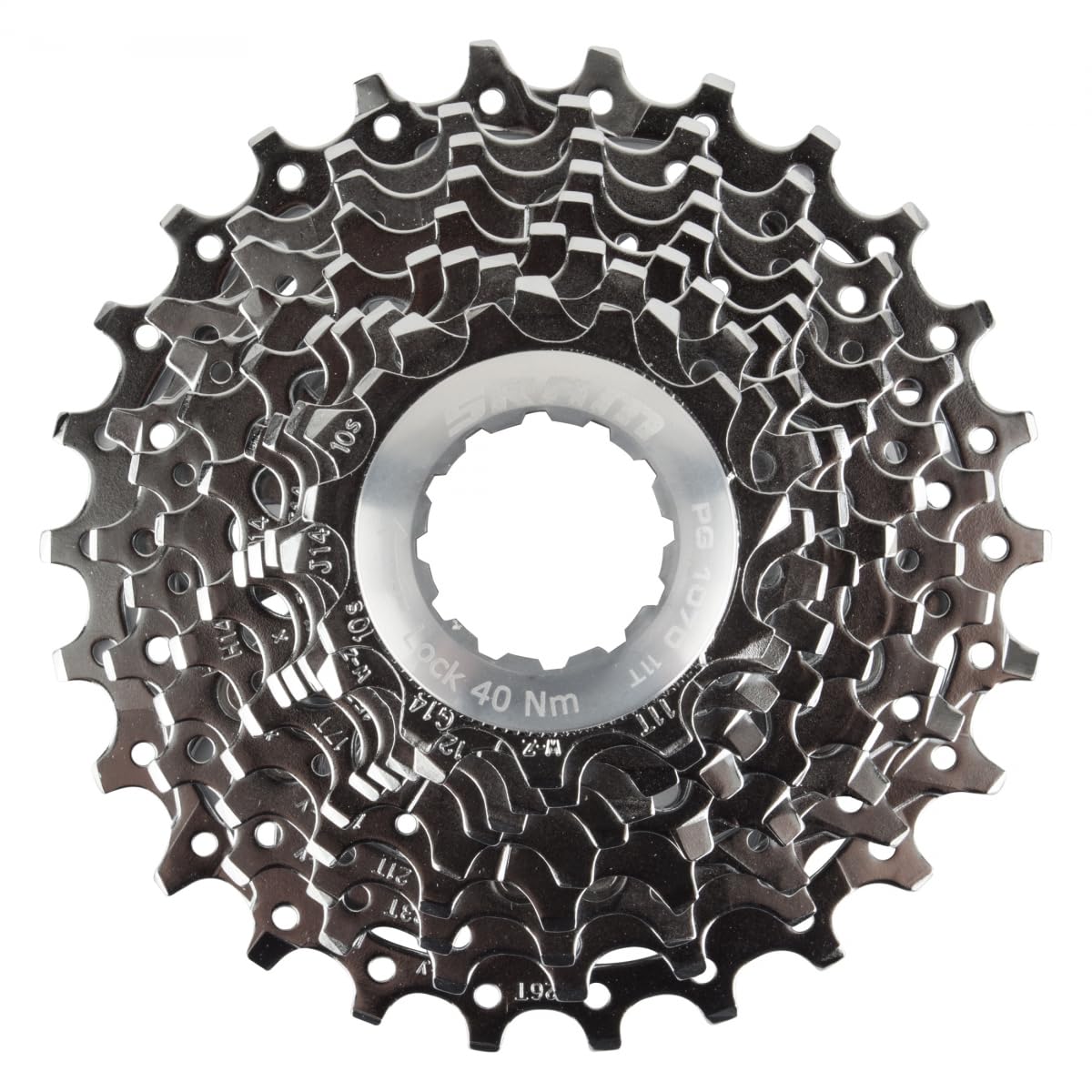
The SRAM PG1070 sits in the middle of SRAM’s 10-speed cassette range, below the lighter and more expensive PG1090 and above the entry-level PG1050. This particular version, with an 11-26T spread, is the close-ratio variant aimed at riders who want small jumps between gears rather than a wide climbing range. It’s a part that rarely gets much attention on its own, but the choice of cassette has a real effect on how a bike feels to ride, and the 11-26T is a specific tool for a specific job.
In practice, the PG1070 is most often found on road bikes and cyclocross builds from the early-to-mid 2010s, and it remains a common replacement part for anyone maintaining a 10-speed SRAM drivetrain. It slots onto a standard Shimano/SRAM-style freehub body, so it works with a wide range of wheels and is straightforward to fit with a cassette tool and chain whip. Riders typically buy it either to replace a worn cassette of the same ratio or to change gearing—for example, swapping a wide-range cassette for a tighter one for crit racing or flat-road riding.
The functional details are conventional but worth spelling out. The cassette uses SRAM’s PowerGlide II tooth profile, which is designed to shift smoothly under load, and the sprockets are made from steel with a nickel-chrome plating for corrosion resistance. The 11-26T spread runs 11, 12, 13, 14, 15, 16, 17, 19, 21, 23, 26, giving closely spaced gears through the middle of the range. That is the point of this cassette: the jumps between the smaller cogs are mostly single-tooth, which keeps cadence changes small when you shift. For a rider who spends most of their time on flatter terrain or in a paceline, that closeness is genuinely useful. The largest sprocket is 26 teeth, which is modest by modern standards and reflects the era and intended use.
Weight is reasonable rather than remarkable. SRAM lists the PG1070 in this size at roughly 240–250 grams, which is heavier than the hollow-pinned PG1090 but lighter than the cheapest steel options. The steel construction means it wears well; riders who keep their chain clean and replace it before it stretches tend to get good mileage out of it. Shifting quality is solid with a compatible SRAM 10-speed chain and derailleur, though it is not the crispest cassette in the range—the higher-tier models do shift a little more cleanly under hard load. It is worth being realistic here: this is a workmanlike component, not a performance upgrade in itself.
The obvious limitation is the gearing. An 11-26T cassette is not suitable for hilly terrain unless the rider is strong or running a small enough chainring. On a standard 53/39 crankset, a 26-tooth largest sprocket gives a bottom gear of around 39×26, which is a hard gear for steep climbs. Riders in mountainous areas will want something like an 11-28T or 12-30T instead, and this cassette simply is not the right choice for them. There is also the broader 10-speed question: SRAM has largely moved its road groups to 11- and 12-speed, so the PG1070 is best seen as a maintenance part for existing 10-speed bikes rather than something to build a new drivetrain around.
Compared with a wide-range cassette such as an 11-32T, the 11-26T trades climbing ease for tighter gear spacing. Compared with the PG1090, it gives up some weight and shift refinement in exchange for a lower price. Compared with third-party options, it offers the reassurance of matching SRAM’s own tooth profiling, which matters if the rest of the drivetrain is SRAM. None of these comparisons make it stand out; they simply place it where it belongs.
Who is it for? Riders maintaining a 10-speed SRAM road or cyclocross bike who want close ratios for flat or rolling terrain, crit racers, and anyone who values small cadence steps over a wide range. It also suits riders on compact or sub-compact cranksets who can afford to give up the biggest sprocket. Who is it not for? Anyone facing sustained steep climbs, loaded touring, or gravel riding with significant elevation—those riders should look at wider cassettes. Riders on 11-speed or 12-speed systems cannot use it at all. And anyone expecting a noticeable performance gain from the cassette alone will be disappointed; it is a sensible, durable replacement part, and it should be judged on that basis.