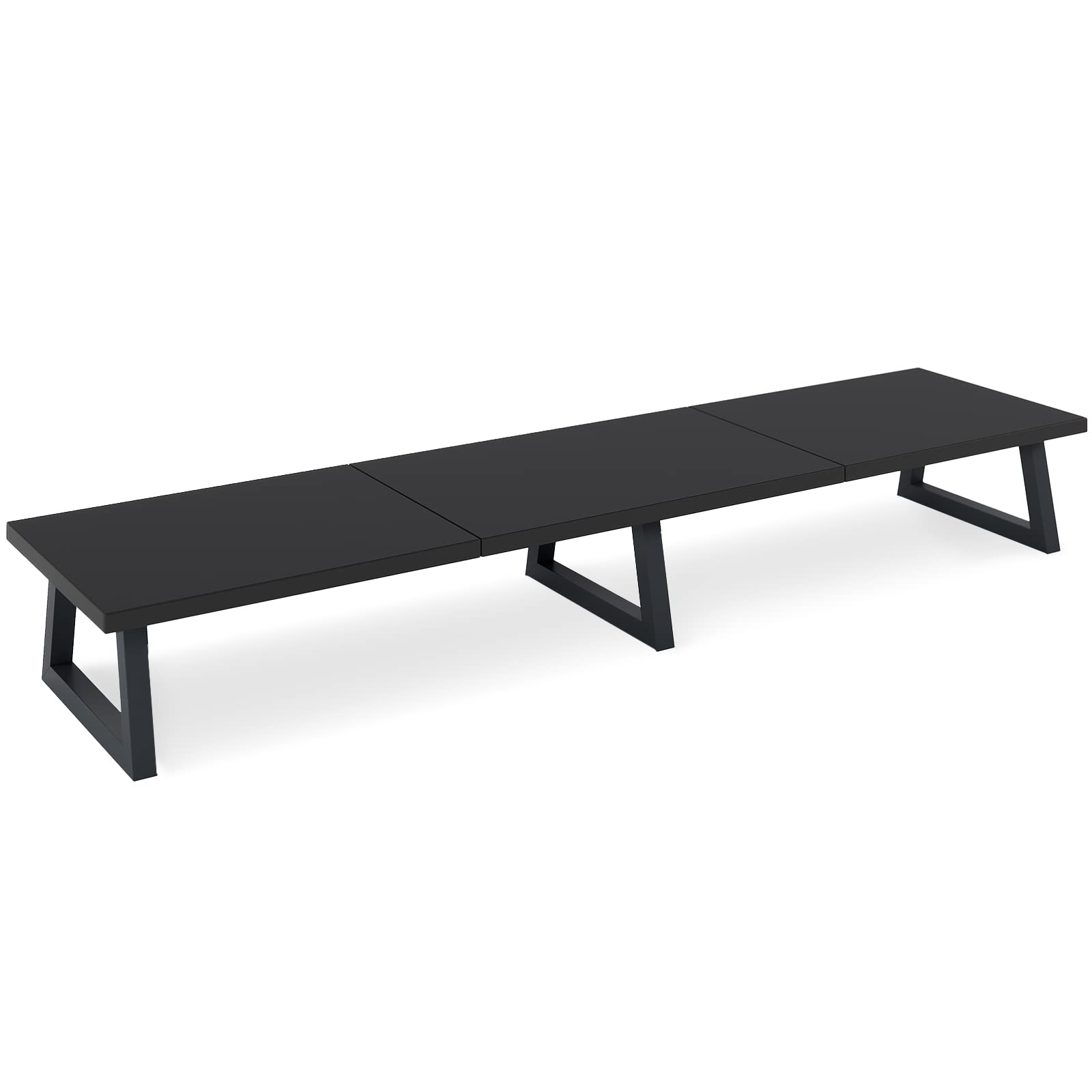
The TEAMIX 42-inch monitor riser belongs to a category of desk furniture that sits somewhere between a monitor stand and a low shelf. It is a wide, flat platform intended to lift two displays, a TV, or a laptop to a more workable height while creating usable storage space underneath. At 42 inches across, it is noticeably larger than the typical single-monitor riser, which changes both what it can hold and how much desk it occupies.
The most common use case is straightforward: someone with a dual-monitor setup on a standard desk wants the screens raised to eye level without drilling into the wall or buying a full monitor arm. The shelf spans both displays, and the space below becomes a place for a keyboard, a stack of notebooks, a small dock, or a closed laptop. Some buyers use it for a TV in a bedroom or dorm, where a low stand needs a bit more height. Others put it on a standing desk to lift a laptop to a more comfortable viewing angle while keeping the area beneath clear.
Functionally, the design is simple. It is a single flat surface supported at each end, with a fixed height. There are no gas springs, no adjustable legs, and no cable management channels built in. That simplicity is part of the appeal for people who want a stable, no-assembly-hassle platform, but it also means the riser does one thing and does not adapt. The load capacity and stability depend heavily on how the legs are constructed and how evenly weight is distributed, and with a 42-inch span, the middle of the shelf is the area to watch. A heavy monitor placed dead center will flex more than two lighter monitors positioned toward the ends.
In real-world use, the shelf works best when it is treated as a fixed-height platform rather than a precision ergonomic tool. The height is what it is, so whether it lands at a comfortable viewing level depends on your chair, your desk height, and your own proportions. Taller users may find it too low; shorter users may find it close to right. This is the central limitation of any fixed riser, and it is worth being honest about: if you need to dial in monitor height to the inch, an adjustable arm or a riser with selectable leg heights is a better fit. The TEAMIX is a commitment to one height.
Another trade-off is footprint. A 42-inch shelf eats a meaningful amount of desk width. On a compact desk, it can crowd out speakers, a lamp, or a second work zone. The storage space underneath is genuinely useful, but it only pays off if the items you store there fit within the clearance and if you do not need that vertical space for anything else. The open design also means whatever sits below is visible, so it does not hide clutter the way an enclosed drawer would.
Compared with a monitor arm, the riser is cheaper, requires no clamping or drilling, and does not depend on desk edge thickness. Compared with a smaller single-monitor stand, it offers more surface and a more unified look for two screens, but it is heavier and less flexible. Compared with a height-adjustable sit-stand converter, it is far simpler and far less expensive, but it will not move with you. Each of these alternatives solves a different problem, and the riser is the right answer mainly for people who have already decided they want a fixed shelf.
Who it suits: people with a wide desk and a dual-monitor or TV setup who want a stable, fixed-height lift and can use the space underneath. It also works for laptop users who want the screen raised and a place to tuck a keyboard.
Who should look elsewhere: anyone who needs precise height adjustment, works on a narrow desk, has very heavy displays, or wants integrated cable management. Those users are better served by a monitor arm or an adjustable riser.
Overall, the TEAMIX 42-inch riser is a practical, low-complexity piece of desk furniture. It does not try to be more than a shelf, and that is fine as long as the fixed height and wide footprint match your setup. Measure your desk, check the clearance you need underneath, and confirm the height works for your seating position before buying. If those numbers line up, it is a sensible, unglamorous addition; if they do not, no amount of storage space will make up for an uncomfortable viewing angle.