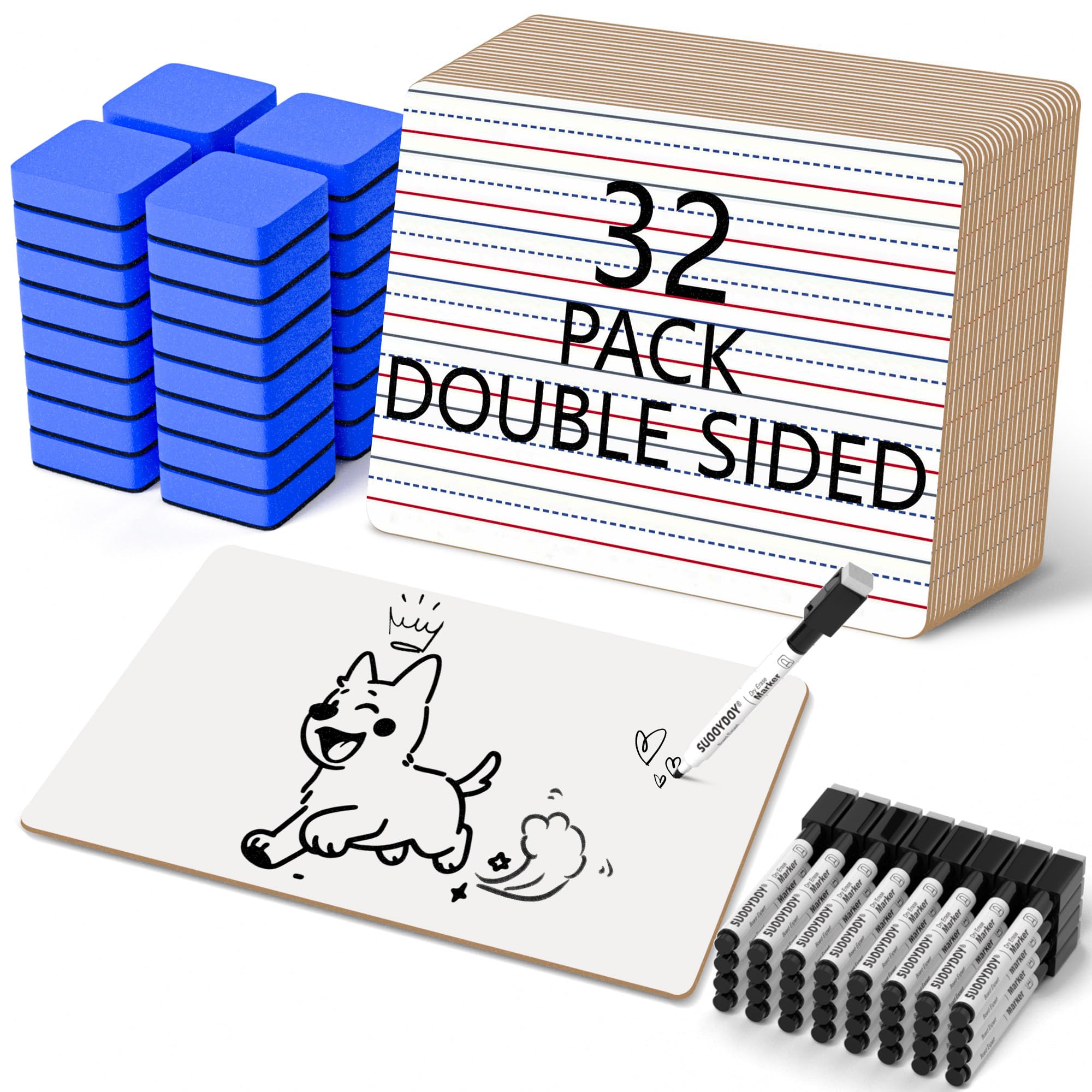
Classroom sets of small whiteboards have become a common sight in elementary and middle school rooms, largely because they let a teacher see every student’s work at a glance instead of waiting for raised hands. This 32-pack of 9″x12″ double-sided boards is aimed squarely at that use case, with one side left blank and the other printed with ruled lines for handwriting and sentence work. The boards are thin, lightweight, and clearly intended to be handed out, wiped down, and stacked at the end of a lesson rather than mounted on a wall.
The lined side is the detail that separates this set from a generic batch of blank mini boards. Ruled lines give younger students a guide for letter sizing and spacing, which matters during handwriting practice, spelling dictation, or short written responses. Flip the board over and you have a plain surface for math problems, quick diagrams, or group brainstorming. In a real classroom, that dual function means one purchase covers several activities, and a teacher does not need to sort boards by type before a lesson.
Size is worth thinking through before buying. At 9 by 12 inches, these are smaller than a standard sheet of notebook paper and noticeably smaller than the 12″x18″ boards some classrooms use. For a single math problem, a short sentence, or a quick check for understanding, the size is fine. For longer writing tasks or multi-step equations, students will run out of room quickly and may need to erase mid-thought. The compact size is also what makes a 32-pack manageable to store and pass out, so it is a trade-off rather than a flaw.
Functionally, the boards are double-sided with a smooth coated surface, and they wipe clean with a standard dry erase eraser or a felt cloth. The lined side uses printed rules rather than embossed guides, so the lines are visual only and will not help students feel where to write. Expect the usual wear patterns: ghosting if marker is left on for days, edge fraying over time, and the occasional board that warps slightly if stored near a heat source. None of this is unusual for inexpensive classroom whiteboards, but buyers should not expect the rigidity or longevity of a framed, porcelain-on-steel board.
The 32 count is a practical number for a typical class of 25 to 30 students, leaving a few spares for damage or for a student who joins mid-year. It also suits a homeschool co-op, a tutoring center, or a family with several children. What the pack does not include is anything to write or erase with, and no storage solution. Markers and erasers are a separate purchase, and for a full class that cost can approach the price of the boards themselves. A simple plastic bin or a file organizer works for storage, but plan for it.
Compared with individual lapboards sold singly or in smaller packs, this set wins on per-unit cost and convenience for group settings. Compared with a larger framed whiteboard mounted on a wall, it offers portability and the ability for every student to work simultaneously, but it gives up surface area and durability. Compared with paper worksheets, the boards save paper and allow instant correction, though they do not produce a record of student work unless a teacher photographs the boards before erasing. That last point matters for assessment, and some teachers pair the boards with a quick photo or a written exit ticket.
These boards are a good fit for elementary and middle school teachers, tutors, homeschool parents, and anyone running small-group instruction who wants a low-cost way to get every student writing and showing work. They are also reasonable for speech therapy, occupational therapy handwriting practice, and church or club activities that need reusable writing surfaces. They are less suitable for high school or college students who need room for full-page notes, for anyone wanting a permanent wall-mounted board, or for settings where the boards will be handled roughly by adults without supervision. Buyers who need long-term durability or a professional-looking surface should look at framed melamine or porcelain boards instead.
Overall, this is a utilitarian classroom supply rather than a premium product. It does the specific job it was designed for, the lined side adds genuine instructional value for younger writers, and the price per board is low enough that replacing a few damaged units over a school year is not painful. The lack of included markers and erasers, the modest surface area, and the thin construction are real limitations, but they are consistent with what this category of product typically offers. For a teacher building a class set from scratch, it is a sensible starting point.