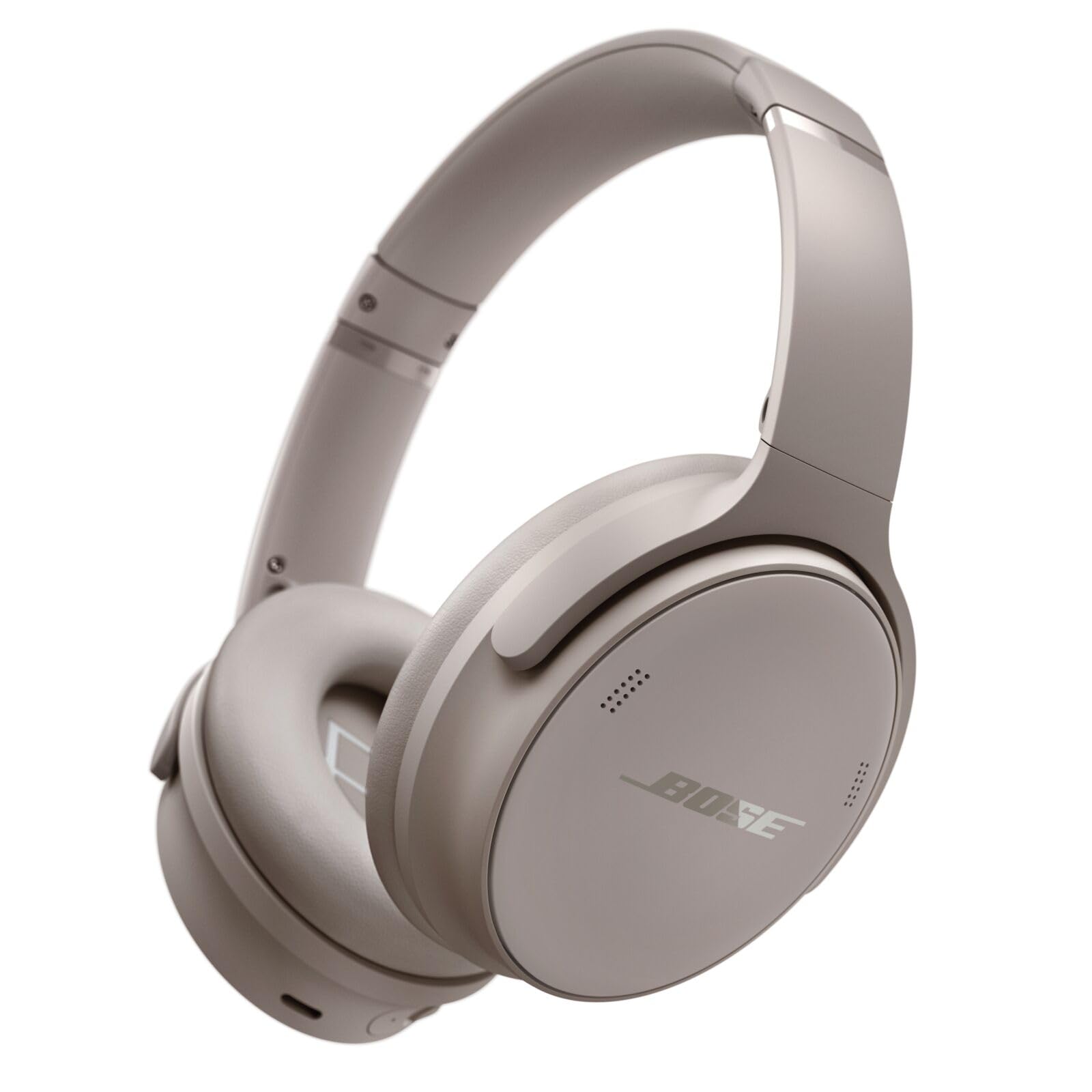
The Bose QuietComfort Headphones occupy an interesting spot in Bose’s lineup. They sit below the flagship QuietComfort Ultra in price and ambition, but above the entry-level options, and they carry a name that has decades of recognition behind it. The question for most buyers is whether the standard QuietComfort still makes sense in 2024 and beyond, or whether it has become the model you settle for when the Ultra is out of budget. The answer depends heavily on how you plan to use them.
The QuietComfort line has always been aimed at people who spend long stretches in noisy environments — commuters, frequent flyers, open-plan office workers, and students trying to carve out quiet in a dorm. That remains the core use case here. The over-ear design, the plush earcups, and the active noise cancelling all point toward extended wear rather than short bursts of listening. In practice, these are headphones you put on at the start of a flight and forget about until landing.
What you actually get
- Active noise cancelling with adjustable levels, plus an aware mode that pipes in surrounding sound
- Bluetooth wireless with multipoint pairing for two devices at once
- Built-in microphone array for calls and voice assistants
- USB-C charging with a claimed 24 hours of playback
- A deliberately bass-forward tuning that Bose has leaned into for years
- Physical buttons rather than touch controls, which is either a feature or a drawback depending on your preferences
The noise cancelling is the headline, and it performs well in the situations most people care about. Low-frequency drone — engine noise, HVAC hum, the rumble of a train — is reduced substantially. Voices and higher-frequency sounds are attenuated but not eliminated, which is typical of the category. If your main complaint is a noisy neighbor or a chatty coworker, these will take the edge off but won’t create a silent bubble. Bose’s own Ultra model does a better job with adaptive cancellation and spatial audio, but it also costs considerably more.
The 24-hour battery claim holds up reasonably in mixed use, though you should expect less if you run noise cancelling at maximum and take a lot of calls. Charging over USB-C is convenient and means one less cable to carry, though there is no fast-charge trick that gets you hours of playback in minutes — a feature some competitors now offer.
Where the experience gets uneven
Comfort is genuinely good. The earcups are soft, the clamping force is moderate, and the headband distributes weight without hotspots during multi-hour sessions. The sandstone colorway is a nice departure from the usual black and grey, though lighter fabrics tend to show wear and smudges over time, so it’s worth thinking about how you’ll treat them.
The sound signature is the most divisive element. The deep bass emphasis works well for pop, hip-hop, and electronic music, and it gives movie soundtracks some weight. But it can overwhelm acoustic recordings, podcasts, and classical music, where the low end starts to bleed into the mids. There is an EQ in the companion app, and it helps, but you’re correcting a house sound rather than starting from neutral. Listeners who want accuracy first should look at options from Sony or Sennheiser in a similar price bracket, which tend to offer a flatter default tuning and, in Sony’s case, more granular control over noise cancelling.
Call quality is serviceable rather than impressive. In quiet rooms the mic array is clear enough for meetings and casual calls. In windy or crowded outdoor settings, the person on the other end will notice background noise creeping in. That’s a common limitation across over-ear Bluetooth headphones, but it’s worth flagging if calls are a primary use.
Build quality is solid without feeling premium. The hinges and headband are mostly plastic, and while they’ve proven durable across generations, the materials don’t match the price point as convincingly as some metal-and-fabric competitors. The folding design does make them easy to stash in a bag, which matters for travel.
Who should consider these
These headphones make the most sense for people who prioritize comfort and effective low-frequency noise cancelling over audiophile tuning. If you fly often, work in a noisy office, or just want a dependable pair for long listening sessions and you like a bass-heavy sound, the QuietComfort delivers without much fuss. The physical buttons are also a quiet advantage for anyone who dislikes touch gestures misfiring in cold weather or with gloves on.
They’re less suitable for critical listeners who want neutral sound, for people who take a lot of calls in loud environments, and for anyone who wants the newest features Bose offers. If spatial audio, adaptive cancellation, or a more refined design matter to you, the Ultra is the better fit despite the higher price. And if you’re primarily comparing against cheaper mid-range options, it’s worth auditioning both, because the gap in noise cancelling is smaller than the gap in price.
Overall, the QuietComfort Headphones are a competent, comfortable pair with a clear personality. They’re not the most advanced or the most neutral option available, but they do the core job — quieting the world and staying comfortable while doing it — reliably enough to justify consideration for the right buyer.