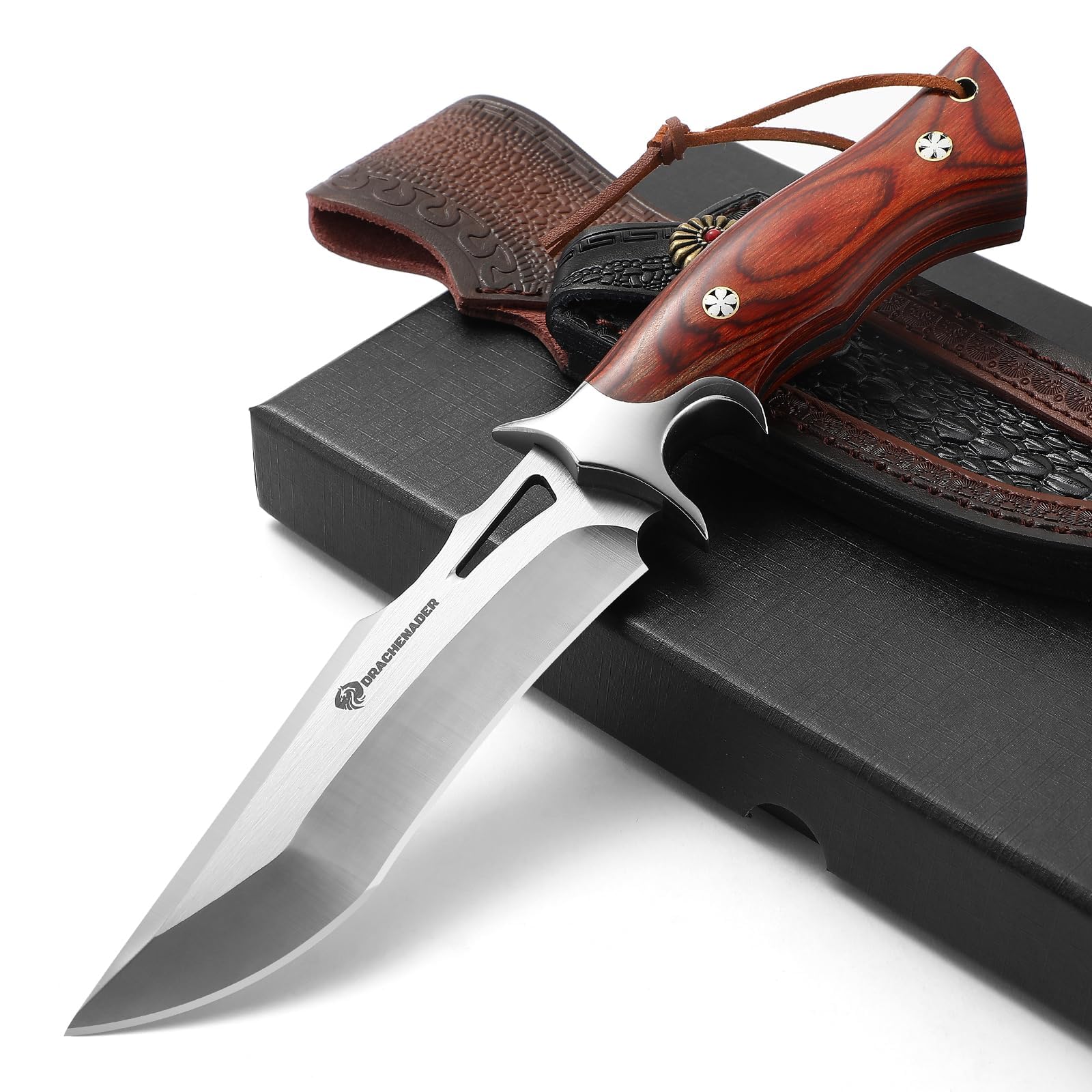
The Drachenader 10.24-inch fixed blade sits in an increasingly crowded segment of the knife market: full-tang bushcraft knives built around a premium powder metallurgy steel, paired with a leather sheath and a wood handle. On paper, the combination of Bohler M390 steel and a 10.24-inch overall length puts it in direct competition with knives costing considerably more. Whether the execution matches the specification is a separate question, and one worth examining before treating the spec sheet as the whole story.
M390 is a legitimate choice for a knife of this type. It is a high-vanadium powder steel known for strong wear resistance and good corrosion resistance, which matters for a tool that will see damp wood, soil, and the occasional forgotten night outside. In practical bushcraft use, that translates to edge retention that holds up through feather-sticking, batoning kindling, and general camp chores without constant honing. The trade-off is that M390 is not a steel you touch up casually on a river stone; it rewards owners who carry a diamond sharpener and know how to use it. Buyers expecting to sharpen on a coffee mug will find it frustrating.
The 10.24-inch figure refers to overall length, which places the blade somewhere in the four-to-five-inch range depending on how the handle is proportioned. That is a sensible size for a general-purpose camp knife: long enough to process wood and prepare food, short enough to choke up on for finer work. The full-tang construction is the right call for a knife intended to take light batoning, and it gives the handle a solid, planted feel that partial-tang knives in this price bracket often lack.
The red wooden handle is the most visually distinctive element, and it is also where expectations should be calibrated. Wood scales look good and offer a warmer grip than synthetic materials in cold weather, but wood moves. Humidity, temperature swings, and repeated soaking can cause scales to shift or develop small gaps over time, and a non-slip finish applied at the factory tends to wear at the points of heaviest contact. The handle shape appears designed for a neutral grip with a modest palm swell, which suits most hand sizes but will not flatter everyone. Users with very large hands may find the handle slightly short for comfortable extended chopping.
In real-world use, this is a knife that fits the pattern of a camp and trail tool rather than a dedicated chopper or a skinning knife. It is the kind of blade that gets used to make tent pegs, split small rounds, shave tinder, and cut cordage — tasks where a sturdy fixed blade with a controllable edge beats a folding knife. The leather sheath is a practical inclusion and generally preferable to nylon for a knife of this style, though leather requires occasional conditioning and should not be stored damp. Left wet in the sheath, even a corrosion-resistant steel will eventually show spots.
Compared with the ubiquitous Scandinavian-style bushcraft knives — typically carbon or simple stainless steel, thinner stock, and a scandi grind — the Drachenader takes a different approach. The M390 and fuller stock suggest a knife built for durability and edge life rather than the fine carving geometry that a scandi grind excels at. Neither approach is universally better; a scandi-ground knife is easier to sharpen in the field and slices wood more cleanly, while a knife like this trades some of that finesse for toughness and wear resistance. Buyers should decide which they value more before choosing between the categories.
There are limitations worth stating plainly. The premium steel drives up the price relative to comparable knives in 14C28N or AUS-8, and for many casual users those steels are more than adequate and far easier to maintain. The wooden handle, while attractive, introduces a maintenance consideration that synthetic-handled knives avoid. And the overall length, while versatile, sits in a middle ground — too large for a pocketable backup, too small for serious chopping — so it works best as a primary camp knife rather than a do-everything tool.
This knife suits campers, hikers, and bushcraft hobbyists who want a durable fixed blade with strong edge retention and are willing to maintain both the steel and the handle. It also fits users who prefer natural materials and traditional leather over synthetics. It is less suitable for people who want a low-maintenance knife they can neglect, for those who sharpen only occasionally and with basic equipment, or for anyone expecting a single knife to handle heavy chopping. As an editorial observation rather than a hands-on verdict, the Drachenader reads as a thoughtfully specified knife whose real-world appeal will depend heavily on how well the handle holds up and how the heat treatment was executed — details that no spec sheet can confirm.