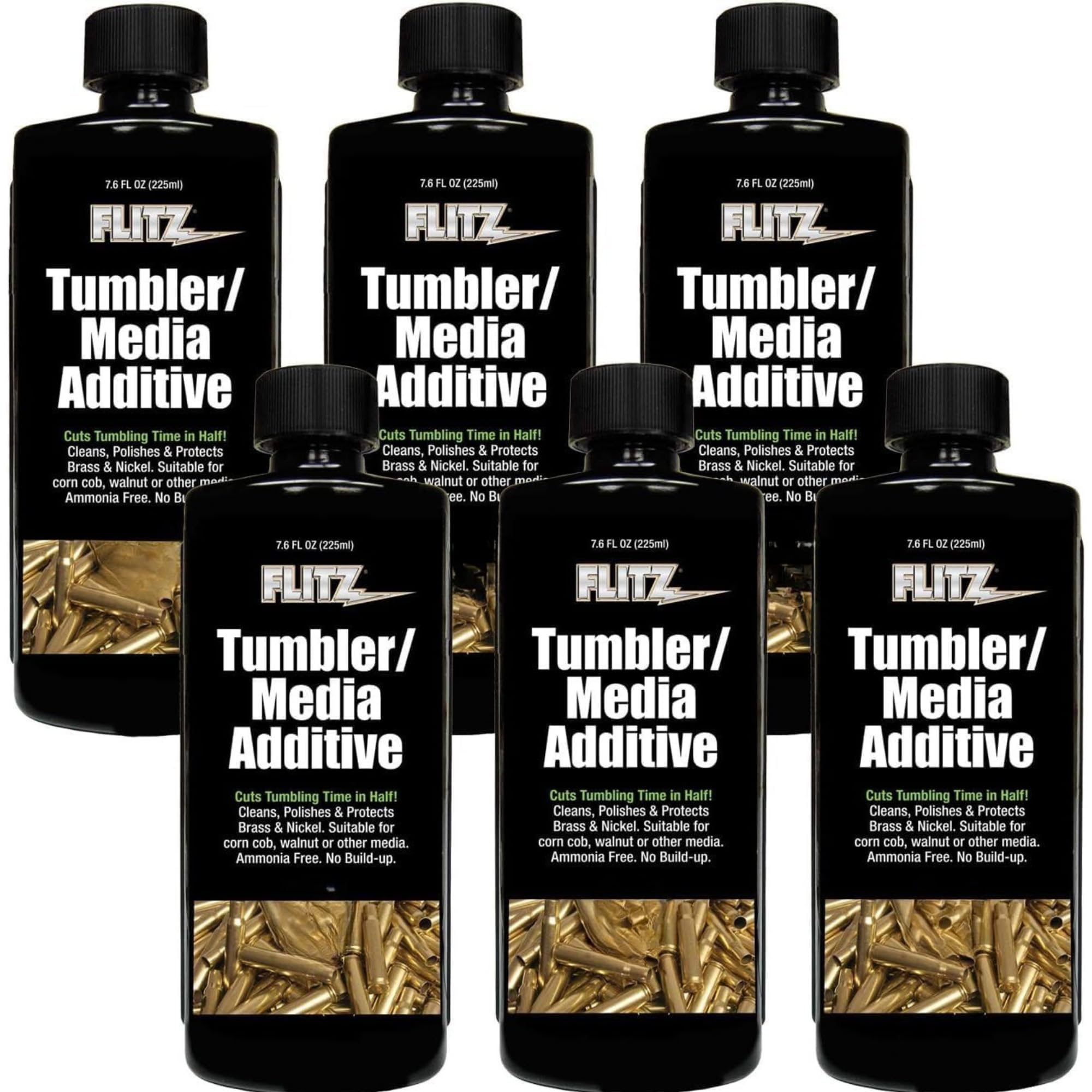
Flitz sells its Tumbler Media Additive as a way to get brighter results from a dry tumbling setup without relying on ammonia. The product is a 7.6-ounce bottle of additive, and this listing is a six-pack, which is a lot of additive for most home reloaders. It is aimed at people running rotary or vibratory tumblers with corn cob or walnut media, primarily for brass cartridge cases, though it also sees use on other metals. Understanding what it does and does not do is the key to deciding whether a six-pack makes sense.
In practice, the additive is poured into the tumbling media before or during a cycle, usually a capful or two per batch depending on drum size and how dirty the brass is. It works as a polishing compound carried by the media rather than as a cleaning solvent in a wet bath. That distinction matters: it will not replace a wet stainless steel pin process for badly tarnished or soot-caked cases. What it does well is put a shine on cases that are already reasonably clean and keep media from loading up with dust and residue. Users typically run a batch for a couple of hours in a vibratory tumbler or longer in a rotary unit, then separate the brass from the media.
The ammonia-free formulation is the headline feature, and it is a legitimate one. Ammonia is common in brass polish, and there is a persistent concern in the reloading community that ammonia can contribute to stress corrosion cracking in brass over time, especially with repeated exposure. Whether that risk is significant at typical concentrations is debated, but shooters who load for precision or store brass long-term often prefer to avoid it. Flitz’s additive sidesteps the issue entirely, which is the main reason many people choose it over generic liquid polishes. The bottle is a modest 7.6 ounces, and because a little goes a long way, a single bottle lasts a good while.
Performance is respectable but not transformative. Cases come out noticeably brighter than with untreated media, and the media itself stays cleaner and lasts longer because the additive helps control dust. It does not remove heavy oxidation or primer pocket grime on its own, and it will not fix cases that need actual cleaning rather than polishing. Expect a clean, shiny surface on already-decent brass, not a restoration job on range pickups that have sat outside for a season. That is a realistic expectation for any dry media additive, but it is worth stating plainly because marketing around brass polishing tends to overpromise.
- Ammonia-free: avoids a compound some reloaders deliberately keep away from their brass.
- Designed for dry media: works with corn cob and walnut, the two most common tumbling media.
- Dust control: keeps media from becoming a cloud of fine powder during long cycles.
- Economical dosing: a capful or two per batch means one bottle covers many sessions.
- Six-pack format: convenient for high-volume users, excessive for casual ones.
The most obvious trade-off is the packaging. A six-pack of 7.6-ounce bottles is roughly 45 ounces of additive, which for a hobbyist running a few hundred cases a month could last years. Buying six at once ties up money in a product that has a long but not infinite shelf life, and it takes up shelf space. A single bottle would be the more sensible entry point for most people, and the multi-pack only makes sense for clubs, small commercial reloaders, or someone splitting an order with friends. There is also the question of value relative to homemade alternatives. Many reloaders mix their own polish from a cheap liquid car polish and mineral spirits, which costs far less per ounce and performs comparably for basic shining. Flitz’s advantage is convenience and the ammonia-free formulation, not a dramatic performance gap.
Compared with wet tumbling using stainless steel pins and a drop of dish soap or citric acid, this additive occupies a different niche. Wet tumbling cleans primer pockets and removes carbon thoroughly but requires drying time and more equipment. Dry tumbling with an additive like this is faster to set up and leaves brass dry and ready to load, at the cost of less aggressive cleaning. Neither is universally better; the choice depends on how dirty the brass is and how much time the reloader wants to spend. Against generic liquid brass polishes, the Flitz product’s main differentiators are the ammonia-free claim and the fact that it is formulated specifically for media rather than as a wipe-on polish.
This additive suits reloaders who already dry-tumble, want to avoid ammonia, and process enough brass that a multi-pack is not wasteful. It is also reasonable for someone who values a ready-made product over mixing their own. It is not a good fit for people who need to clean heavily tarnished or dirty brass, who wet-tumble with pins and are happy with that process, or who only load occasionally and would be better served by a single bottle. It is a competent, narrowly focused product that does what it claims without being a necessity.