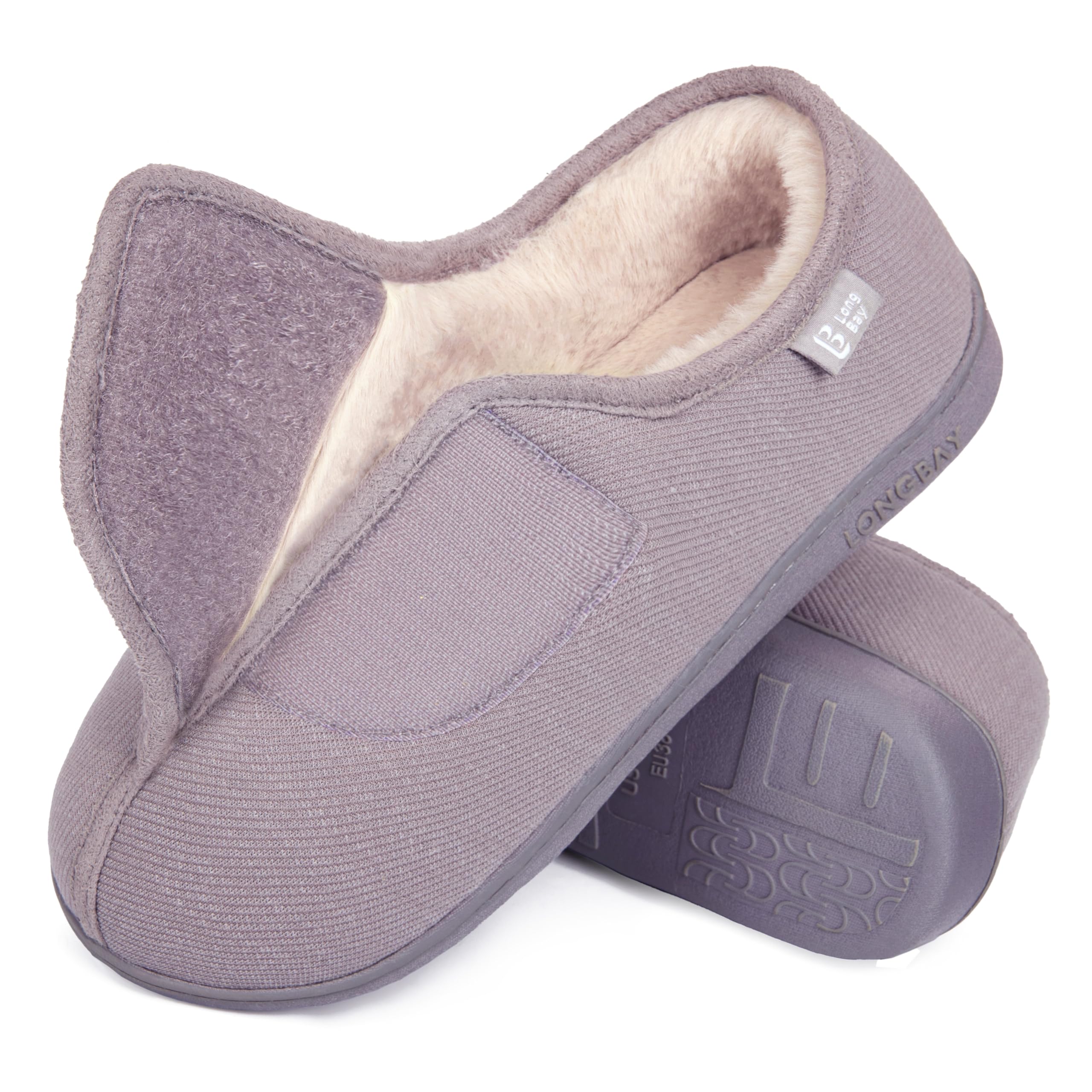
Slippers for people with diabetes or persistently swollen feet tend to fall into two camps: medical-looking footwear that feels institutional, or soft house shoes that offer no real adjustability. The LongBay Women’s Adjustable Wide Diabetic House Shoes sit somewhere in between, aiming to combine a softer, more home-like appearance with the wide fit and closure system that this category actually requires. Whether they succeed depends heavily on what a buyer needs from a slipper day to day.
The core design is straightforward. These are wide-width house shoes with an open-back or slide-style entry (depending on the listing variant) and an adjustable closure across the instep, typically a hook-and-loop strap. That strap is the most important feature here. Feet that swell during the day, or that change size between morning and evening, need a shoe that can be let out and cinched back up without buying a second pair. The wide toe box is the second key element, giving room for bunions, hammertoes, or bandaged toes without pressing on the sides.
Construction is what you would expect at this price point: a soft fabric or fleece-like upper, a cushioned footbed, and a flexible outsole. The materials are designed for indoor wear and light trips to the mailbox or patio, not for extended outdoor use. The Gray colorway is neutral and forgiving, which matters more than it sounds for a shoe that may be worn every day and washed occasionally.
In real-world use, these slippers tend to serve three groups well. First, people managing diabetic neuropathy who need protection from stubbing toes or stepping on small objects around the house, where a hard sole and closed toe provide a barrier that socks and bare feet do not. Second, people with edema or post-surgical swelling who need footwear that can be loosened in the afternoon and tightened in the morning. Third, older adults who want a slip-on they can put on without bending far or wrestling with laces, but who still want something that stays on the foot while walking.
The adjustable strap does most of the work in that last scenario. A wide opening means the foot can slide in easily, and the strap can then be fastened to keep the slipper from flopping off mid-stride. That combination of easy entry and secure retention is harder to find than it should be. Many wide slippers are simply too loose once the foot is inside, which creates a tripping risk on stairs or carpet edges.
There are real trade-offs, though. The cushioned footbed is comfortable for standing and short walks, but it is not a substitute for a supportive shoe. Anyone who spends hours on their feet at home, or who has significant arch or heel pain, will likely find the underfoot support too soft and too flat over time. The outsole is also thin and flexible; it handles indoor floors and a quick step outside, but it is not built for gravel, wet pavement, or long walks. Buyers expecting a house shoe that doubles as an outdoor shoe will be disappointed.
Sizing is another consideration. Because the fit is intentionally wide and the closure is adjustable, the slippers run roomy. Some users will need to size down, especially if swelling is mild rather than pronounced. Those with very narrow feet may find the strap cannot tighten enough to feel secure, which makes this a poor match for narrow-footed buyers regardless of the adjustability. The fabric upper also stretches with wear, so the fit in month three may be looser than in week one.
Durability is fair rather than exceptional. The stitching and strap hardware hold up under normal indoor use, but the cushioned insole compresses over months of daily wear, and the fabric can pill or mat in high-friction areas. Machine washing is generally possible on a gentle cycle, though air drying is preferable to preserve the shape of the footbed. Expect a lifespan of roughly six to twelve months with daily use, which is typical for this category.
Compared with a dedicated orthopedic slipper or a diabetic shoe from a medical brand, the LongBay pair is softer, less structured, and considerably less expensive. Compared with a generic memory-foam house slipper, it offers meaningfully more width and adjustability, which is the whole point. It sits in the middle: more practical than a fashion slipper, less clinical than a prescription-style shoe.
Who should consider it: people with mild to moderate foot swelling, wide feet, or sensitivity who want an easy-on house shoe with a secure closure and a protective sole. Who should look elsewhere: narrow-footed buyers, anyone needing firm arch support or a shoe for extended outdoor wear, and people with severe foot deformities that require custom or prescription footwear. For the intended use, these slippers are a sensible, affordable option, provided expectations stay focused on indoor comfort rather than orthopedic support.