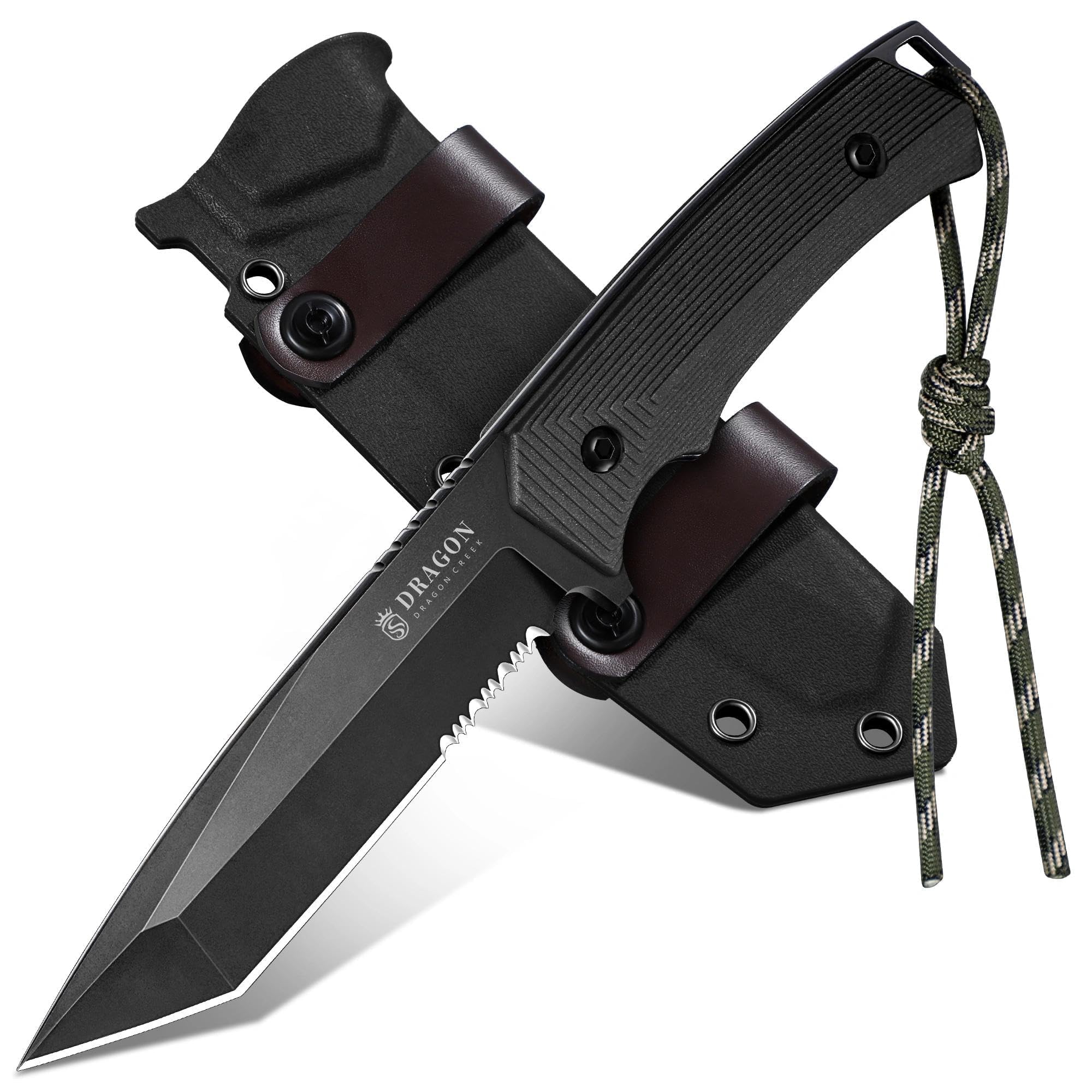
The Dragon Creek Fixed Blade in black is one of those knives that sits in an odd middle ground. It is not a dedicated bushcraft tool, and it is not a folding EDC knife either. Instead, it reads as a fixed-blade utility knife meant for general outdoor and workshop tasks, and how useful it turns out to be depends heavily on what you expect from it going in.
In practical use, a full-tang fixed blade like this tends to show up in places where a folder would be a liability. Campers use it for splitting kindling, shaving tinder, and food prep at the picnic table. Homeowners reach for it when breaking down cardboard, cutting rope, or prying open a paint can lid (carefully, and not with the tip). The fixed handle and lack of a hinge mean there is nothing to fold shut on your fingers under load, which is the main reason people choose this format over a pocket knife. The Dragon Creek fits that role without much drama.
The full-tang construction is the headline functional detail. The steel runs the length of the handle, which generally translates to more stiffness and better resistance to snapping under lateral force than a stick-tang or partial-tang design. The black finish is likely a coating rather than a bare polished surface, and that has practical consequences: it cuts glare and offers some corrosion resistance, but coated blades tend to show scratches and wear more visibly over time, and some coatings add slight drag when slicing through dense material. Buyers should expect the finish to look used after real work, not stay pristine.
Handle ergonomics are where fixed blades live or die. Without handling the specific knife, the general expectation for a full-tang model in this class is a slab handle, often synthetic or micarta-style, with some contouring and a finger guard or choil. That configuration works well for medium-sized hands during draw cuts and push cuts. The trade-off is that full-tang knives transmit more vibration and cold than hidden-tang designs, and a hard synthetic handle can get slick when wet or bloody. Gloves help, but they are not a fix for everyone.
Weight and balance deserve honest mention. A full-tang knife of this type will generally be heavier than a comparable folding knife, and it will not disappear in a pack the way a small folder does. The upside is that the extra mass helps with chopping and batoning light material. The downside is that it is a poor choice for ultralight backpacking or anyone counting ounces. The sheath, which is not described in detail here, matters as much as the blade for carry comfort, and a mediocre sheath can undermine an otherwise decent knife.
Compared with a folding EDC knife, the Dragon Creek offers more strength and simpler cleaning, since there is no pivot to trap grit and moisture. Compared with a traditional bushcraft scandi-grind knife, it likely gives up some fine carving control, because scandi grinds excel at woodwork in a way that general-purpose grinds do not. Compared with a cheap stamped kitchen-style utility blade, it is more durable but also heavier and more expensive to replace. The honest framing is that this is a generalist, and generalists rarely win specialized comparisons.
Who it suits:
- Campers and car campers who want one sturdy blade for kindling, rope, and food tasks
- Homeowners and hobbyists who need a fixed blade for yard, garage, or workshop work
- Buyers who prefer simple construction with no moving parts to maintain
Who it does not suit:
- Ultralight hikers and ounce-counting backpackers
- Woodworkers who need precise carving and prefer a scandi grind
- City dwellers looking for a discreet everyday carry knife, since fixed blades are conspicuous and legally restricted in many places
Performance expectations should stay grounded. A knife in this category will handle routine cutting, light batoning, and general outdoor chores, but it is not a chopper and should not be treated as one. Edge retention depends on the steel, which is not specified here, so buyers should plan on routine sharpening rather than assuming long intervals between honings. The coating will wear, the handle may need occasional cleaning and oiling, and the sheath should be checked for retention before relying on it in the field.
Overall, the Dragon Creek Fixed Blade is a sensible, unglamorous tool. It does the jobs a fixed blade is supposed to do, with the strength that full-tang construction provides, and it asks buyers to accept extra weight and visible wear in exchange. That is a fair trade for the right user and a poor one for the wrong user, which is about as honest as a knife review gets.