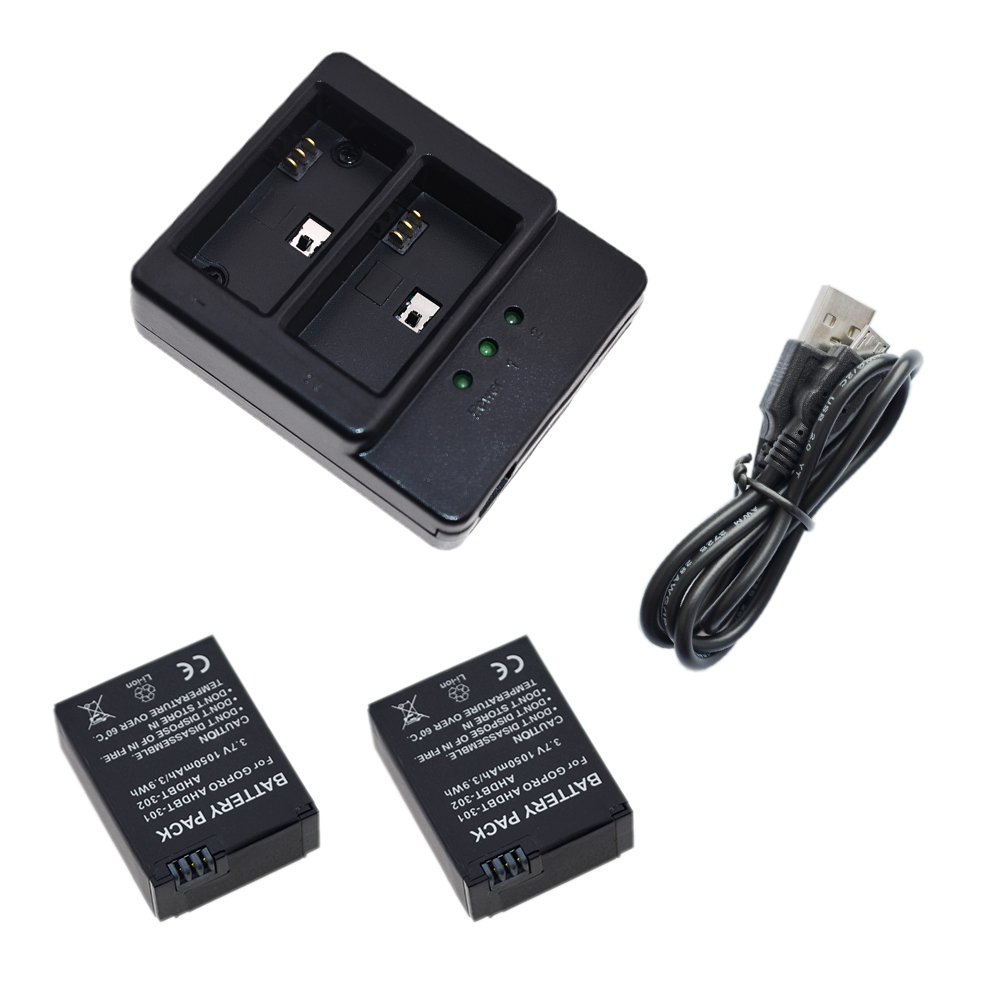
The GoPro Hero 3 and Hero 3+ are old cameras now, but plenty of them are still in use — in toolbags, glove boxes, on drones, and in the hands of people who simply don’t need to upgrade. The problem with keeping an old action camera alive is the batteries. Original GoPro AHDBT-301 and AHDBT-302 packs have been out of production for years, and the ones still floating around are often swollen, weak, or both. Third-party replacements like this Suptig two-pack with a dual charger are one of the few realistic ways to keep these cameras running.
The kit is straightforward: two replacement batteries and a wall charger with two independent bays. The batteries are cross-compatible with the AHDBT-301 and AHDBT-302, which covers the Hero 3 White, Silver, and Black as well as the Hero 3+ line. The charger plugs into a standard outlet and charges each bay separately, so you can top up both packs at once rather than waiting for one to finish before starting the other.
In practice, this is the kind of accessory that lives in a camera bag and gets used in specific, unglamorous situations. Someone filming a mountain bike run wants a spare pack in a pocket, ready to swap when the first one dies. A dashcam or helmet-cam user may want two packs cycling through the charger overnight. The dual-bay design is genuinely useful here — it turns a two-hour charging chore into a single session, and it means you can rotate packs without a gap.
What the kit does not do is match original GoPro cell performance. Third-party batteries for this generation typically run somewhat shorter than a healthy OEM pack did when new, and capacity claims on the packaging should be treated as optimistic. Expect noticeably less runtime than the camera’s original battery delivered in its prime, especially in cold weather, where these cells tend to sag faster. For short clips and casual use that’s usually fine. For long continuous recording — say, a full track session or a lengthy timelapse — you’ll want to plan around shorter intervals and carry both packs.
Build quality is acceptable but not remarkable. The plastic shells fit the camera compartments without binding, and the contacts line up correctly, which is the main thing. The charger itself is light and plasticky, with a simple LED indicator per bay that shows charging status but not much else — no percentage readout, no discharge or storage mode. It’s a basic wall charger, and it behaves like one.
There’s also the usual caveat with third-party packs: consistency varies between units and between batches. Some buyers report packs that hold up for a couple of years of light use; others get cells that lose capacity within months. That variance is the trade-off you accept for the price, and it’s worth buying from a seller with a reasonable return window rather than the cheapest listing available.
Compared with the alternatives, the calculus is simple. Original GoPro batteries for this generation are scarce and often aged stock, so paying a premium for an OEM pack doesn’t guarantee better performance — you may be buying a cell that’s been sitting on a shelf for years. A generic single-battery replacement is cheaper but leaves you with one pack and no charger. This kit sits in the middle: two packs plus a charger for roughly the cost of one questionable OEM battery. For a camera this old, that’s a sensible ratio.
The kit makes the most sense for people who still use a Hero 3 or 3+ regularly and want a low-cost way to keep shooting without hunting down discontinued originals. It’s also reasonable for anyone who bought a used camera and found the included battery weak. It is not a good fit for anyone expecting OEM-level runtime, for professional or mission-critical work where a battery failure ruins the shoot, or for users who have already moved to a newer GoPro with a different battery format — the packs won’t fit. If you need guaranteed capacity and long-term reliability, a newer camera with current battery support is the more honest answer than propping up a decade-old model.
Overall, this is a functional, inexpensive stopgap rather than an upgrade. It solves the immediate problem — dead or missing batteries — at a price that makes sense for hardware this age, provided you go in with realistic expectations about runtime and lifespan.