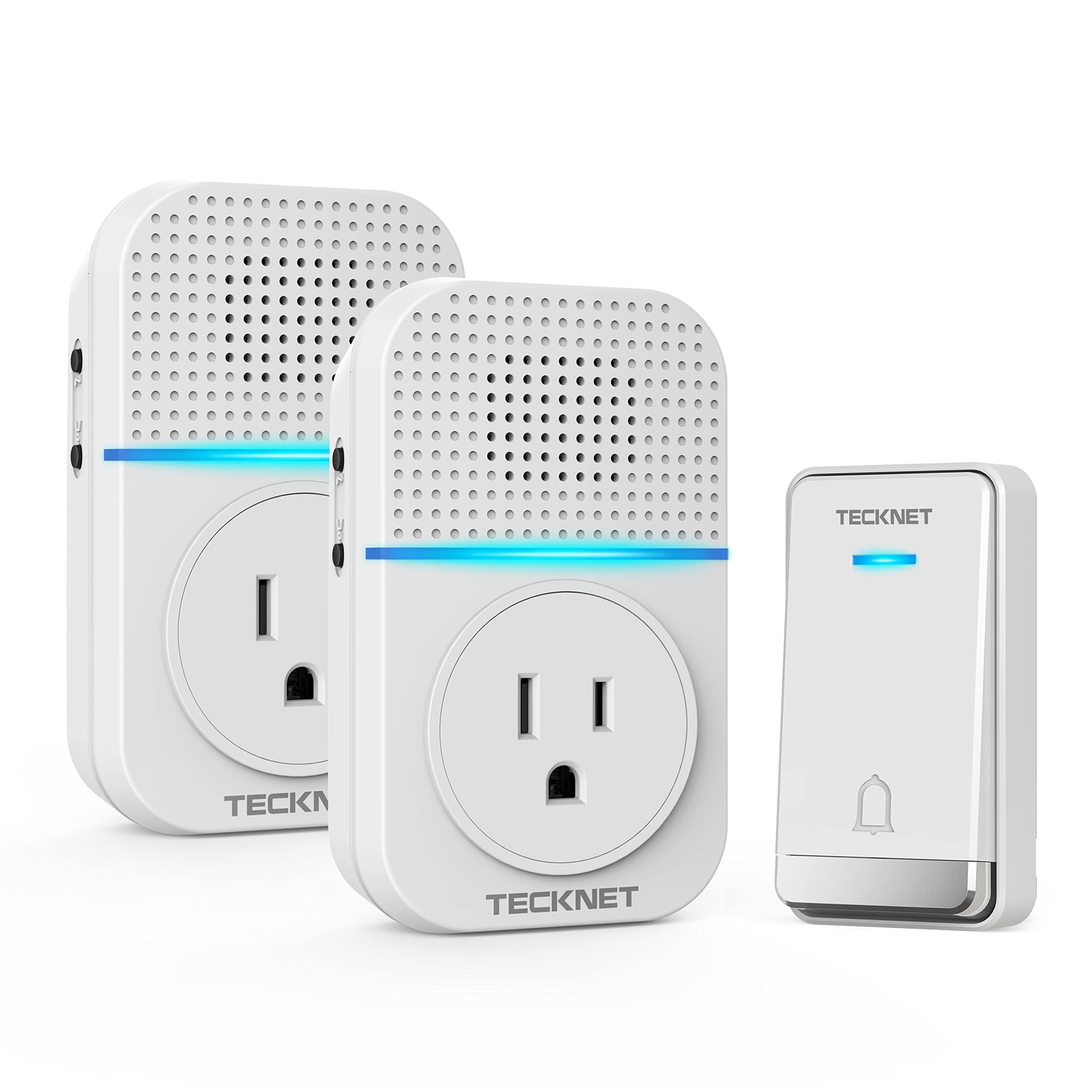
The TECKNET Wireless Doorbell is one of those products that sounds almost too clever on paper: a doorbell ringer that claims to be self-powered, waterproof to IP66, and capable of reaching 1,300 feet, all while plugging directly into a wall socket. It ships with an extra socket and a push button that doesn’t need batteries. The pitch is appealing for anyone tired of swapping coin cells every few months, but the reality is a bit more nuanced than the spec sheet suggests.
The core idea here is a plug-through receiver. The chime unit goes straight into a wall outlet, and because it has a pass-through socket on its face, you don’t lose the outlet entirely. That’s a genuinely useful detail in older homes or apartments where outlets are scarce. The transmitter button, meanwhile, is the self-powered part: pressing it generates a small electrical charge that sends the signal, so there’s no battery to replace on the button side. In practice, this means the button feels a little stiffer than a standard battery-powered push button, and it requires a deliberate press rather than a light tap. For most people that’s fine, but anyone with limited hand strength may notice the difference.
Volume is adjustable from silent up to a claimed 110 dB, and there are 60 chime options to cycle through. In a real hallway, the loudest settings are genuinely loud—enough to be heard over a running shower or a vacuum, which is the point. The trade-off is that the higher volume settings on some of the more elaborate melodies can sound harsh and slightly distorted, especially the ones with layered tones. The simpler ding-dong and basic bell options hold up better. The LED light is a helpful addition for noisy households, hearing-impaired users, or anyone who works with headphones on; it flashes when the button is pressed, giving a visual cue that doesn’t depend on audio.
Range is where the marketing and the reality tend to diverge. The 1,300-foot figure is an open-air, line-of-sight measurement. Through typical home walls—brick, plaster, multiple interior partitions—expect a much shorter usable distance, often in the range of 100 to 300 feet depending on construction. For a single-family home with the receiver centrally placed, that’s usually adequate. For a detached garage, a garden gate, or a multi-story house with thick walls, it may not be. Buyers should treat the range number as a ceiling, not a guarantee.
The IP66 rating applies to the push button, which is the part exposed to weather. It can handle rain and dust, but IP66 is not the same as submersible, and mounting it in a spot with direct, prolonged water runoff—like under a leaking gutter—is asking for trouble. The receiver itself is indoor-only, since it needs a socket. That’s worth stating plainly because the product photos can make the whole system look more weather-ready than it is.
Compared with a traditional wired doorbell, this unit is far easier to install—no low-voltage wiring, no transformer, no drilling through walls for a chime box. Compared with a battery-powered wireless doorbell from a brand like Honeywell or a basic Avantek model, the main advantage is the lack of button batteries, while the main disadvantage is the stiffer press and the fact that the receiver occupies an outlet (partially mitigated by the pass-through). Compared with a smart video doorbell, it’s dramatically simpler and cheaper, but it offers no camera, no app, no recording, and no phone alerts. It’s a chime, not a security device.
Who is it for? It suits renters who can’t wire a doorbell, homeowners replacing a dead wired chime, classroom teachers who want a portable signal for attention or transitions, and anyone with a small-to-medium home where a plug-in receiver can be placed centrally. It’s also a reasonable choice for a back door or side entrance where running wire is impractical. Who is it not for? People in large or thick-walled homes who need long-range reliability, anyone who wants app-based notifications or video, and users who need a very light-touch button for accessibility reasons. The 60 chimes are fun for about a week and then most people will settle on one or two, so don’t weight that feature heavily.
Build quality is acceptable for the price bracket—plastic housings, a button that feels reasonably sealed, and a receiver that sits securely in the socket without wobbling. It’s not a premium product, and it doesn’t pretend to be. The main caveats are the range claims, the indoor-only receiver, and the stiffer button press. If those don’t apply to your situation, it’s a practical, low-maintenance solution that does its one job without fuss.