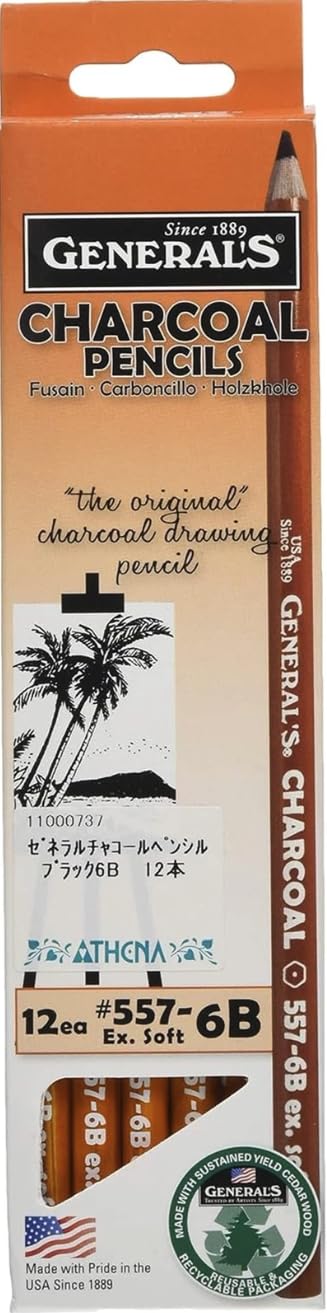
The General Charcoal Pencil 557-6B, sold in a box of 12, is a staple in many artists’ kits, and for good reason. It occupies a specific niche in the world of drawing tools, offering a balance between the messiness of traditional vine charcoal and the precision of a graphite pencil. This review is based on using these pencils for a variety of tasks, from quick gesture drawings to more detailed tonal studies.
In practice, these pencils feel like a natural extension for anyone accustomed to graphite but looking for deeper, richer blacks. The 6B grade provides a soft, velvety line that can be smudged, blended, or layered with relative ease. I found them particularly useful for large-scale shading, where covering an area with consistent tone is key. The pencil holds its point reasonably well for a soft charcoal, though frequent sharpening is necessary to maintain a fine tip for detail work. They are less brittle than some competing charcoal pencils, which reduces breakage during sharpening, but they are not indestructible—a drop on a hard floor can still snap the core.
Key functional features include the standard hexagonal barrel, which prevents rolling off a tilted desk, and the consistent core density across the box. The 6B designation is fairly accurate; it’s soft enough for dark darks without being overly crumbly. The wood casing is easy to sharpen with a standard handheld sharpener, though a craft knife offers more control for exposing a longer core for broad strokes. The charcoal itself has a slightly waxy binder, which helps it adhere to paper better than pure compressed charcoal, reducing dust—though you will still want to work over a drop cloth or newspaper.
A notable limitation is the lack of variety within this single-grade box. While 6B is versatile, you’ll need other grades (like 2B or 4B) to achieve a full range of values without overworking the paper. For fine details, these pencils are not ideal; a harder charcoal or a mechanical pencil would serve better. Additionally, the finish is not as archival as some artist-grade charcoals, as it can fade or smudge over time if not fixed with a spray fixative. The box itself is functional but plain—no frills, just twelve pencils secured in a cardboard container that can wear out after repeated use.
Comparatively, these pencils sit between a standard graphite pencil and a stick of vine charcoal. Graphite offers more precision and erasability but lacks the deep, matte black that charcoal provides. Vine charcoal, on the other hand, is softer and easier to erase but is more fragile and dustier. The General Charcoal Pencil is a good middle ground: it’s sturdier than vine charcoal, messier than graphite, and offers a unique texture that many artists prefer for expressive work. If you are used to a brand like Derwent or Faber-Castell, the General version has a slightly grittier feel and a less refined core, which some artists might actually prefer for its raw, unpredictable quality.
Who is this product suitable for? It is a solid choice for students, hobbyists, and professional artists who need a reliable, affordable charcoal pencil for sketching, life drawing, or value studies. It works well on a variety of papers, from smooth newsprint to rough-textured drawing paper. However, it is not ideal for those seeking ultra-fine detail work or for artists who prefer a cleaner, less dusty medium. It is also not the best option for final, presentation-ready pieces unless you are comfortable with the need for fixative and the potential for smudging. If you are a beginner, this box is a cost-effective way to explore charcoal drawing without a large investment, but be prepared for the learning curve of controlling a soft, blendable medium.
In summary, the General Charcoal Pencil 557-6B is a dependable tool that does exactly what it promises: delivers dark, blendable marks for drawing. It has some rough edges—limited grade range, moderate dust, and a need for frequent sharpening—but it earns its place through consistency and value. It is not a revolutionary product, but a practical one that many will find useful for everyday practice and study.