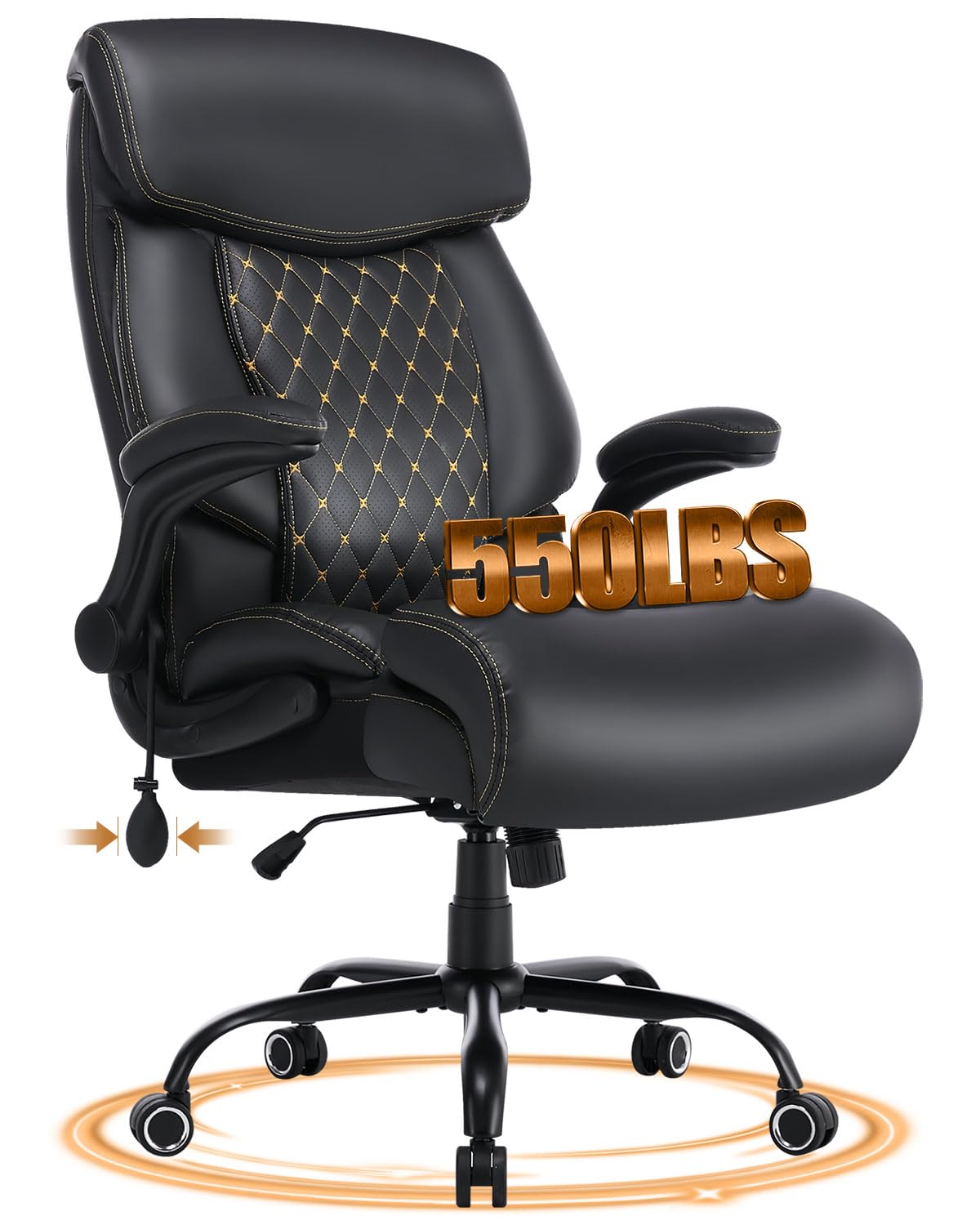
The market for office chairs rated above 400 pounds has grown, but most options still feel like modified versions of standard chairs rather than purpose-built seating. The 550LBS Big and Tall Office Chair sits in that category, aimed at users who need a wider seat pan, a sturdier base, and support that holds up over a full workday. It combines a high-back executive leather design with flip-up padded arms, adjustable lumbar support, and a rocking function. On paper, that is a lot of features for the price range these chairs typically occupy. Whether they work together is a separate question.
In real-world use, this chair is most likely to end up in a home office or a small business workspace where someone spends six to ten hours a day seated. The 550-pound weight rating suggests a reinforced gas lift and a heavier-duty base, which matters because the failure point on standard chairs is usually the cylinder or the star base rather than the cushion. Buyers in this category are often replacing a chair that sagged, wobbled, or collapsed, so the structural claims are the main draw. The seat is wider than a typical executive chair, and the high back extends further up the torso, which helps taller users who find standard headrests land at their shoulder blades.
The functional list is broad but not unusual for the category. The padded arms flip up and out of the way, which is genuinely useful for anyone who pulls the chair close to a desk for typing or slides it under a table. The lumbar support adjusts, though on most chairs in this segment the adjustment range is modest and the mechanism is a ratchet or strap rather than a dial. The rocking function tilts the whole seat and back as a unit, which some users prefer for reading or taking calls and others find distracting during focused work. The leather is almost certainly bonded or PU rather than top-grain at this price point, so expect a firm, slightly synthetic feel that softens with use but does not breathe like fabric.
Where this chair deserves scrutiny is in the details that heavy-duty marketing tends to gloss over. A 550-pound rating does not mean the chair is equally comfortable at that weight. The foam density is the limiting factor: seats rated this high often use firmer foam that resists compression but can feel hard after a few hours, especially for users under 250 pounds who do not need that level of support. The flip-up arms, while convenient, are a moving part, and moving parts are where budget chairs tend to develop play over time. The rocking mechanism on a chair this heavy also puts stress on the tilt tension spring, so the recline may feel stiffer or less refined than on a lighter executive chair. None of these are dealbreakers, but they are the kind of trade-offs that separate a serviceable chair from a genuinely comfortable one.
Compared with a standard ergonomic mesh task chair, this model trades breathability and fine-grained adjustability for width, weight capacity, and a plusher executive look. A mesh chair in the same price range will usually offer better airflow and a more articulated back, but it likely will not support the same weight or seat width. Compared with a drafting stool or a saddle chair, this is a conventional seated workstation chair, not an active-sitting option. Buyers who want to alternate between sitting and standing should look at height-adjustable desks rather than expecting this chair to fill that role.
Who is this for? Primarily larger and taller users who have struggled to find a chair that does not pinch at the hips or feel flimsy after a few months. It also suits people who want arms that get out of the way and a back that reaches higher than a mid-back task chair. Who is it not for? Users under roughly 200 pounds who want a soft, breathable seat for long sessions may find the foam too firm and the leather too warm. Anyone who needs precise, multi-axis arm adjustments or a highly tunable lumbar curve will likely be disappointed by the simpler mechanisms here. And anyone expecting genuine leather at this price should adjust expectations before ordering.
The realistic take is that this is a competent heavy-duty chair with a feature set that covers the basics and a few conveniences. It is not a premium ergonomic investment, and it should not be treated as one. Buyers should check the return policy and assembly instructions carefully, since chairs in this weight class are heavy and awkward to move once built. Treated as a durable, wide-seat workhorse rather than a precision ergonomic tool, it fills a real gap for a segment of users that mainstream chair makers still underserve.